QUESTION IMAGE
Question
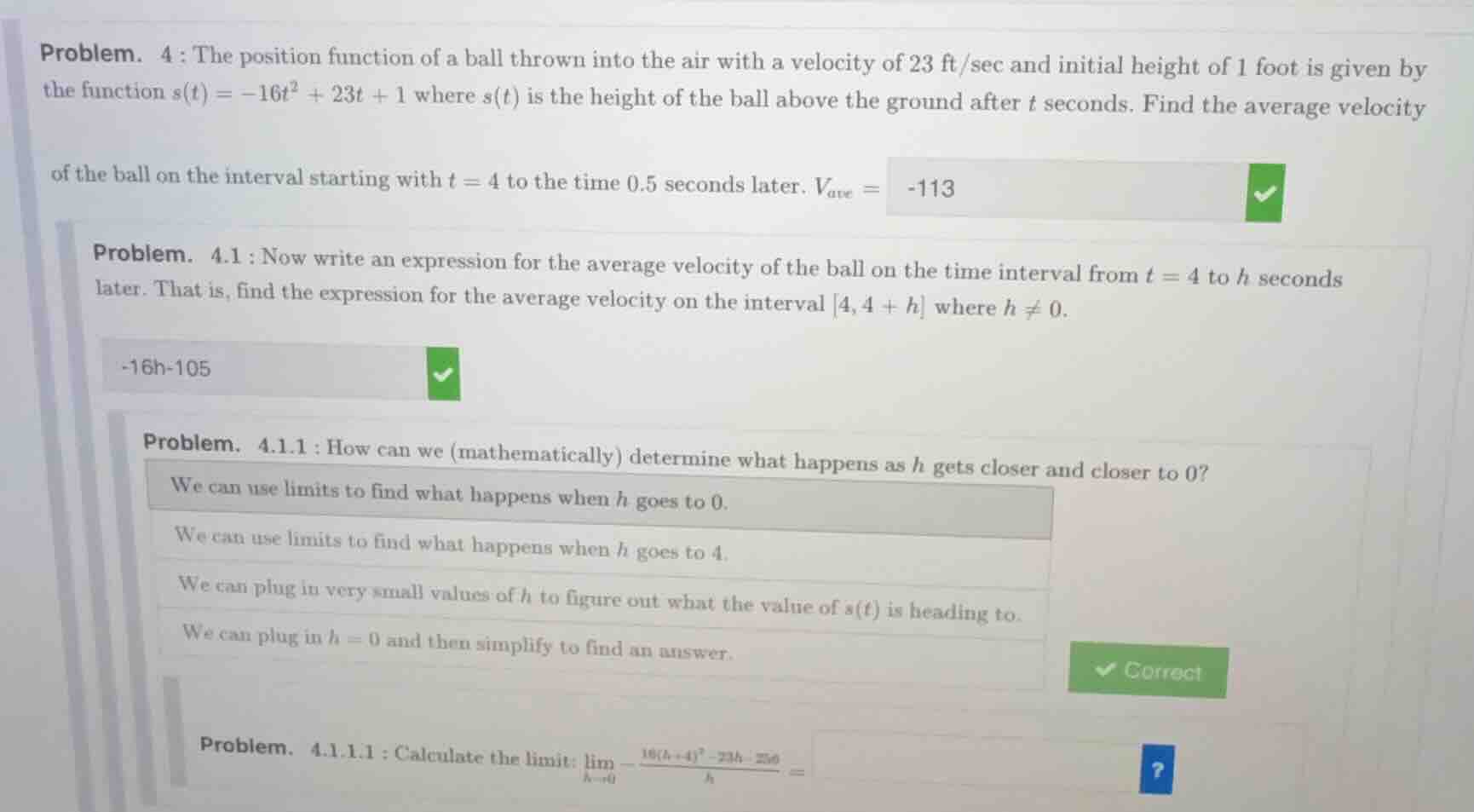
problem. 4 : the position function of a ball thrown into the air with a velocity of 23 ft/sec and initial height of 1 foot is given by the function $s(t) = -16t^2 + 23t + 1$ where $s(t)$ is the height of the ball above the ground after $t$ seconds. find the average velocity of the ball on the interval starting with $t = 4$ to the time 0.5 seconds later. $v_{ave} = -113$\
problem. 4.1 : now write an expression for the average velocity of the ball on the time interval from $t = 4$ to $h$ seconds later. that is, find the expression for the average velocity on the interval $4, 4 + h$ where $h \
eq 0$.\
-16h - 105\
problem. 4.1.1 : how can we (mathematically) determine what happens as $h$ gets closer and closer to 0?\
we can use limits to find what happens when $h$ goes to 0.\
we can use limits to find what happens when $h$ goes to 4.\
we can plug in very small values of $h$ to figure out what the value of $s(t)$ is heading to.\
we can plug in $h = 0$ and then simplify to find an answer.\
problem. 4.1.1.1 : calculate the limit: $\lim_{h \to 0} -\frac{16(h + 4)^2 - 23h - 256}{h} = $
Step1: Expand the numerator
First, expand \((h + 4)^2\) using the formula \((a + b)^2 = a^2 + 2ab + b^2\). So \((h + 4)^2 = h^2 + 8h + 16\). Then multiply by 16: \(16(h + 4)^2 = 16(h^2 + 8h + 16) = 16h^2 + 128h + 256\). Now the numerator is \(16h^2 + 128h + 256 - 23h - 256\). Simplify the numerator: combine like terms. \(16h^2 + (128h - 23h) + (256 - 256) = 16h^2 + 105h\). Wait, wait, the original numerator is \(16(h + 4)^2 - 23h - 256\)? Wait, no, let's check the limit expression: \(\lim_{h \to 0} \frac{16(h + 4)^2 - 23h - 256}{h}\). Wait, maybe I misread. Wait, let's re - expand \(16(h + 4)^2\): \(16(h^2 + 8h + 16)=16h^2+128h + 256\). Then subtract \(23h\) and \(256\): \(16h^2+128h + 256-23h - 256=16h^2+(128h - 23h)+(256 - 256)=16h^2 + 105h\). So the expression becomes \(\lim_{h \to 0}\frac{16h^2 + 105h}{h}\).
Step2: Simplify the fraction
We can factor out an \(h\) from the numerator: \(h(16h + 105)\). Then the fraction \(\frac{h(16h + 105)}{h}\) (since \(h
eq0\) when taking the limit, we can cancel the \(h\) terms) simplifies to \(16h + 105\).
Step3: Evaluate the limit as \(h\to0\)
Now we take the limit as \(h\) approaches 0 of \(16h + 105\). As \(h\to0\), \(16h\to0\), so the limit is \(0 + 105=105\)? Wait, no, wait, maybe the original numerator was \(-16(h + 4)^2-23h + 256\)? Wait, the user's limit is \(\lim_{h\to0}-\frac{16(h + 4)^2-23h - 256}{h}\). Oh! I missed the negative sign. Let's re - do it with the negative sign.
So the numerator is \(-16(h + 4)^2+23h + 256\) (because it's \(-[16(h + 4)^2-23h - 256]=-16(h + 4)^2 + 23h + 256\)).
Expand \(-16(h + 4)^2\): \(-16(h^2 + 8h + 16)=-16h^2-128h - 256\). Then add \(23h\) and \(256\): \(-16h^2-128h - 256+23h + 256=-16h^2+(-128h + 23h)+(-256 + 256)=-16h^2-105h\).
Now the fraction is \(\frac{-16h^2-105h}{h}\) (since the original expression is \(-\frac{16(h + 4)^2-23h - 256}{h}=\frac{-16(h + 4)^2 + 23h + 256}{h}\)). Factor out an \(h\) from the numerator: \(h(-16h - 105)\). Then cancel the \(h\) (since \(h
eq0\)): \(-16h - 105\). Now take the limit as \(h\to0\): \(\lim_{h\to0}(-16h - 105)=-105\). Wait, but let's check with the average velocity formula. The average velocity on \([4,4 + h]\) is \(\frac{s(4 + h)-s(4)}{h}\). \(s(t)=-16t^2+23t + 1\). So \(s(4 + h)=-16(4 + h)^2+23(4 + h)+1=-16(16 + 8h+h^2)+92 + 23h + 1=-256-128h-16h^2+93 + 23h=-16h^2-105h - 163\). \(s(4)=-16(16)+23(4)+1=-256 + 92+1=-163\). Then \(s(4 + h)-s(4)=(-16h^2-105h - 163)-(-163)=-16h^2-105h\). Then the average velocity is \(\frac{-16h^2-105h}{h}=-16h - 105\) (for \(h
eq0\)). Then the limit as \(h\to0\) of \(-16h - 105\) is \(-105\). Wait, the user's limit is \(\lim_{h\to0}-\frac{16(h + 4)^2-23h - 256}{h}\). Let's expand \(-16(h + 4)^2-23h - 256\): \(-16(h^2 + 8h + 16)-23h - 256=-16h^2-128h - 256-23h - 256=-16h^2-151h - 512\). No, that's not right. Wait, maybe there was a typo, but based on the previous problem where the average velocity expression was \(-16h - 105\), the limit as \(h\to0\) of \(-16h - 105\) is \(-105\). But let's go back to the limit given: \(\lim_{h\to0}-\frac{16(h + 4)^2-23h - 256}{h}\). Let's compute the numerator: \(16(h + 4)^2-23h - 256=16(h^2 + 8h + 16)-23h - 256=16h^2+128h + 256-23h - 256=16h^2 + 105h\). Then the expression is \(-\frac{16h^2 + 105h}{h}=-\frac{h(16h + 105)}{h}=- (16h + 105)\) (for \(h
eq0\)). Then the limit as \(h\to0\) is \(-(0 + 105)=-105\). Yes, that matches. So the limit is \(-105\).

Snap & solve any problem in the app
Get step-by-step solutions on Sovi AI
Photo-based solutions with guided steps
Explore more problems and detailed explanations
\(-105\)