QUESTION IMAGE
Question
procedure c:
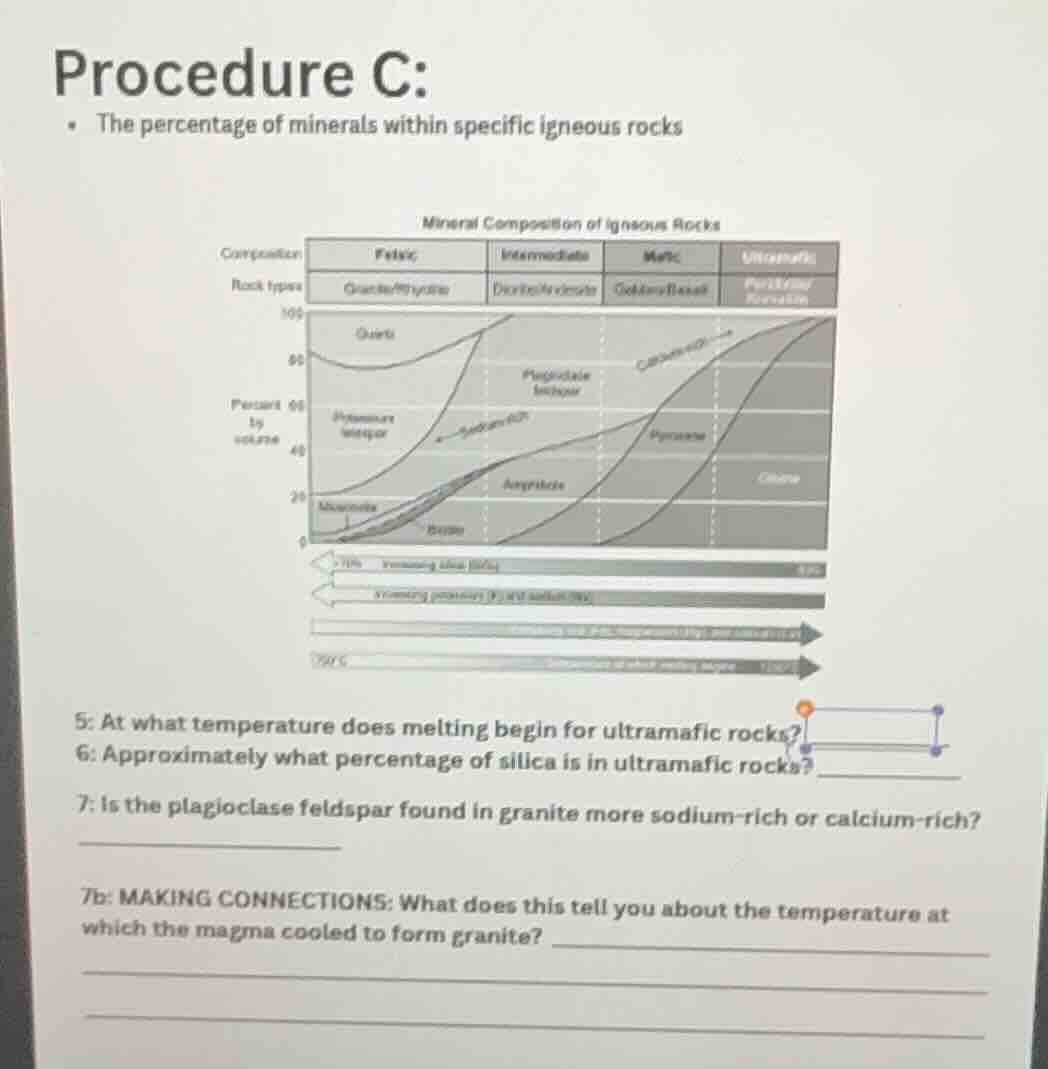
- the percentage of minerals within specific igneous rocks
5: at what temperature does melting begin for ultramafic rocks?
6: approximately what percentage of silica is in ultramafic rocks?
7: is the plagioclase feldspar found in granite more sodium - rich or calcium - rich?
7b: making connections: what does this tell you about the temperature at which the magma cooled to form granite?
- Refer to the bottom temperature axis of the graph; ultramafic rocks correspond to the rightmost range, where melting begins at the lower end of this range.
- Locate the silica percentage axis (bottom gray bar) and match it to the ultramafic rock category.
- Granite is a felsic rock; the graph shows felsic plagioclase is sodium-rich (albite endmember).
7b. Sodium-rich plagioclase forms in lower-temperature environments, so granite magma cooled slowly at lower temperatures.

Snap & solve any problem in the app
Get step-by-step solutions on Sovi AI
Photo-based solutions with guided steps
Explore more problems and detailed explanations
- $\boldsymbol{1200^\circ C}$
- $\boldsymbol{45\%}$ (approximate range 40-50% is acceptable)
- More sodium-rich
7b. The magma that formed granite cooled at a relatively low temperature, as sodium-rich plagioclase crystallizes at lower temperatures compared to calcium-rich plagioclase.