QUESTION IMAGE
Question
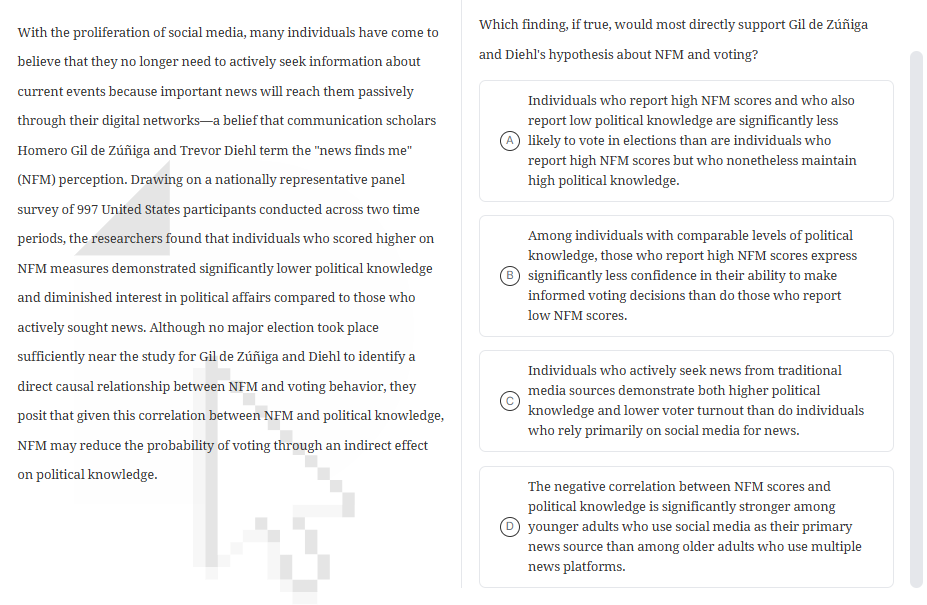
with the proliferation of social media, many individuals have come to believe that they no longer need to actively seek information about current events because important news will reach them passively through their digital networks—a belief that communication scholars homero gil de zúñiga and trevor diehl term the
ews finds me\ (nfm) perception. drawing on a nationally representative panel survey of 997 united states participants conducted across two time periods, the researchers found that individuals who scored higher on nfm measures demonstrated significantly lower political knowledge and diminished interest in political affairs compared to those who actively sought news. although no major election took place sufficiently near the study for gil de zúñiga and diehl to identify a direct causal relationship between nfm and voting behavior, they posit that given this correlation between nfm and political knowledge, nfm may reduce the probability of voting through an indirect effect on political knowledge. which finding, if true, would most directly support gil de zúñiga and diehls hypothesis about nfm and voting? a individuals who report high nfm scores and who also report low political knowledge are significantly less likely to vote in elections than are individuals who report high nfm scores but who nonetheless maintain high political knowledge. b among individuals with comparable levels of political knowledge, those who report high nfm scores express significantly less confidence in their ability to make informed voting decisions than do those who report low nfm scores. c individuals who actively seek news from traditional media sources demonstrate both higher political knowledge and lower voter turnout than do individuals who rely primarily on social media for news. d the negative correlation between nfm scores and political knowledge is significantly stronger among younger adults who use social media as their primary news source than among older adults who use multiple news platforms.
Gil de Zúñiga and Diehl's hypothesis is that NFM may reduce voting probability indirectly through political knowledge. We need to find an option that supports this (linking NFM, political knowledge, and voting).
- Option A: Compares two groups with high NFM but different political knowledge in terms of voting. The group with high NFM and low political knowledge is less likely to vote than high NFM + high political knowledge. This shows that political knowledge (affected by NFM) mediates the NFM - voting relationship, supporting the hypothesis.
- Option B: Talks about confidence in making informed decisions, not voting, so irrelevant to the voting hypothesis.
- Option C: Compares traditional vs social media news seekers, not about NFM's effect on voting via political knowledge.
- Option D: Discusses age and news sources in NFM - political knowledge correlation, not voting.

Snap & solve any problem in the app
Get step-by-step solutions on Sovi AI
Photo-based solutions with guided steps
Explore more problems and detailed explanations
A. Individuals who report high NFM scores and who also report low political knowledge are significantly less likely to vote in elections than are individuals who report high NFM scores but who nonetheless maintain high political knowledge.