QUESTION IMAGE
Question
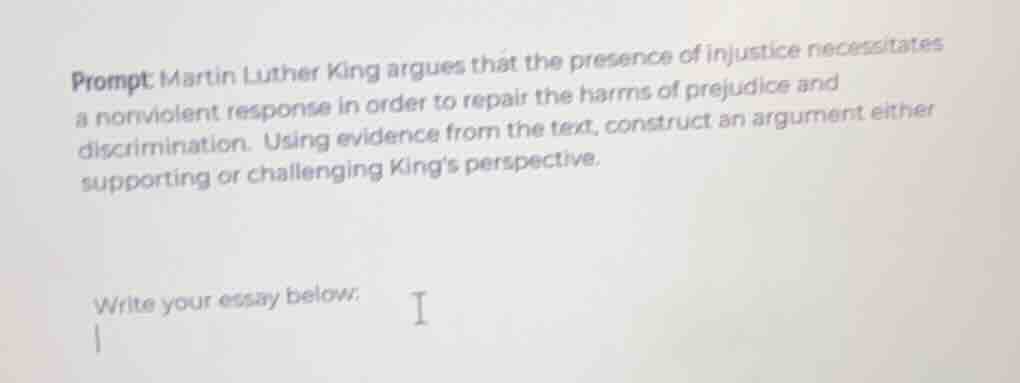
prompt: martin luther king argues that the presence of injustice necessitates a nonviolent response in order to repair the harms of prejudice and discrimination. using evidence from the text, construct an argument either supporting or challenging kings perspective. write your essay below:
Supporting King's Perspective: The Power of Nonviolence in Addressing Injustice
Martin Luther King Jr.’s assertion that injustice demands a nonviolent response to heal the wounds of prejudice and discrimination is both morally compelling and practically effective. Nonviolence, as King demonstrated, is not passive submission but a “soul force” that exposes injustice while preserving the humanity of both oppressor and oppressed.
First, nonviolence disrupts the cycle of harm. In Letter from Birmingham Jail, King explains that direct action—such as sit - ins and marches—“seeks to create a crisis and foster tension” not for chaos, but to force society to confront its moral contradictions. For example, the Montgomery Bus Boycott, a nonviolent protest, highlighted the absurdity of segregated seating: Black riders’ peaceful refusal to comply with unjust laws made the system’s cruelty visible, ultimately leading to the desegregation of public transit. By refusing to meet violence with violence, nonviolence prevents the escalation of hatred, ensuring that the struggle remains focused on justice, not revenge.
Second, nonviolence builds broad - based solidarity. King’s approach appealed to the moral conscience of the nation, including white allies. The images of peaceful protesters being attacked by police dogs and fire hoses in Birmingham galvanized public opinion. These scenes, broadcast nationwide, revealed the immorality of segregation to those who had previously been indifferent. In contrast, a violent response would have alienated potential allies, framing the movement as “dangerous” or “radical” rather than a fight for basic human rights. Nonviolence allowed the civil rights movement to claim the moral high ground, uniting people across racial lines in support of equality.
Finally, nonviolence addresses the root causes of prejudice. King argued that injustice thrives on dehumanization—both the oppressor’s dehumanization of the oppressed and the oppressed’s internalization of that dehumanization. Nonviolent resistance, by emphasizing love and dignity, rehumanizes all parties. When Black students sat at whites - only lunch counters, they did not seek to humiliate their opponents but to assert their own humanity. This approach undermined the ideological foundations of discrimination, showing that the “other” was worthy of respect. Over time, this shift in perception laid the groundwork for lasting social change, as seen in the passage of the Civil Rights Act and Voting Rights Act.
Critics may argue that nonviolence is too slow or ineffective against extreme oppression. However, history shows that violent uprisings often result in more bloodshed without resolving systemic issues. King’s nonviolent strategy proved that change could come through moral persuasion, not force. By choosing nonviolence, the civil rights movement repaired the harms of prejudice not by destroying the oppressor, but by transforming the system—and the hearts of those within it. In a world still plagued by injustice, King’s vision remains vital: nonviolence is not a weakness, but the most powerful tool to heal a divided society.

Snap & solve any problem in the app
Get step-by-step solutions on Sovi AI
Photo-based solutions with guided steps
Explore more problems and detailed explanations
Supporting King's Perspective: The Power of Nonviolence in Addressing Injustice
Martin Luther King Jr.’s assertion that injustice demands a nonviolent response to heal the wounds of prejudice and discrimination is both morally compelling and practically effective. Nonviolence, as King demonstrated, is not passive submission but a “soul force” that exposes injustice while preserving the humanity of both oppressor and oppressed.
First, nonviolence disrupts the cycle of harm. In Letter from Birmingham Jail, King explains that direct action—such as sit - ins and marches—“seeks to create a crisis and foster tension” not for chaos, but to force society to confront its moral contradictions. For example, the Montgomery Bus Boycott, a nonviolent protest, highlighted the absurdity of segregated seating: Black riders’ peaceful refusal to comply with unjust laws made the system’s cruelty visible, ultimately leading to the desegregation of public transit. By refusing to meet violence with violence, nonviolence prevents the escalation of hatred, ensuring that the struggle remains focused on justice, not revenge.
Second, nonviolence builds broad - based solidarity. King’s approach appealed to the moral conscience of the nation, including white allies. The images of peaceful protesters being attacked by police dogs and fire hoses in Birmingham galvanized public opinion. These scenes, broadcast nationwide, revealed the immorality of segregation to those who had previously been indifferent. In contrast, a violent response would have alienated potential allies, framing the movement as “dangerous” or “radical” rather than a fight for basic human rights. Nonviolence allowed the civil rights movement to claim the moral high ground, uniting people across racial lines in support of equality.
Finally, nonviolence addresses the root causes of prejudice. King argued that injustice thrives on dehumanization—both the oppressor’s dehumanization of the oppressed and the oppressed’s internalization of that dehumanization. Nonviolent resistance, by emphasizing love and dignity, rehumanizes all parties. When Black students sat at whites - only lunch counters, they did not seek to humiliate their opponents but to assert their own humanity. This approach undermined the ideological foundations of discrimination, showing that the “other” was worthy of respect. Over time, this shift in perception laid the groundwork for lasting social change, as seen in the passage of the Civil Rights Act and Voting Rights Act.
Critics may argue that nonviolence is too slow or ineffective against extreme oppression. However, history shows that violent uprisings often result in more bloodshed without resolving systemic issues. King’s nonviolent strategy proved that change could come through moral persuasion, not force. By choosing nonviolence, the civil rights movement repaired the harms of prejudice not by destroying the oppressor, but by transforming the system—and the hearts of those within it. In a world still plagued by injustice, King’s vision remains vital: nonviolence is not a weakness, but the most powerful tool to heal a divided society.