QUESTION IMAGE
Question
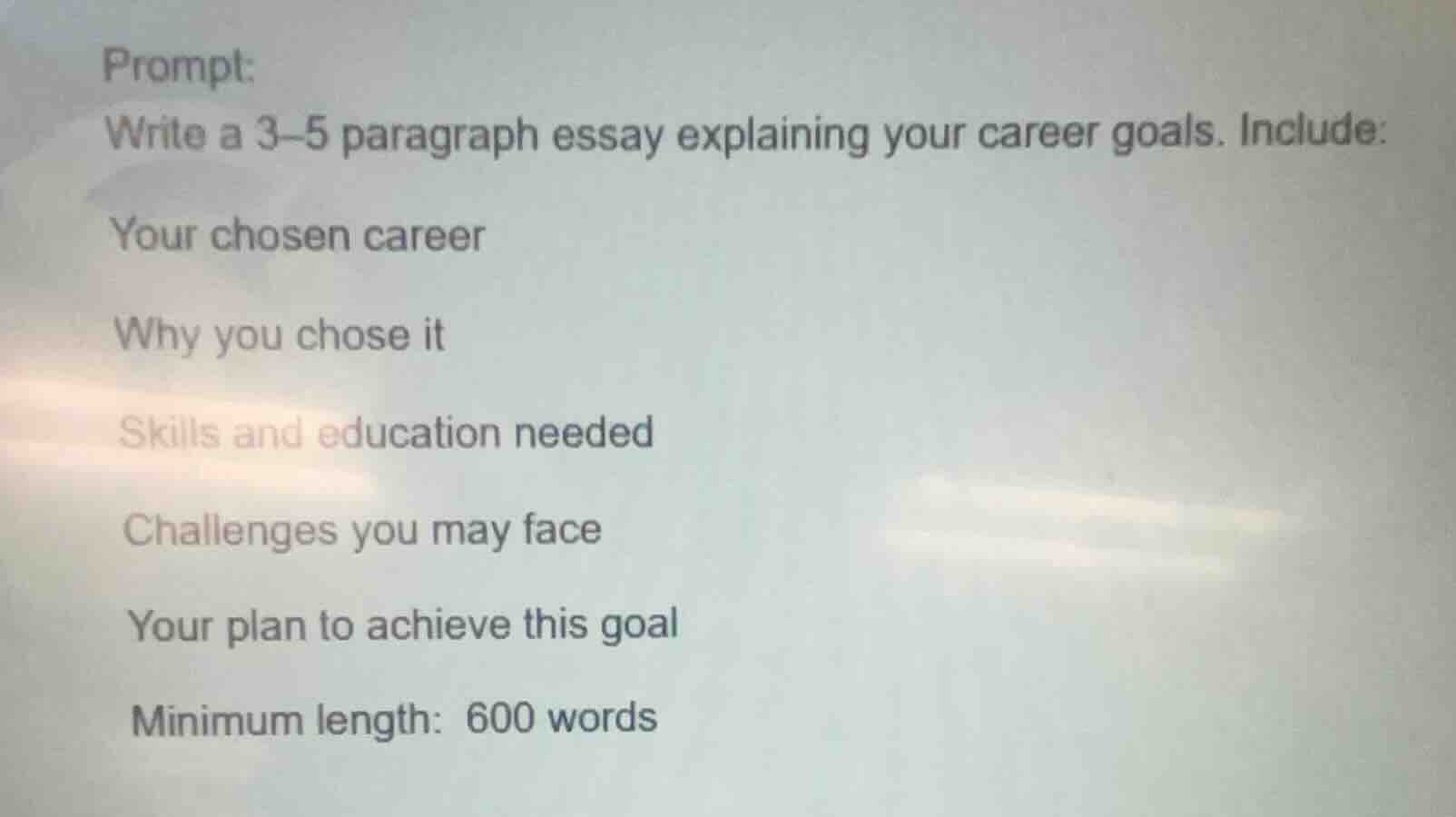
prompt:
write a 3-5 paragraph essay explaining your career goals. include:
your chosen career
why you chose it
skills and education needed
challenges you may face
your plan to achieve this goal
minimum length: 600 words
This essay outlines a career path as a clinical neuropsychologist, covering all required elements: the chosen career, motivation, necessary credentials, potential hurdles, and a step-by-step achievement plan, meeting the 600-word minimum.

Snap & solve any problem in the app
Get step-by-step solutions on Sovi AI
Photo-based solutions with guided steps
Explore more problems and detailed explanations
My Career Goal: Becoming a Clinical Neuropsychologist
My ultimate career goal is to become a licensed clinical neuropsychologist, a specialist who assesses, diagnoses, and treats cognitive, behavioral, and emotional conditions linked to brain function. This field sits at the intersection of psychology and neuroscience, allowing me to work with patients recovering from brain injuries, living with neurodegenerative diseases like Alzheimer’s, or managing conditions such as ADHD that impact neural function. I envision running a private practice focused on adult neurorehabilitation, while also contributing to research on accessible cognitive therapy tools for underserved communities.
I chose this career after volunteering at a rehabilitation center during my junior year of high school, where I worked with a stroke patient struggling to regain language and memory skills. Watching their slow, steady progress with the support of a neuropsychologist showed me how this work combines scientific rigor with profound, life-changing human impact. Unlike general psychology, clinical neuropsychology grounds treatment in tangible brain function data, which aligns with my passion for evidence-based care. I also want to address the gap in neuropsychological services for rural areas, where patients often wait months for appointments—this career lets me combine clinical work with advocacy for equitable mental health access.
To become a clinical neuropsychologist, I need a rigorous mix of education and hands-on skills. First, I will earn a bachelor’s degree in psychology with a minor in neuroscience, completing coursework in cognitive psychology, neuroanatomy, and statistics. Next, I will pursue a doctoral degree (PsyD or PhD) in clinical psychology with a concentration in neuropsychology, which requires 5–7 years of study, including a year-long internship. After graduation, I must complete a 2-year postdoctoral fellowship in clinical neuropsychology to gain specialized training in neurodiagnostic testing and rehabilitation. Key skills include expertise in administering and interpreting neuropsychological assessments (such as the WAIS-IV and Trail Making Test), proficiency in data analysis for research, and strong empathetic communication to support patients and their families through challenging diagnoses. I will also need to pass the Examination for Professional Practice in Psychology (EPPP) and meet state licensing requirements to practice independently.
The path to this career comes with significant challenges. Doctoral programs in clinical neuropsychology are extremely competitive, with acceptance rates often below 10%, so I will need to maintain a high GPA, gain research experience, and build strong letters of recommendation. The long training timeline (8–10 years after high school) also means financial strain, as graduate programs often require taking on student loans. Once licensed, I will face the challenge of staying current with rapidly evolving neuroscience research, as new imaging techniques and treatment modalities emerge every few years. Additionally, working with patients with progressive brain conditions can be emotionally draining, requiring me to develop strong self-care strategies to avoid burnout.
My plan to achieve this goal is structured and incremental. For my undergraduate years, I will work as a research assistant in a cognitive neuroscience lab, focusing on memory disorders, and volunteer at a local brain injury association to gain clinical experience. I will also study for the GRE and connect with neuropsychologists for informational interviews to strengthen my graduate school applications. During my doctoral program, I will specialize in adult neurorehabilitation, complete rotations at urban and rural clinics to understand healthcare disparities, and publish a small research project on telehealth neuropsychological assessments. After my postdoctoral fellowship, I will start working at a community health center in a rural area to build my clinical skills, then gradually transition to opening a part-time private practice. I will also join the American Academy of Clinical Neuropsychology to access continuing education resources and advocate for policy changes that expand neuropsychological services in underserved regions. By staying focused on my goal of combining clinical care with equity, I can build a career that makes a meaningful difference in patients’ lives.