QUESTION IMAGE
Question
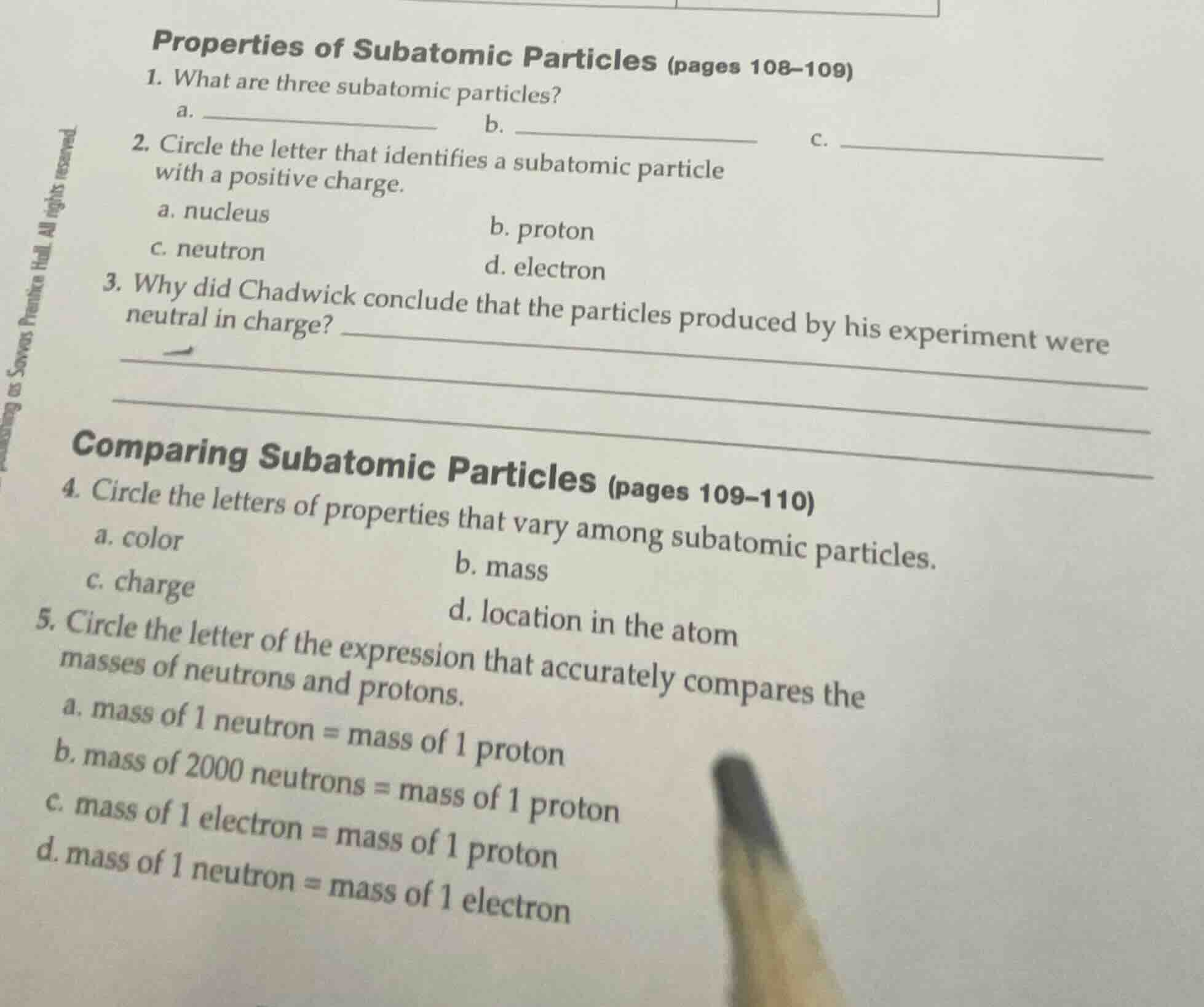
properties of subatomic particles (pages 108–109)
- what are three subatomic particles?
a. _____________ b. ________________ c. __________________
- circle the letter that identifies a subatomic particle with a positive charge.
a. nucleus b. proton
c. neutron d. electron
- why did chadwick conclude that the particles produced by his experiment were neutral in charge? ____________________
_____________________________________________________________________
_____________________________________________________________________
comparing subatomic particles (pages 109–110)
- circle the letters of properties that vary among subatomic particles.
a. color b. mass
c. charge d. location in the atom
- circle the letter of the expression that accurately compares the masses of neutrons and protons.
a. mass of 1 neutron = mass of 1 proton
b. mass of 2000 neutrons = mass of 1 proton
c. mass of 1 electron = mass of 1 proton
d. mass of 1 neutron = mass of 1 electron
Question 1
Subatomic particles are the particles that make up an atom. The three main subatomic particles are proton, neutron, and electron. Protons are positively charged, neutrons are neutral, and electrons are negatively charged.
We need to identify the subatomic particle with a positive charge. The nucleus is the central part of an atom (not a particle), a proton has a positive charge, a neutron has no charge, and an electron has a negative charge. So the correct option is the one with proton.
Chadwick's experiment involved bombarding beryllium with alpha particles. The particles produced (neutrons) were not deflected by electric or magnetic fields, which shows they have no charge (neutral). Also, they were able to penetrate materials that charged particles couldn't, supporting neutrality.

Snap & solve any problem in the app
Get step-by-step solutions on Sovi AI
Photo-based solutions with guided steps
Explore more problems and detailed explanations
a. proton
b. neutron
c. electron