QUESTION IMAGE
Question
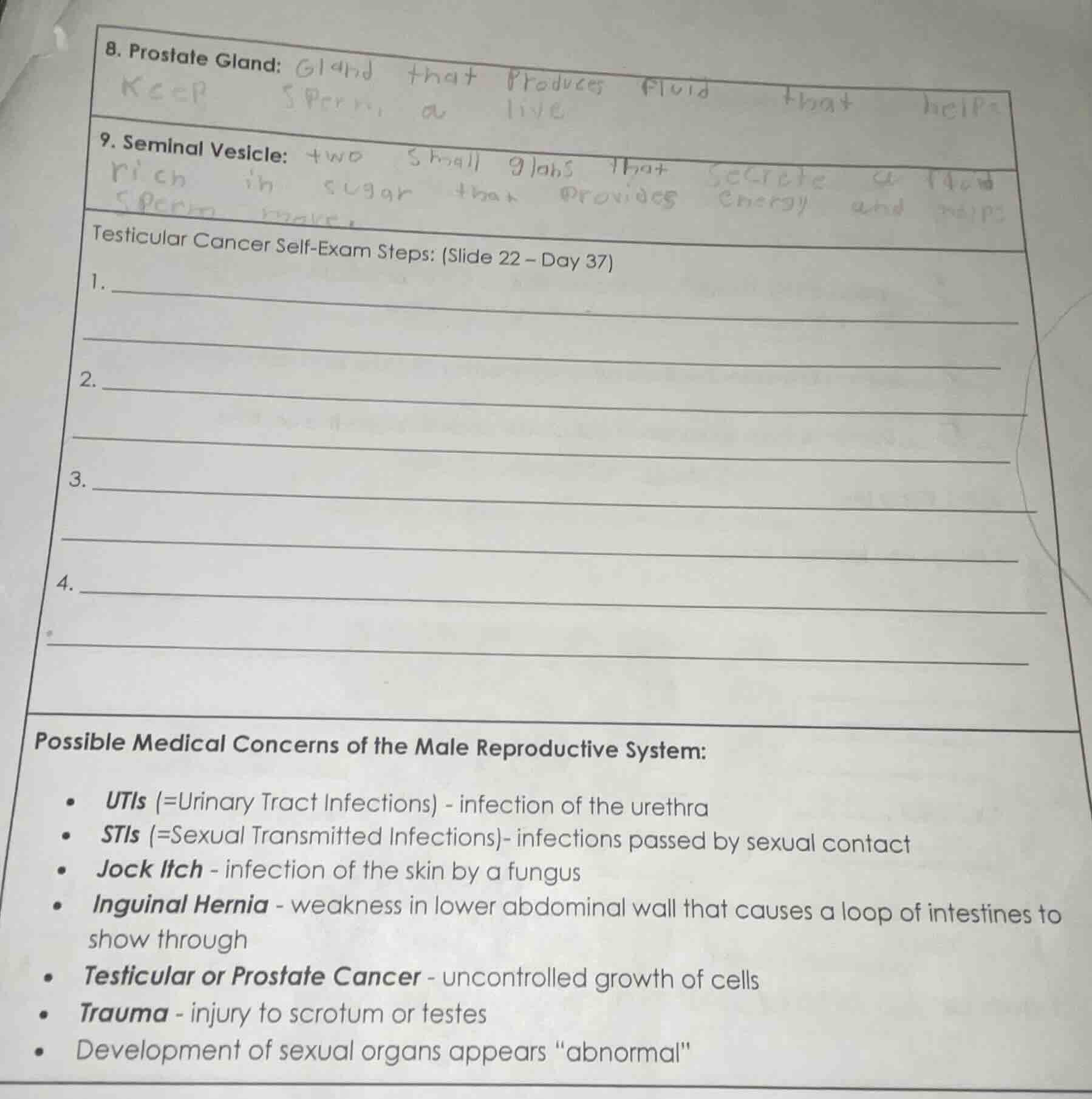
- prostate gland: gland that produces fluid that helps keep sperm, a live
- seminal vesicle: two small glans that secrete a fluid rich in sugar that provides energy and helps sperm move.
testicular cancer self-exam steps: (slide 22 – day 37)
1.
2.
3.
4.
possible medical concerns of the male reproductive system:
- utis (=urinary tract infections) - infection of the urethra
- stis (=sexual transmitted infections)- infections passed by sexual contact
- jock itch - infection of the skin by a fungus
- inguinal hernia - weakness in lower abdominal wall that causes a loop of intestines to show through
- testicular or prostate cancer - uncontrolled growth of cells
- trauma - injury to scrotum or testes
- development of sexual organs appears \abnormal\
To answer the question about the steps of the testicular cancer self - exam, we can refer to the general medical knowledge of testicular self - examination:
Step 1: Prepare
Stand in front of a mirror, undress from the waist down, and look at the scrotum. Check if there are any obvious changes in the size, shape, or skin appearance of the scrotum or testicles.
Step 2: Feel the testicles
Use both hands to gently hold each testicle. The testicles are usually oval - shaped and have a smooth surface. Roll each testicle between the thumb and fingers of the other hand. While doing this, feel for any lumps, hard spots, or areas that are different from the normal texture of the testicle.
Step 3: Check the epididymis
The epididymis is a structure located behind the testicle. It has a cord - like or slightly bumpy texture. Make sure that any lumps or abnormal feelings are not just the normal epididymis. If you find something that feels like a lump or is different from the normal tissue, it needs further attention.
Step 4: Note any changes
If you find any lumps, swelling, pain, or other abnormal symptoms during the self - exam, record the details (such as the location, size, and how it feels) and consult a doctor as soon as possible.

Snap & solve any problem in the app
Get step-by-step solutions on Sovi AI
Photo-based solutions with guided steps
Explore more problems and detailed explanations
- Stand in front of a mirror, undress from the waist down, and observe the scrotum for obvious changes in size, shape, or skin appearance.
- Use both hands to gently hold each testicle and roll it between the thumb and fingers of the other hand, feeling for lumps, hard spots, or abnormal textures.
- Check the epididymis (behind the testicle) to distinguish normal epididymal texture from abnormal lumps.
- If any abnormal symptoms (lumps, swelling, pain, etc.) are found, record the details and consult a doctor promptly.