QUESTION IMAGE
Question
- protein synthesis
animal cells utilize many different proteins. discuss the synthesis of proteins in an animal cell.
your answer must include at least:
- the identity of the building blocks required to synthesize these proteins
- the identity of the sites in the cell where the proteins are assembled
- an explanation of the role of dna in the process of making proteins in the cell
- state two differences between dna and rna
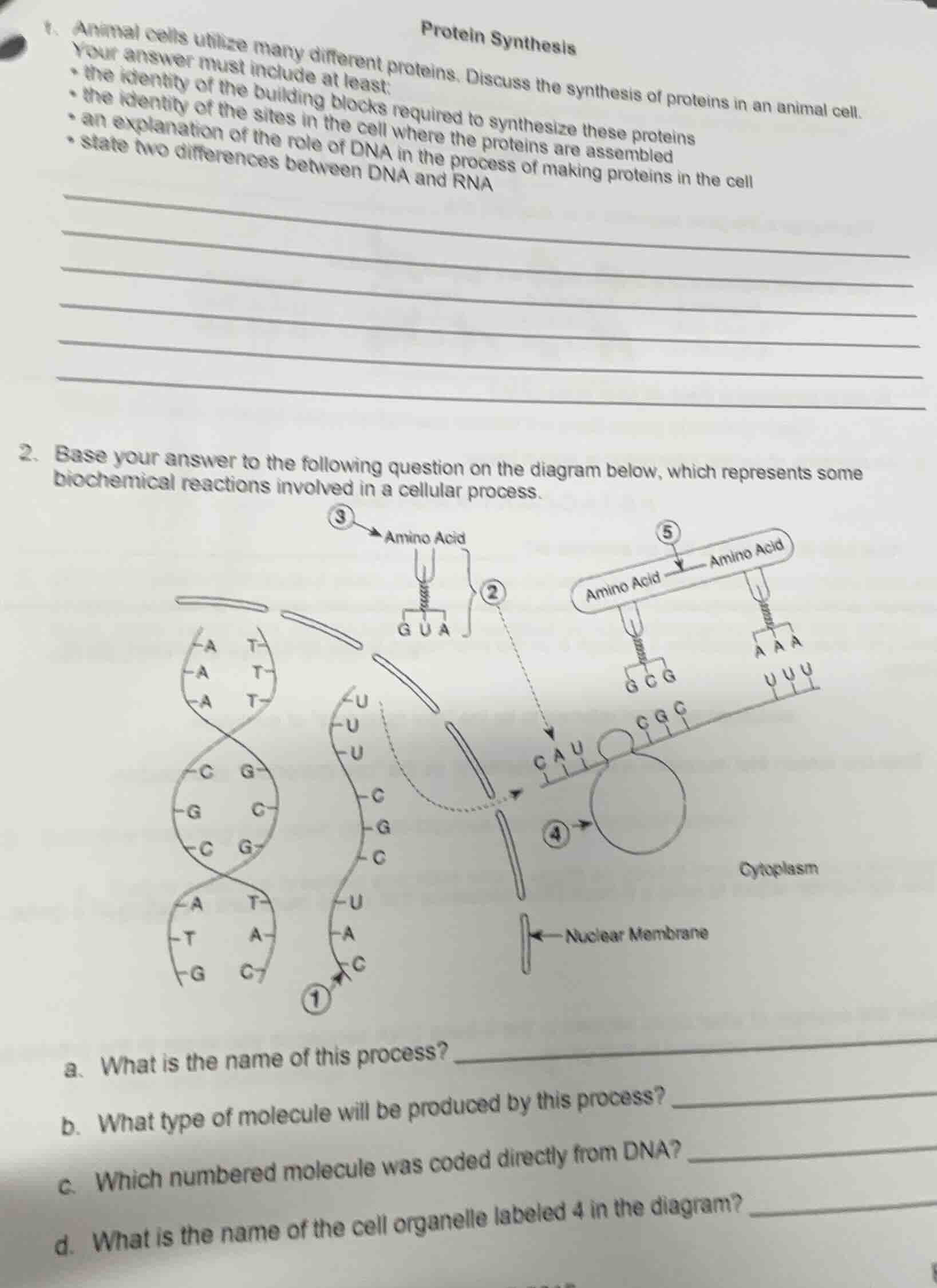
- base your answer to the following question on the diagram below, which represents some biochemical reactions involved in a cellular process.
a. what is the name of this process?
b. what type of molecule will be produced by this process?
c. which numbered molecule was coded directly from dna?
d. what is the name of the cell organelle labeled 4 in the diagram?
Question 1
- Building blocks: Amino acids are the monomers (building blocks) for proteins.
- Sites of assembly: Ribosomes (free in cytoplasm or bound to rough ER) are where amino acids are linked to form proteins.
- Role of DNA: DNA contains the genetic code (genes) that is transcribed into mRNA. This mRNA carries the code to ribosomes, where it is translated into a protein sequence.
- DNA vs RNA differences: 1. DNA has deoxyribose sugar, RNA has ribose. 2. DNA has thymine (T), RNA has uracil (U). 3. DNA is double - stranded, RNA is usually single - stranded (any two of these can be stated).
The diagram shows DNA being transcribed (formation of RNA) and then RNA being translated (with ribosomes and tRNAs bringing amino acids) to form a protein. This overall process is protein synthesis (or translation, but since transcription is also shown leading to it, protein synthesis is more comprehensive).
The end product of this process (protein synthesis) is a protein (polypeptide chain) formed from amino acids linked together.

Snap & solve any problem in the app
Get step-by-step solutions on Sovi AI
Photo-based solutions with guided steps
Explore more problems and detailed explanations
- Building blocks: Amino acids.
- Sites of assembly: Ribosomes (cytoplasm or rough endoplasmic reticulum).
- Role of DNA: Contains genetic code (genes) transcribed to mRNA for protein synthesis.
- DNA - RNA differences: (1) DNA has deoxyribose, RNA has ribose; (2) DNA has T, RNA has U.