QUESTION IMAGE
Question
protein synthesis step two: translation
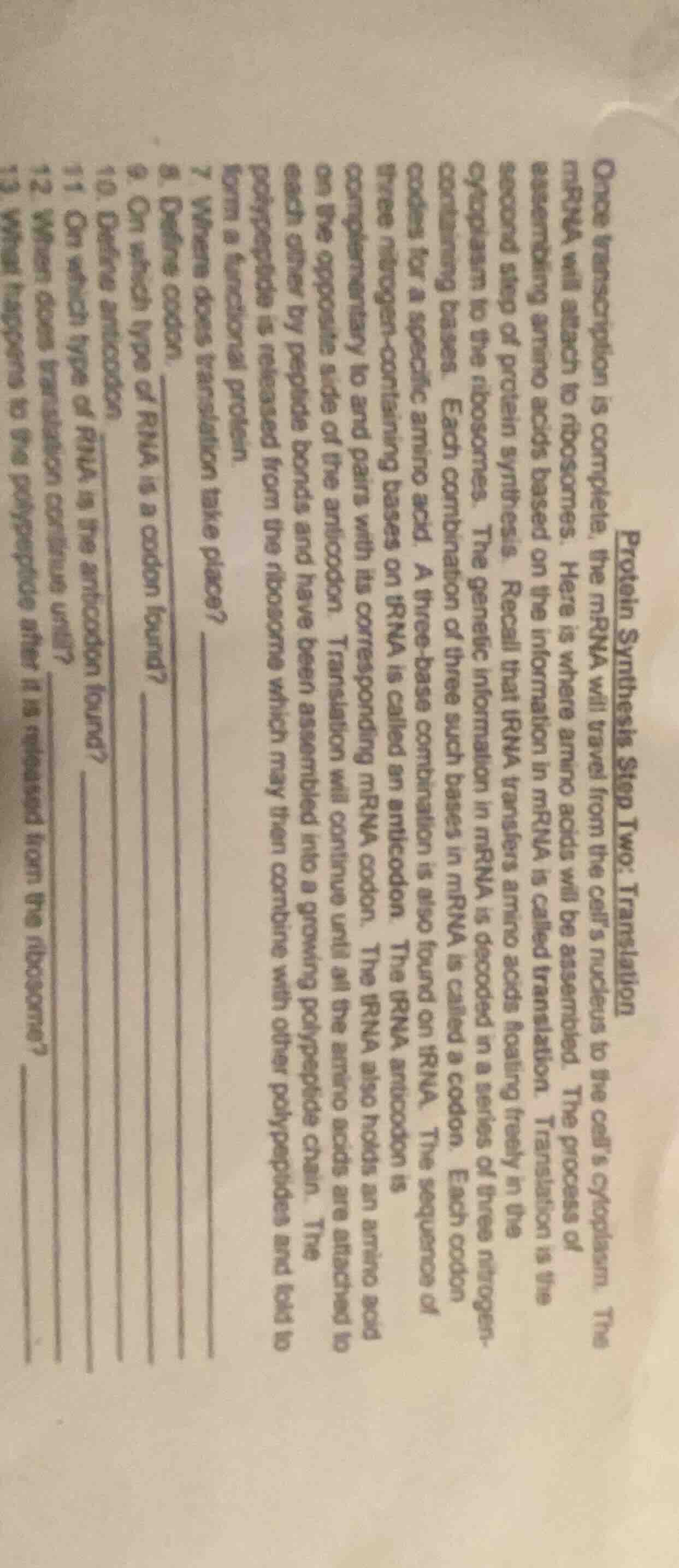
once transcription is complete, the mrna will travel from the cells nucleus to the cells cytoplasm. the mrna will attach to ribosomes. here is where amino acids will be assembled. the process of assembling amino acids based on the information in mrna is called translation. translation is the second step of protein synthesis. recall that trna transfers amino acids floating freely in the cytoplasm to the ribosomes. the genetic information in mrna is decoded in a series of three nitrogen-containing bases. each combination of three such bases in mrna is called a codon. each codon codes for a specific amino acid. a three-base combination is also found on trna. the sequence of three nitrogen-containing bases on trna is called an anticodon. the trna anticodon is complementary to and pairs with its corresponding mrna codon. the trna also holds an amino acid on the opposite side of the anticodon. translation will continue until all the amino acids are attached to each other by peptide bonds and have been assembled into a growing polypeptide chain. the polypeptide is released from the ribosome which may then combine with other polypeptides and fold to form a functional protein.
- where does translation take place?
- define codon.
- on which type of rna is a codon found?
- define anticodon.
- on which type of rna is the anticodon found?
- when does translation continue until?
- what happens to the polypeptide after it is released from the ribosome?
- Translation location is stated in the preamble.
- Codon definition is from the provided text.
- Codon's RNA type is specified in the preamble.
- Anticodon definition is from the provided text.
- Anticodon's RNA type is stated in the preamble.
- Translation stop condition is in the preamble.
- Post-release polypeptide fate is in the preamble.

Snap & solve any problem in the app
Get step-by-step solutions on Sovi AI
Photo-based solutions with guided steps
Explore more problems and detailed explanations
- In the cell's cytoplasm (on ribosomes)
- A three-base sequence on mRNA that codes for a specific amino acid
- Messenger RNA (mRNA)
- A three-base sequence on tRNA that is complementary to an mRNA codon
- Transfer RNA (tRNA)
- All amino acids are attached to form a polypeptide chain
- It may combine with other polypeptides and fold to form a functional protein