QUESTION IMAGE
Question
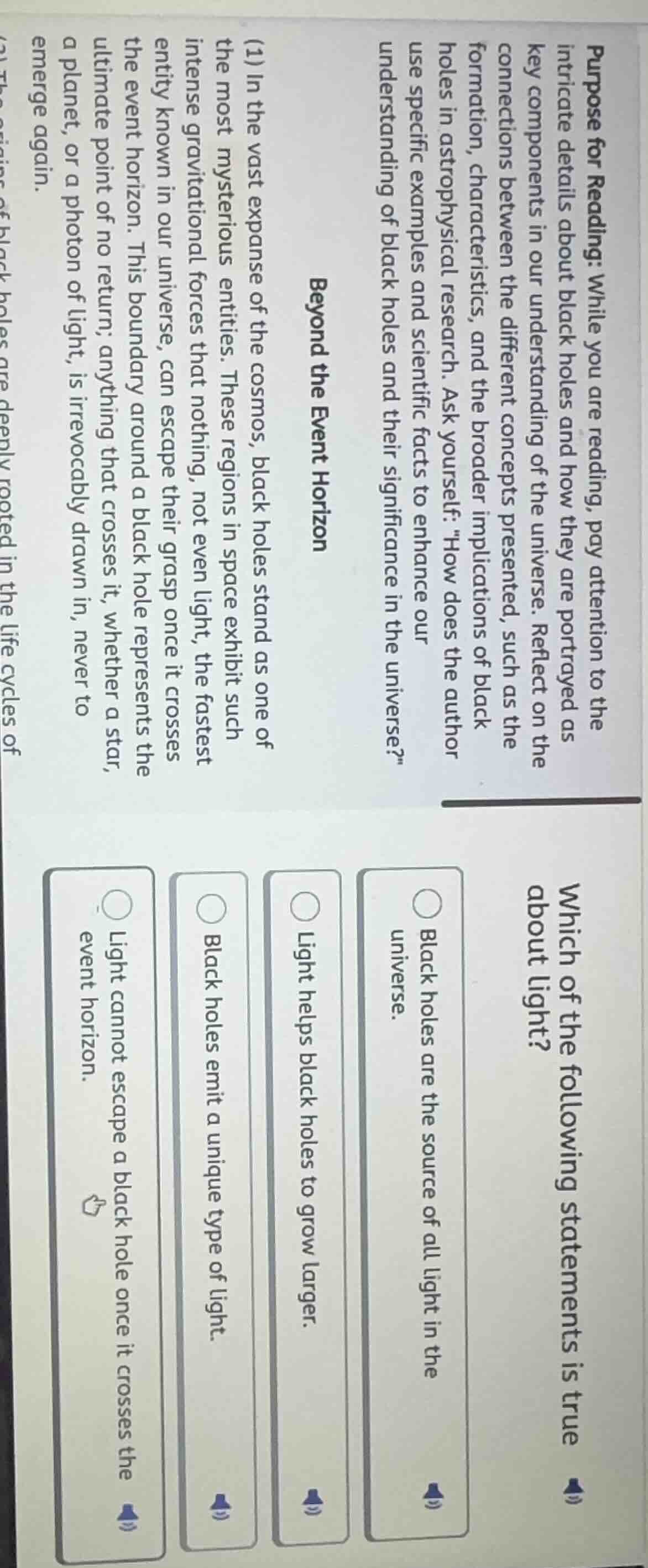
purpose for reading: while you are reading, pay attention to the intricate details about black holes and how they are portrayed as key components in our understanding of the universe. reflect on the connections between the different concepts presented, such as the formation, characteristics, and the broader implications of black holes in astrophysical research. ask yourself: \how does the author use specific examples and scientific facts to enhance our understanding of black holes and their significance in the universe?\
beyond the event horizon
(1) in the vast expanse of the cosmos, black holes stand as one of the most mysterious entities. these regions in space exhibit such intense gravitational forces that nothing, not even light, the fastest entity known in our universe, can escape once it crosses the event horizon. this boundary around a black hole represents the ultimate point of no return; anything that crosses it, whether a star, a planet, or a photon of light, is irrevocably drawn in, never to emerge again.
which of the following statements is true about light?
- black holes are the source of all light in the universe.
- light helps black holes to grow larger.
- black holes emit a unique type of light.
- light cannot escape a black hole once it crosses the event horizon.
To solve this, we analyze each option against the text. The text says "nothing, not even light, the fastest entity known in our universe, can escape their grasp once it crosses the event horizon".
- Option 1: "Black holes are the source of all light in the universe" – The text doesn't support this; black holes trap light, not produce it.
- Option 2: "Light helps black holes to grow larger" – The text has no info about light helping black holes grow.
- Option 3: "Black holes emit a unique type of light" – The text states nothing can escape black holes, so they don't emit light.
- Option 4: "Light cannot escape a black hole once it crosses the event horizon" – This matches the text's description of the event horizon as a point of no return for light.

Snap & solve any problem in the app
Get step-by-step solutions on Sovi AI
Photo-based solutions with guided steps
Explore more problems and detailed explanations
D. Light cannot escape a black hole once it crosses the event horizon.