QUESTION IMAGE
Question
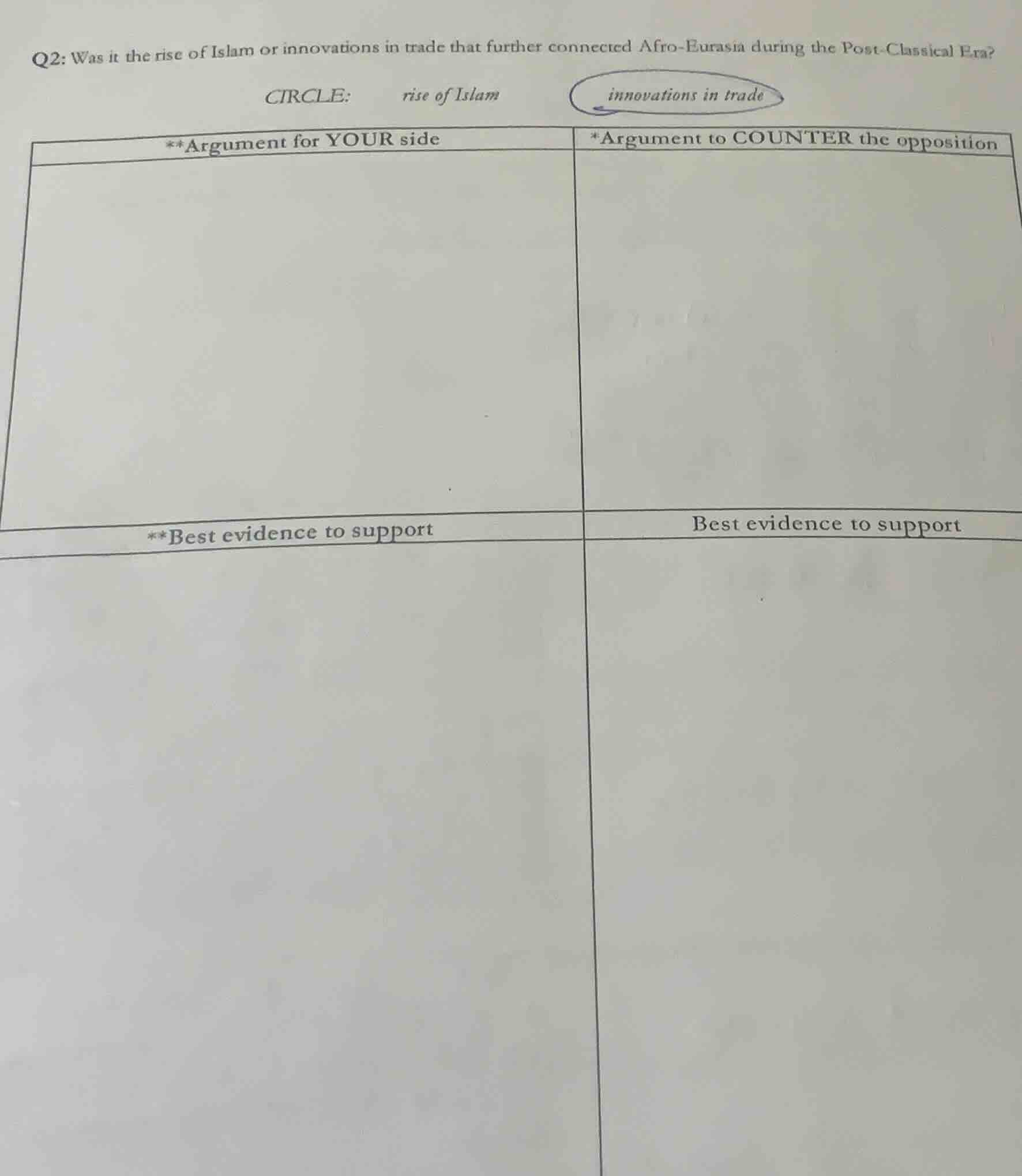
q2: was it the rise of islam or innovations in trade that further connected afro - eurasia during the post - classical era? circle: rise of islam innovations in trade *argument for your side argument to counter the opposition **best evidence to support best evidence to support
Argument for YOUR side (innovations in trade)
Trade innovations like the use of caravanserais, new forms of credit (e.g., bills of exchange), and the expansion of trade networks (like the Indian Ocean trade with Gujarati merchants, Arab traders, and Chinese junks) facilitated the movement of goods, ideas, and people across Afro - Eurasia. These innovations reduced transaction costs, increased the volume of trade, and connected regions that were previously less integrated. For example, the Chinese invention of paper money and the Islamic development of banking practices made long - distance trade more efficient, allowing merchants from different regions to conduct business with greater ease.
Argument to COUNTER the opposition (rise of Islam)
While Islam did spread across parts of Afro - Eurasia and created a common religious and cultural sphere in some regions, its influence was more limited in areas where trade networks reached but Islam did not fully penetrate (e.g., parts of Southeast Asia where Hindu - Buddhist cultures coexisted with trade). Also, trade innovations were not dependent on the spread of Islam—non - Islamic regions like Christian Europe and Hindu - dominated India also participated in the trade networks that were enhanced by these innovations. For instance, the Venetian merchants in Europe were part of the Mediterranean trade network that benefited from trade innovations, and they were not primarily motivated by the rise of Islam.
Best evidence to support YOUR side
The existence of the Indian Ocean trade network, where merchants from Arabia, India, and China used the monsoon winds (a natural phenomenon but also harnessed through trade innovation in navigation) to trade spices, textiles, and precious goods. Archaeological evidence of Chinese porcelain in East African ports, Indian textiles in Persian markets, and Arab - made glassware in South Asian sites shows the physical connection of regions through trade. Also, the development of the camel saddle for desert travel (a trade innovation) allowed for the expansion of trans - Saharan trade, connecting West Africa with North Africa and beyond.
Best evidence to support COUNTER argument
The continued flourishing of trade in regions with diverse religious beliefs, such as the trade between Christian Europe and the Islamic Middle East during the Crusades (where trade continued despite religious conflict) and the trade between Hindu India and Islamic Persia. This shows that trade innovations were a more fundamental driver of connection than the spread of a single religion. Additionally, the presence of non - Islamic trading cities like Venice and Genoa, which were major hubs in the Mediterranean trade, demonstrates that trade could thrive without the rise of Islam as a unifying force.

Snap & solve any problem in the app
Get step-by-step solutions on Sovi AI
Photo-based solutions with guided steps
Explore more problems and detailed explanations
Argument for YOUR side (innovations in trade)
Trade innovations like the use of caravanserais, new forms of credit (e.g., bills of exchange), and the expansion of trade networks (like the Indian Ocean trade with Gujarati merchants, Arab traders, and Chinese junks) facilitated the movement of goods, ideas, and people across Afro - Eurasia. These innovations reduced transaction costs, increased the volume of trade, and connected regions that were previously less integrated. For example, the Chinese invention of paper money and the Islamic development of banking practices made long - distance trade more efficient, allowing merchants from different regions to conduct business with greater ease.
Argument to COUNTER the opposition (rise of Islam)
While Islam did spread across parts of Afro - Eurasia and created a common religious and cultural sphere in some regions, its influence was more limited in areas where trade networks reached but Islam did not fully penetrate (e.g., parts of Southeast Asia where Hindu - Buddhist cultures coexisted with trade). Also, trade innovations were not dependent on the spread of Islam—non - Islamic regions like Christian Europe and Hindu - dominated India also participated in the trade networks that were enhanced by these innovations. For instance, the Venetian merchants in Europe were part of the Mediterranean trade network that benefited from trade innovations, and they were not primarily motivated by the rise of Islam.
Best evidence to support YOUR side
The existence of the Indian Ocean trade network, where merchants from Arabia, India, and China used the monsoon winds (a natural phenomenon but also harnessed through trade innovation in navigation) to trade spices, textiles, and precious goods. Archaeological evidence of Chinese porcelain in East African ports, Indian textiles in Persian markets, and Arab - made glassware in South Asian sites shows the physical connection of regions through trade. Also, the development of the camel saddle for desert travel (a trade innovation) allowed for the expansion of trans - Saharan trade, connecting West Africa with North Africa and beyond.
Best evidence to support COUNTER argument
The continued flourishing of trade in regions with diverse religious beliefs, such as the trade between Christian Europe and the Islamic Middle East during the Crusades (where trade continued despite religious conflict) and the trade between Hindu India and Islamic Persia. This shows that trade innovations were a more fundamental driver of connection than the spread of a single religion. Additionally, the presence of non - Islamic trading cities like Venice and Genoa, which were major hubs in the Mediterranean trade, demonstrates that trade could thrive without the rise of Islam as a unifying force.