QUESTION IMAGE
Question
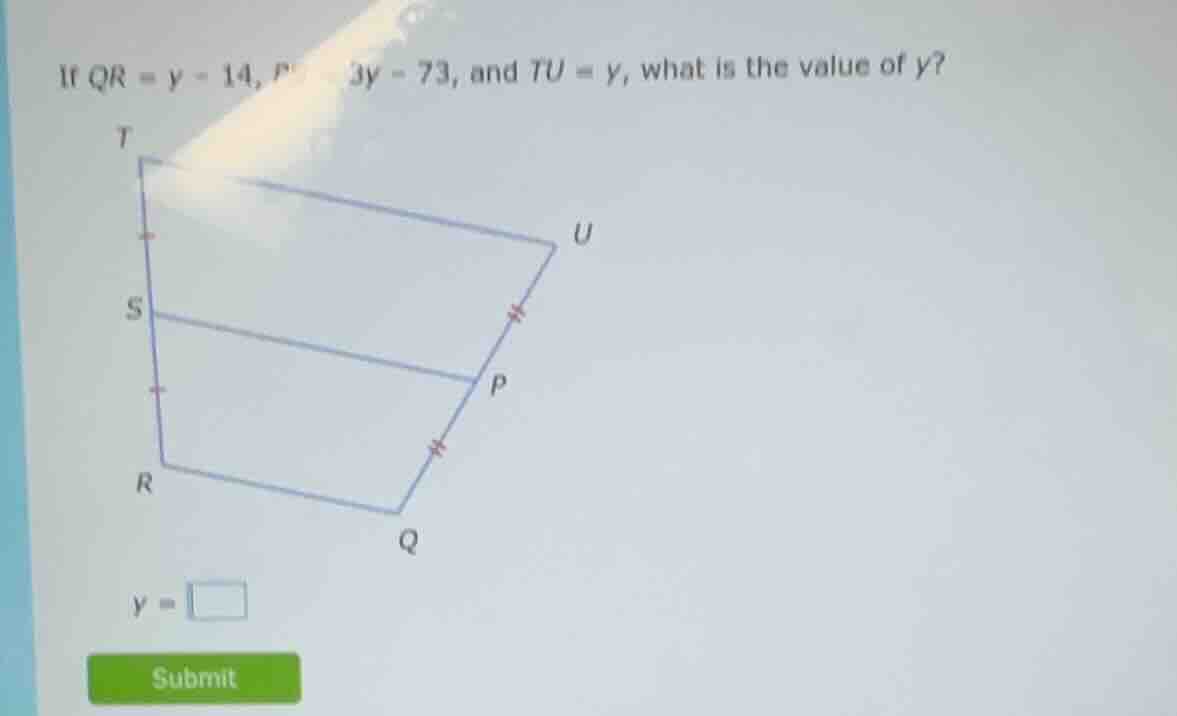
if qr = y - 14, pq = 3y - 73, and tu = y, what is the value of y? (there is a trapezoid - like figure with points t, u, q, r and midpoints s, p marked with tick marks on sides tr and uq respectively))
Step1: Identify the Midline Theorem (Trapezoid Midline)
In a trapezoid, the midline (or midsegment) length is the average of the two bases. Here, \( S P \) is the midline, \( Q R \) and \( T U \) are the two bases. Wait, actually, looking at the segments: \( S \) is the midpoint of \( T R \), \( P \) is the midpoint of \( U Q \), so by the Midline Theorem (for trapezoid or the midline of a quadrilateral with midpoints), the length of \( S P \) should be the average of \( T U \) and \( Q R \). But wait, the problem has \( PQ = 3y - 73 \)? Wait, maybe a typo, but looking at the diagram, \( P \) is on \( UQ \), and \( S \) is on \( TR \), with \( TS = SR \) (midpoint) and \( UP = PQ \) (midpoint). So the midline \( SP \) should satisfy \( SP=\frac{QR + TU}{2} \), but wait, maybe the problem is that \( SP = PQ \)? Wait, no, the given is \( QR = y - 14 \), \( PQ = 3y - 73 \), and \( TU = y \). Wait, maybe the correct relation is that \( PQ \) is equal to the average? Wait, no, let's re-express. Wait, maybe the segment \( SP \) is equal to \( PQ \)? No, looking at the diagram, \( TU \) and \( QR \) are the two parallel sides (bases), and \( SP \) is the midline, so \( SP=\frac{QR + TU}{2} \). But also, since \( P \) is the midpoint of \( UQ \) and \( S \) is the midpoint of \( TR \), maybe \( SP = PQ \)? Wait, the problem says \( QR = y - 14 \), \( PQ = 3y - 73 \), \( TU = y \). Wait, maybe it's a trapezoid with \( TU \parallel QR \), and \( SP \) is the midline, so \( SP=\frac{TU + QR}{2} \), and \( SP = PQ \)? Wait, no, maybe the problem is that \( PQ \) is equal to \( SP \), and \( SP \) is the midline. So:
\( 3y - 73=\frac{(y - 14)+y}{2} \)
Step2: Solve the Equation
First, simplify the right-hand side:
\( \frac{(y - 14)+y}{2}=\frac{2y - 14}{2}=y - 7 \)
So the equation is:
\( 3y - 73 = y - 7 \)
Subtract \( y \) from both sides:
\( 2y - 73=-7 \)
Add 73 to both sides:
\( 2y=66 \)
Divide by 2:
\( y = 33 \)
Wait, let's check:
Left-hand side (LHS): \( 3y - 73 = 3*33 -73 = 99 -73 = 26 \)
Right-hand side (RHS): \( y - 7 = 33 -7 = 26 \)
And \( QR = y -14 = 19 \), \( TU = y = 33 \), midline \( SP=\frac{19 + 33}{2}=\frac{52}{2}=26 \), which matches \( PQ = 26 \). So that works.
Step1 (Correct): Set Up the Midline Formula
In a trapezoid, the midsegment (SP) length is the average of the two bases (QR and TU). Also, since P is the midpoint of UQ, SP should equal PQ (assuming PQ is the midsegment? Wait, no, SP is the midsegment, and PQ is equal to SP? Wait, the key is that the midsegment SP is equal to (QR + TU)/2, and SP is equal to PQ (given as 3y -73). So:
\( 3y - 73=\frac{(y - 14)+y}{2} \)
Step2: Simplify the Equation
Simplify the right side:
\( \frac{y - 14 + y}{2}=\frac{2y - 14}{2}=y - 7 \)
So equation: \( 3y - 73 = y - 7 \)
Subtract \( y \) from both sides: \( 2y - 73=-7 \)
Add 73 to both sides: \( 2y = 66 \)
Divide by 2: \( y = 33 \)

Snap & solve any problem in the app
Get step-by-step solutions on Sovi AI
Photo-based solutions with guided steps
Explore more problems and detailed explanations
\( \boxed{33} \)