QUESTION IMAGE
Question
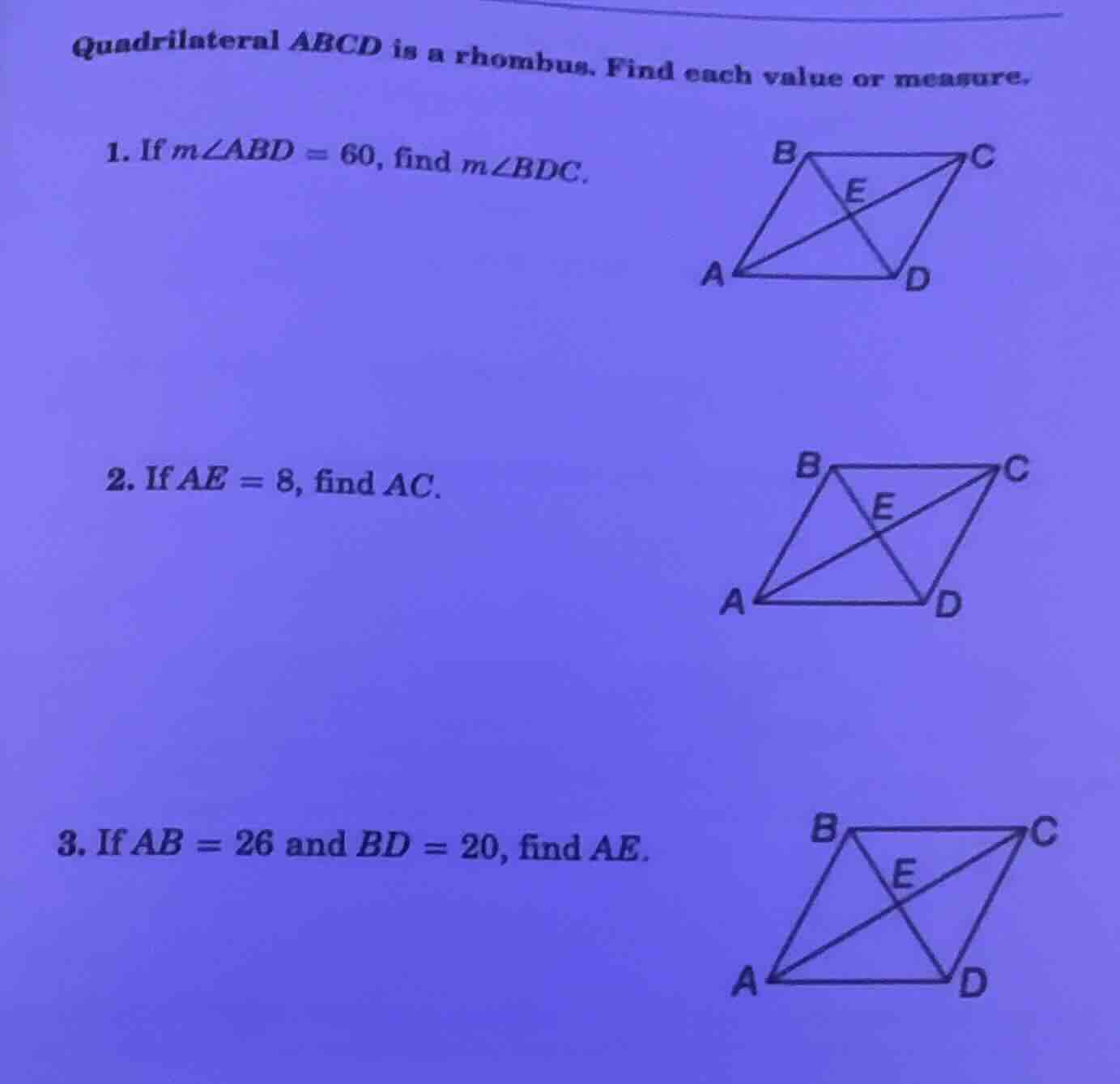
quadrilateral abcd is a rhombus. find each value or measure.
- if ( mangle abd = 60 ), find ( mangle bdc ).
- if ( ae = 8 ), find ( ac ).
- if ( ab = 26 ) and ( bd = 20 ), find ( ae ).
Problem 1
Step1: Recall rhombus properties
In a rhombus, \(AB \parallel CD\), so alternate interior angles are equal. \(\angle ABD\) and \(\angle BDC\) are alternate interior angles formed by transversal \(BD\) cutting parallel lines \(AB\) and \(CD\).
Step2: Determine the measure
Since \(AB \parallel CD\) and \(BD\) is a transversal, \(m\angle ABD = m\angle BDC\). Given \(m\angle ABD = 60^\circ\), so \(m\angle BDC = 60^\circ\).
Step1: Recall rhombus diagonal property
In a rhombus, the diagonals bisect each other. So \(E\) is the midpoint of \(AC\), meaning \(AC = 2 \times AE\).
Step2: Calculate \(AC\)
Given \(AE = 8\), then \(AC = 2\times8 = 16\).
Step1: Recall rhombus diagonal property
In a rhombus, diagonals bisect each other at right angles. So \(BE = ED=\frac{BD}{2}\) and \(AE = EC\), and \(\triangle AEB\) is a right triangle.
Step2: Find \(BE\)
Given \(BD = 20\), then \(BE=\frac{20}{2}=10\).
Step3: Use Pythagorean theorem in \(\triangle AEB\)
In right triangle \(AEB\), \(AB = 26\) (hypotenuse), \(BE = 10\) (one leg). Let \(AE = x\). By Pythagorean theorem, \(AB^{2}=AE^{2}+BE^{2}\), so \(26^{2}=x^{2}+10^{2}\).
Step4: Solve for \(x\)
\(x^{2}=26^{2}- 10^{2}=676 - 100 = 576\), then \(x=\sqrt{576}=24\). So \(AE = 24\).

Snap & solve any problem in the app
Get step-by-step solutions on Sovi AI
Photo-based solutions with guided steps
Explore more problems and detailed explanations
\(60^\circ\)