QUESTION IMAGE
Question
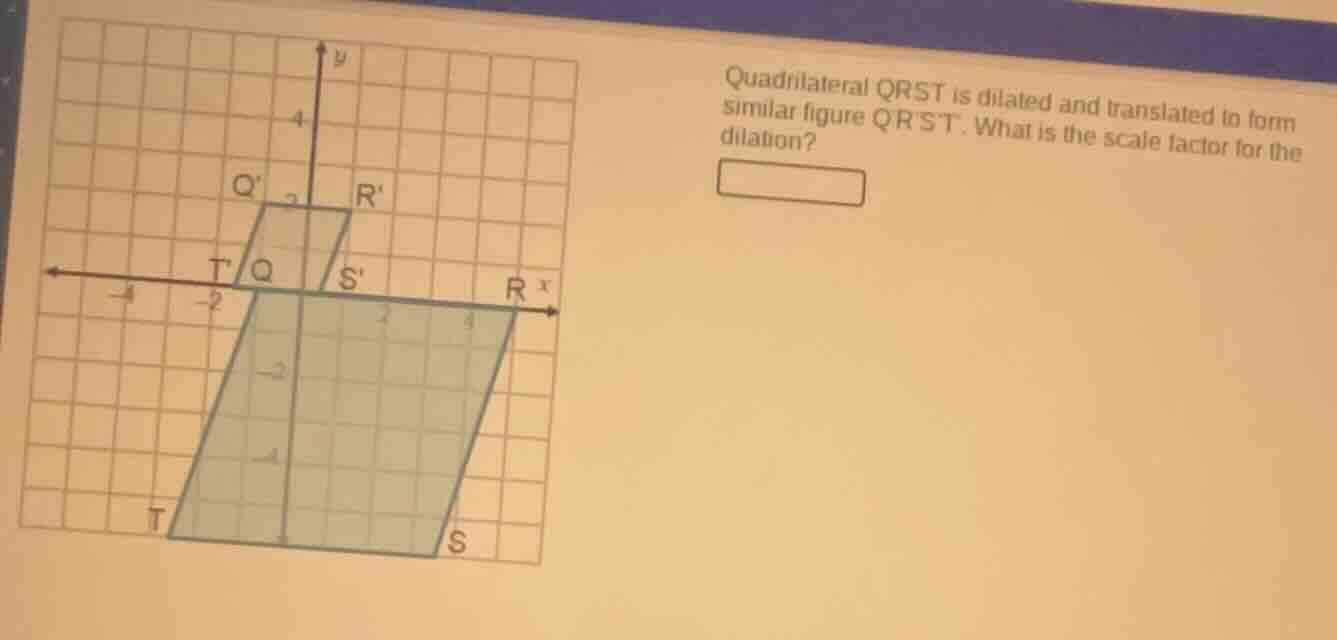
quadrilateral qrst is dilated and translated to form similar figure qrst. what is the scale factor for the dilation?
Step1: Find length of a side in QRST
Looking at the base of QRST (the lower quadrilateral), from Q to R on the x - axis. Let's assume each grid square has a side length of 1. The length of QR: from x = - 1 (approximate, but let's check the coordinates). Wait, looking at the coordinates, Q is at (-1,0), R is at (4,0)? Wait, no, let's look at the horizontal side. For the original quadrilateral QRST, the length of QS' (wait, no, let's take the horizontal side. Wait, the upper quadrilateral Q'R'S'T' and lower QRST. Let's take the length of R'Q' (upper) and RQ (lower).
Looking at the grid, for the upper figure Q'R'S'T', the length of R'Q' (horizontal) is 2 units? Wait, no, let's count the grid squares. For the lower quadrilateral QRST, the length from Q to R (horizontal) is 4 units? Wait, no, let's see the coordinates. Let's take the side length of the upper figure (Q'R'S'T'): the horizontal side R'Q' is 2 units (from x = - 1 to x = 1, so length 2). The lower figure QRST: the horizontal side from Q (x=-1) to R (x = 3), so length 4? Wait, no, maybe I made a mistake. Wait, the upper figure (Q'R'S'T') has a vertical side of length 2 (from y = 0 to y = 2), and the lower figure (QRST) has a vertical side of length 4 (from y = 0 to y=-4, but absolute value 4). Wait, scale factor is the ratio of corresponding sides. So if the upper figure is the image (Q'R'S'T') and the lower is the pre - image (QRST), then scale factor k = length of image side / length of pre - image side. Let's take the vertical sides: image vertical side length is 2, pre - image vertical side length is 4. So k = 2/4=1/2. Wait, or if the pre - image is the upper and image is the lower? No, the problem says "Quadrilateral QRST is dilated and translated to form similar figure Q'R'S'T'". So QRST is the pre - image, Q'R'S'T' is the image. So we need to find the ratio of corresponding sides of Q'R'S'T' to QRST. Let's take the horizontal side: in QRST, the length of QR (horizontal) is, let's count the grid. From Q (x=-1) to R (x = 3), so length is 3 - (-1)=4. In Q'R'S'T', the length of Q'R' (horizontal) is from x=-1 to x = 1, so length is 1 - (-1)=2. So scale factor k = length of Q'R' / length of QR=2/4 = 1/2. Or take the vertical side: in QRST, the vertical side length (from y = 0 to y=-4) is 4, in Q'R'S'T', the vertical side length (from y = 0 to y = 2) is 2. So k=2/4=1/2.
Step2: Calculate the scale factor
Scale factor \( k=\frac{\text{Length of side in image (}Q'R'S'T'\text{)}}{\text{Length of corresponding side in pre - image (}QRST\text{)}} \)
Let the length of a corresponding side in \( Q'R'S'T' \) be \( l_{image} \) and in \( QRST \) be \( l_{pre - image} \).
We found that \( l_{image}=2 \) and \( l_{pre - image}=4 \) (for corresponding horizontal or vertical sides).
So \( k = \frac{2}{4}=\frac{1}{2} \)

Snap & solve any problem in the app
Get step-by-step solutions on Sovi AI
Photo-based solutions with guided steps
Explore more problems and detailed explanations
\(\frac{1}{2}\)