QUESTION IMAGE
Question
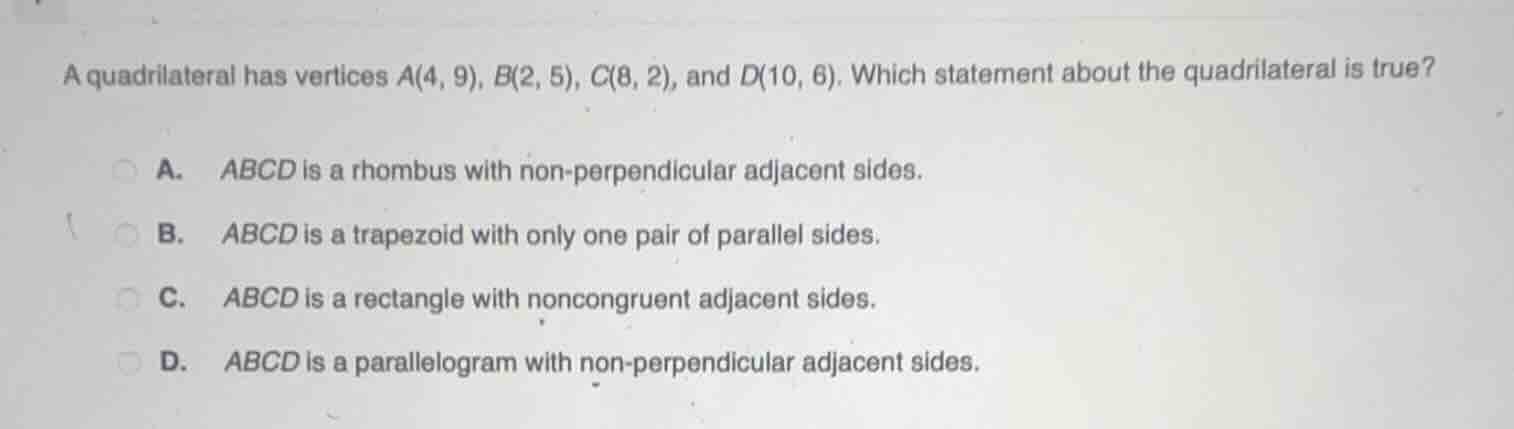
a quadrilateral has vertices a(4, 9), b(2, 5), c(8, 2), and d(10, 6). which statement about the quadrilateral is true?
a. abcd is a rhombus with non - perpendicular adjacent sides.
b. abcd is a trapezoid with only one pair of parallel sides.
c. abcd is a rectangle with noncongruent adjacent sides.
d. abcd is a parallelogram with non - perpendicular adjacent sides.
Step1: Calculate side lengths
Use distance formula $d=\sqrt{(x_2-x_1)^2+(y_2-y_1)^2}$:
- $AB=\sqrt{(2-4)^2+(5-9)^2}=\sqrt{4+16}=\sqrt{20}=2\sqrt{5}$
- $BC=\sqrt{(8-2)^2+(2-5)^2}=\sqrt{36+9}=\sqrt{45}=3\sqrt{5}$
- $CD=\sqrt{(10-8)^2+(6-2)^2}=\sqrt{4+16}=\sqrt{20}=2\sqrt{5}$
- $DA=\sqrt{(4-10)^2+(9-6)^2}=\sqrt{36+9}=\sqrt{45}=3\sqrt{5}$
Step2: Calculate side slopes
Use slope formula $m=\frac{y_2-y_1}{x_2-x_1}$:
- $m_{AB}=\frac{5-9}{2-4}=\frac{-4}{-2}=2$
- $m_{BC}=\frac{2-5}{8-2}=\frac{-3}{6}=-\frac{1}{2}$
- $m_{CD}=\frac{6-2}{10-8}=\frac{4}{2}=2$
- $m_{DA}=\frac{9-6}{4-10}=\frac{3}{-6}=-\frac{1}{2}$
Step3: Analyze parallel/perpendicular sides
- Parallel: $m_{AB}=m_{CD}$, $m_{BC}=m_{DA}$ → both pairs of opposite sides parallel.
- Perpendicular check: $m_{AB} \times m_{BC}=2 \times -\frac{1}{2}=-1$, but $AB
eq BC$, so adjacent sides are perpendicular only for this pair? Wait no, recheck: Wait $m_{AB}=2$, $m_{DA}=-\frac{1}{2}$, $2 \times -\frac{1}{2}=-1$ too. Wait no, wait the product is -1, which means perpendicular, but wait the side lengths: $AB=2\sqrt{5}$, $BC=3\sqrt{5}$, so adjacent sides are not congruent. Wait no, wait let's recheck the slope of DA: $A(4,9)$, $D(10,6)$: $\frac{9-6}{4-10}=\frac{3}{-6}=-\frac{1}{2}$, correct. $AB$ slope is 2, so 2 * (-1/2) = -1, so AB is perpendicular to BC and DA? Wait no, AB is adjacent to BC and DA. Wait AB and BC: slope product -1, so perpendicular. AB and DA: slope product 2*(-1/2)=-1, also perpendicular. Wait then all angles are right angles, but adjacent sides are not congruent, so it's a rectangle? Wait no, wait wait CD slope is 2, BC slope is -1/2, product is -1, so BC perpendicular to CD. So all angles are right angles, adjacent sides different lengths. Wait but wait let's check the distance from A to C: diagonal AC: $\sqrt{(8-4)^2+(2-9)^2}=\sqrt{16+49}=\sqrt{65}$. Diagonal BD: $\sqrt{(10-2)^2+(6-5)^2}=\sqrt{64+1}=\sqrt{65}$. Oh, diagonals are equal, which confirms rectangle. Wait but wait option C says "ABCD is a rectangle with noncongruent adjacent sides." But wait wait, let's recheck the slope of CD: D(10,6), C(8,2): $\frac{6-2}{10-8}=\frac{4}{2}=2$, correct. Slope of DA: $\frac{9-6}{4-10}=-\frac{1}{2}$, correct. So AB || CD, BC || DA, all angles 90 degrees, adjacent sides 2√5 and 3√5, so noncongruent. Wait but wait option D says parallelogram with non-perpendicular adjacent sides, but adjacent sides are perpendicular. Wait did I miscalculate slope?
Wait AB: A(4,9), B(2,5): (5-9)/(2-4) = (-4)/(-2)=2, correct. BC: B(2,5), C(8,2): (2-5)/(8-2)= (-3)/6= -1/2, correct. 2 * (-1/2) = -1, so AB ⊥ BC, right. So adjacent sides are perpendicular. Then option C says rectangle with noncongruent adjacent sides, which fits. Wait but let's check option A: rhombus requires all sides equal, which they are not, so A is wrong. Option B: trapezoid has only one pair of parallel sides, but we have two pairs, so B wrong. Option D: parallelogram, but adjacent sides are perpendicular, so D wrong. Wait so the correct answer is C? Wait wait no, wait let's recheck the diagonal lengths: AC is from (4,9) to (8,2): $\sqrt{(8-4)^2 + (2-9)^2} = \sqrt{16 + 49} = \sqrt{65}$. BD is from (2,5) to (10,6): $\sqrt{(10-2)^2 + (6-5)^2} = \sqrt{64 + 1} = \sqrt{65}$. Diagonals are equal, which is a property of rectangles. And all angles are right angles, adjacent sides not equal, so it's a rectangle with noncongruent adjacent sides.
Wait but wait, let's confirm if it's a parallelogram first: opposite sides equal and parallel, yes, so it's a parallelogram. Then with right angles, so rectangle. Adjacent sides not equal…

Snap & solve any problem in the app
Get step-by-step solutions on Sovi AI
Photo-based solutions with guided steps
Explore more problems and detailed explanations
C. ABCD is a rectangle with noncongruent adjacent sides.