QUESTION IMAGE
Question
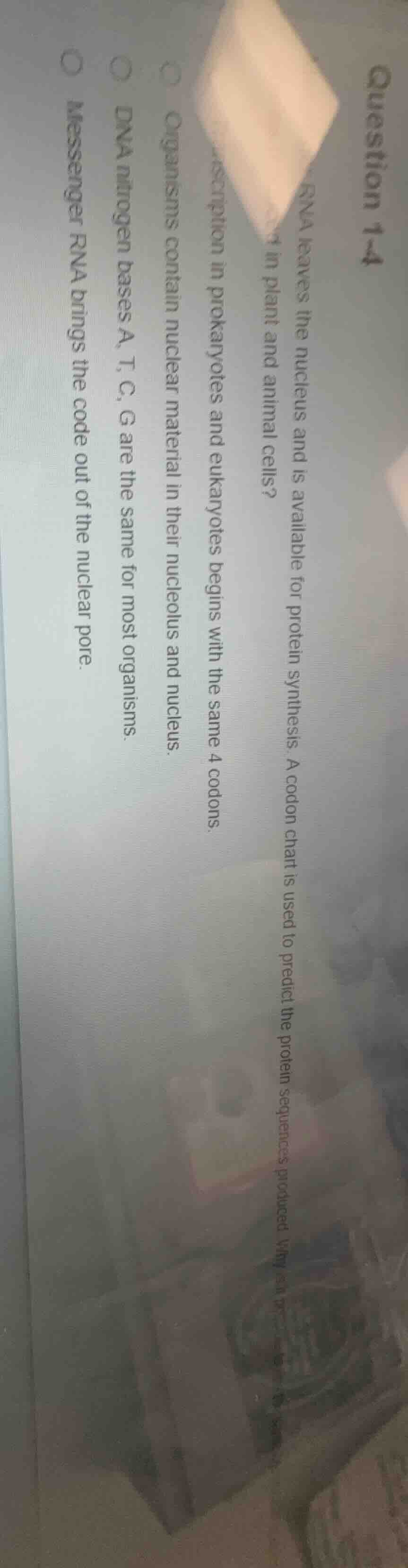
question 1-4 rna leaves the nucleus and is available for protein synthesis. a codon chart is used to predict the protein sequences produced why can in plant and animal cells? scription in prokaryotes and eukaryotes begins with the same 4 codons. organisms contain nuclear material in their nucleolus and nucleus. dna nitrogen bases a, t, c, g are the same for most organisms. messenger rna brings the code out of the nuclear pore.
To determine the correct statement, we analyze each option:
- First option (Transcription in prokaryotes and eukaryotes begins with the same 4 codons):
Transcription starts with a promoter sequence, not specific codons (codons are for translation). So this is incorrect.
- Second option (Organisms contain nuclear material in their nucleolus and nucleus):
The nucleolus is a structure within the nucleus (in eukaryotes) and is involved in ribosome production. Nuclear material (DNA) is in the nucleus (or nucleoid in prokaryotes), not the nucleolus. So this is incorrect.
- Third option (DNA nitrogen bases A, T, C, G are the same for most organisms):
The DNA bases (adenine, thymine, cytosine, guanine) are universal across most living organisms (the genetic code is nearly universal, with rare exceptions). This reflects the conservation of DNA structure and function.
- Fourth option (Messenger RNA brings the code out of the nuclear pore):
mRNA is synthesized in the nucleus (transcription) and exits through nuclear pores to the cytoplasm for translation. However, the question asks why a codon chart works for both plant and animal cells. The universality of DNA bases (and thus the genetic code) is the key reason codon charts are universal. The mRNA transport is a process, not the reason for codon chart universality.

Snap & solve any problem in the app
Get step-by-step solutions on Sovi AI
Photo-based solutions with guided steps
Explore more problems and detailed explanations
The correct option is the one stating "DNA nitrogen bases A, T, C, G are the same for most organisms." (The third option in the list, as per the image: "DNA nitrogen bases A, T, C, G are the same for most organisms.")