QUESTION IMAGE
Question
question 1-6
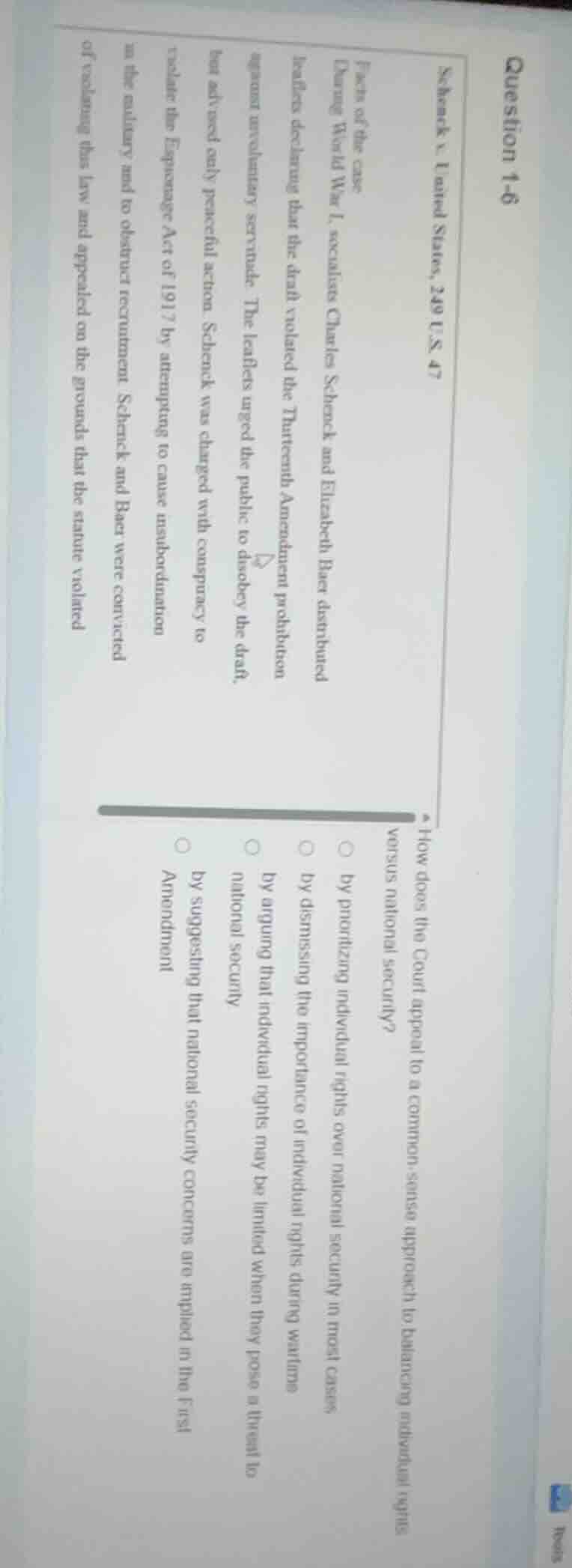
schenck v. united states, 249 u.s. 47
facts of the case
during world war i, socialists charles schenck and elizabeth baer distributed leaflets declaring that the draft violated the thirteenth amendment prohibition against involuntary servitude. the leaflets urged the public to disobey the draft, but used only peaceful action. schenck was charged with conspiracy to violate the espionage act of 1917 by attempting to cause insubordination in the military and to obstruct recruitment. schenck and baer were convicted of violating this law and appealed on the grounds that the statute violated
how does the court appeal to a common - sense approach to balancing individual rights versus national security?
○ by prioritizing individual rights over national security in most cases
○ by dismissing the importance of individual rights during wartime
○ by arguing that individual rights may be limited when they pose a threat to national security
○ by suggesting that national security concerns are implied in the first amendment
The Schenck v. United States case established the "clear and present danger" test, holding that individual First Amendment rights can be restricted when they threaten national security, especially in wartime. The Court reasoned that context matters, and speech that would be permissible in peacetime can be limited if it creates a tangible risk to the nation during a crisis.

Snap & solve any problem in the app
Get step-by-step solutions on Sovi AI
Photo-based solutions with guided steps
Explore more problems and detailed explanations
by arguing that individual rights may be limited when they pose a threat to national security