QUESTION IMAGE
Question
question 7 of 10
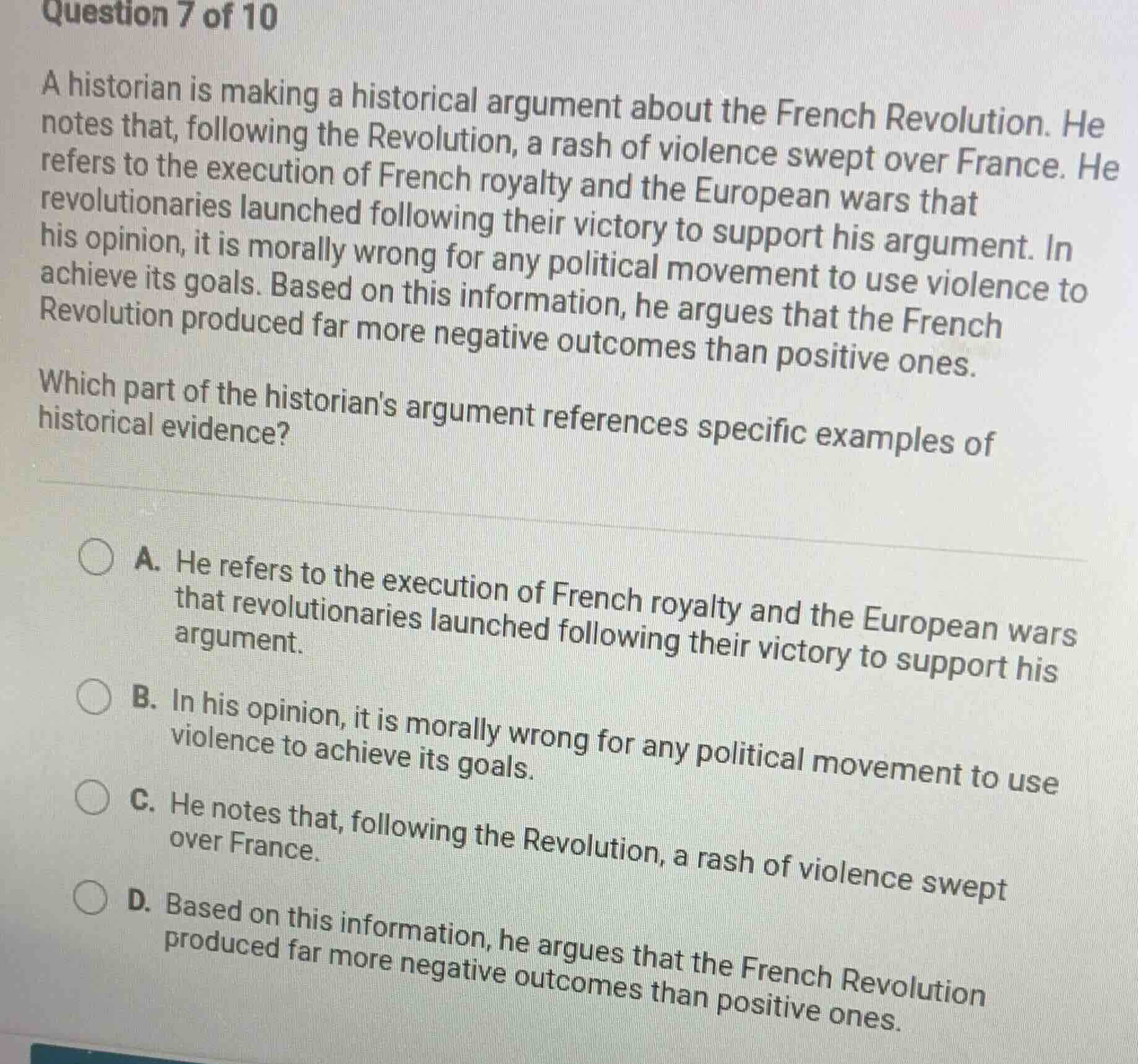
a historian is making a historical argument about the french revolution. he notes that, following the revolution, a rash of violence swept over france. he refers to the execution of french royalty and the european wars that revolutionaries launched following their victory to support his argument. in his opinion, it is morally wrong for any political movement to use violence to achieve its goals. based on this information, he argues that the french revolution produced far more negative outcomes than positive ones.
which part of the historians argument references specific examples of historical evidence?
a. he refers to the execution of french royalty and the european wars that revolutionaries launched following their victory to support his argument.
b. in his opinion, it is morally wrong for any political movement to use violence to achieve its goals.
c. he notes that, following the revolution, a rash of violence swept over france.
d. based on this information, he argues that the french revolution produced far more negative outcomes than positive ones.
To determine which part references specific historical evidence, we analyze each option:
- Option A: Mentions the execution of French royalty and European wars launched by revolutionaries, which are specific events (historical evidence) from the French Revolution period.
- Option B: Is a moral opinion, not historical evidence.
- Option C: Describes a general situation of violence but not specific examples.
- Option D: Is the historian's conclusion, not evidence.

Snap & solve any problem in the app
Get step-by-step solutions on Sovi AI
Photo-based solutions with guided steps
Explore more problems and detailed explanations
A. He refers to the execution of French royalty and the European wars that revolutionaries launched following their victory to support his argument.