QUESTION IMAGE
Question
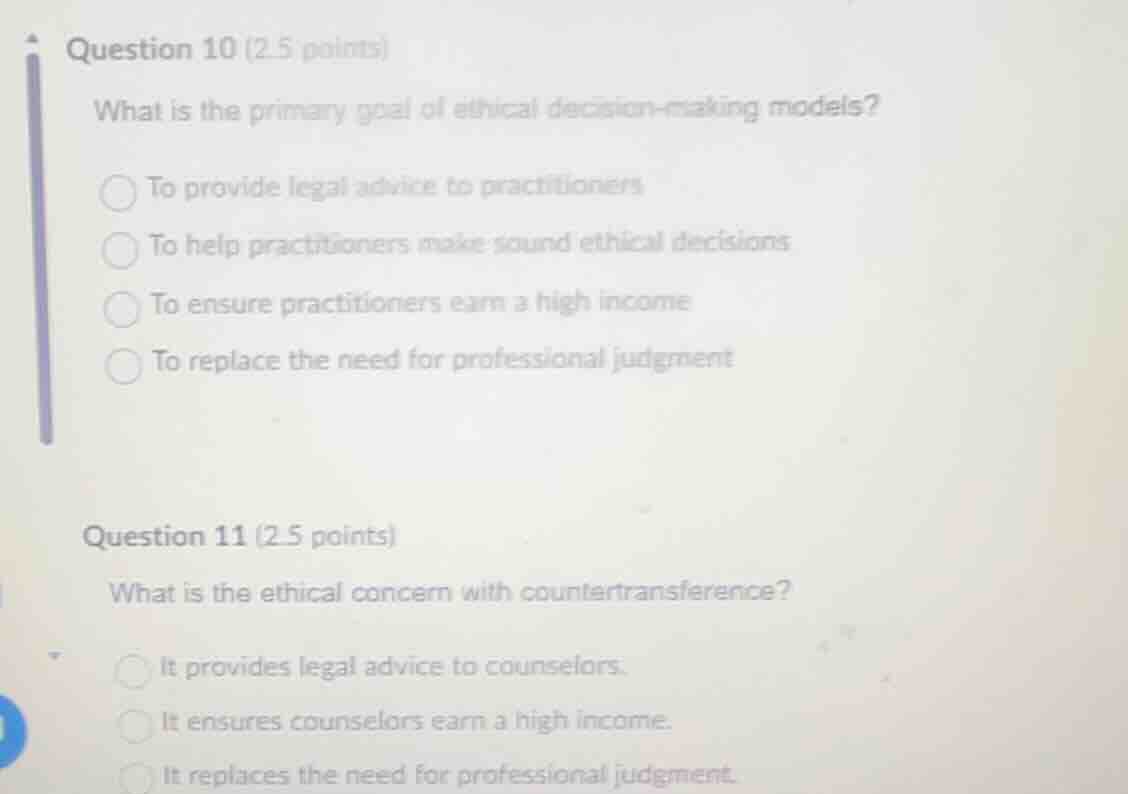
question 10 (2.5 points)
what is the primary goal of ethical decision - making models?
to provide legal advice to practitioners
to help practitioners make sound ethical decisions
to ensure practitioners earn a high income
to replace the need for professional judgment
question 11 (2.5 points)
what is the ethical concern with countertransference?
it provides legal advice to counselors.
it ensures counselors earn a high income.
it replaces the need for professional judgment.
Question 10
- "To provide legal advice to practitioners" is incorrect because ethical decision - making models are about ethics, not legal advice.
- "To help practitioners make sound ethical decisions" is correct. Ethical decision - making models are designed to guide practitioners in analyzing situations and making decisions that are ethically appropriate.
- "To ensure practitioners earn a high income" is incorrect as ethical decision - making has no direct relation to income.
- "To replace the need for professional judgment" is incorrect. These models are meant to assist, not replace, professional judgment.

Snap & solve any problem in the app
Get step-by-step solutions on Sovi AI
Photo-based solutions with guided steps
Explore more problems and detailed explanations
B. To help practitioners make sound ethical decisions
Question 11 (Note: The options provided seem incomplete, but based on the pattern of Question 10 and the topic of countertransference in ethics (usually in fields like Psychology which is a subfield of Social Science), the correct idea related to ethical concern with countertransference would be something like it can interfere with the counselor's ability to provide objective and ethical care, and if we assume the intended correct option was about how it can impact professional judgment or ethical practice, but with the given (incomplete) options, we can infer that the correct - type option would be related to how it affects ethical practice. However, since the options are cut off, if we assume a similar structure to Question 10's incorrect options, the correct ethical concern would be about how countertransference can lead to unethical practice by clouding professional judgment, etc. But with the given (incomplete) options, we can't fully determine, but if we assume the last option was supposed to be about how it affects ethical practice (e.g., "It can lead to unethical behavior due to the counselor's personal reactions"), but based on the given (incomplete) options, we can note that the options provided don't seem to have the correct one fully, but if we follow the error pattern of the options, the intended correct option would be related to the negative impact on ethical practice, like interfering with professional judgment or ethical care.
(If we assume the last option was mistyped and was supposed to be something like "It can lead to unethical practice as the counselor's personal feelings interfere with client care", then that would be the correct - type option. But with the given incomplete options, we can only point out the issue with the options and the correct concept related to countertransference's ethical concern.)