QUESTION IMAGE
Question
question 4 of 10
select the correct answer.
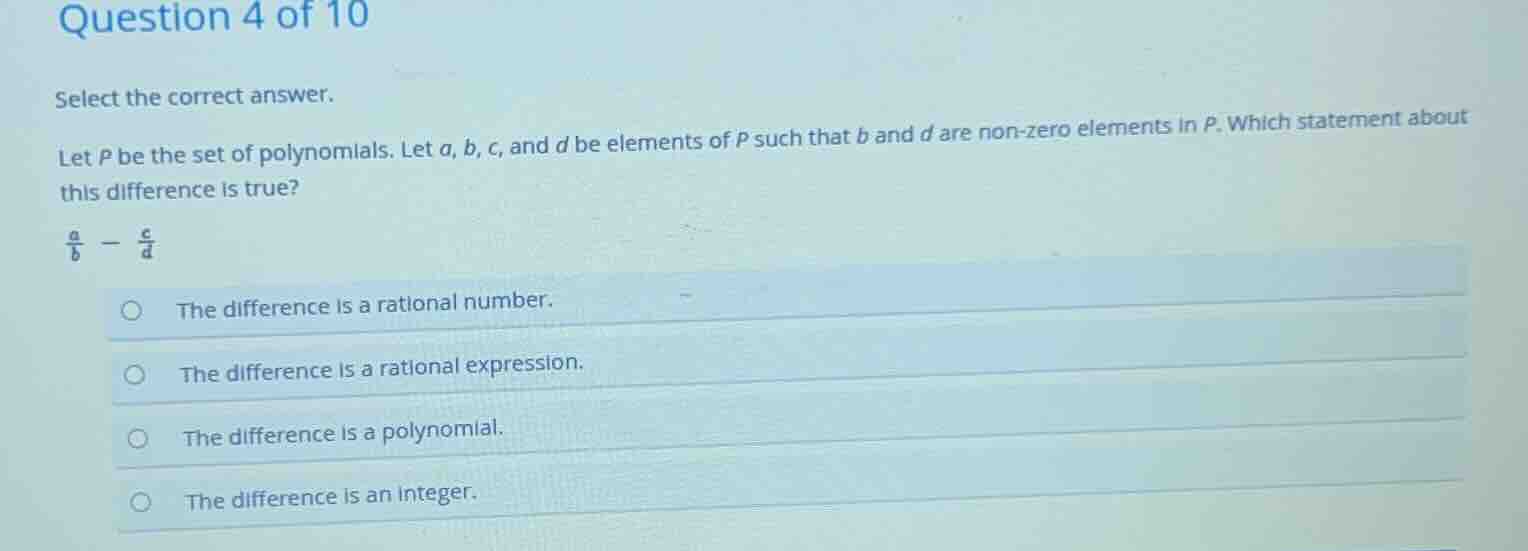
let ( p ) be the set of polynomials. let ( a ), ( b ), ( c ), and ( d ) be elements of ( p ) such that ( b ) and ( d ) are non - zero elements in ( p ). which statement about this difference is true?
( \frac{a}{b}-\frac{c}{d} )
- the difference is a rational number.
- the difference is a rational expression.
- the difference is a polynomial.
- the difference is an integer.
Step1: Recall definitions
A rational expression is a fraction where the numerator and denominator are polynomials (and the denominator is non - zero). Here, \(a,b,c,d\) are polynomials, and \(b
eq0\), \(d
eq0\).
Step2: Simplify the difference
We simplify \(\frac{a}{b}-\frac{c}{d}\) using the common denominator \(bd\). So \(\frac{a}{b}-\frac{c}{d}=\frac{ad - bc}{bd}\).
The numerator \(ad - bc\) is a polynomial (since the product and difference of polynomials are polynomials) and the denominator \(bd\) is a non - zero polynomial (because \(b\) and \(d\) are non - zero polynomials). So \(\frac{ad - bc}{bd}\) is a rational expression.
A rational number is a number of the form \(\frac{p}{q}\) where \(p,q\) are integers and \(q
eq0\), but here \(a,b,c,d\) are polynomials, not necessarily integers. A polynomial has no variable in the denominator, but our result has a polynomial in the denominator (unless \(bd = 1\), which is not guaranteed). An integer is a whole number, and our result is a fraction of polynomials, not necessarily an integer.

Snap & solve any problem in the app
Get step-by-step solutions on Sovi AI
Photo-based solutions with guided steps
Explore more problems and detailed explanations
The difference is a rational expression.