QUESTION IMAGE
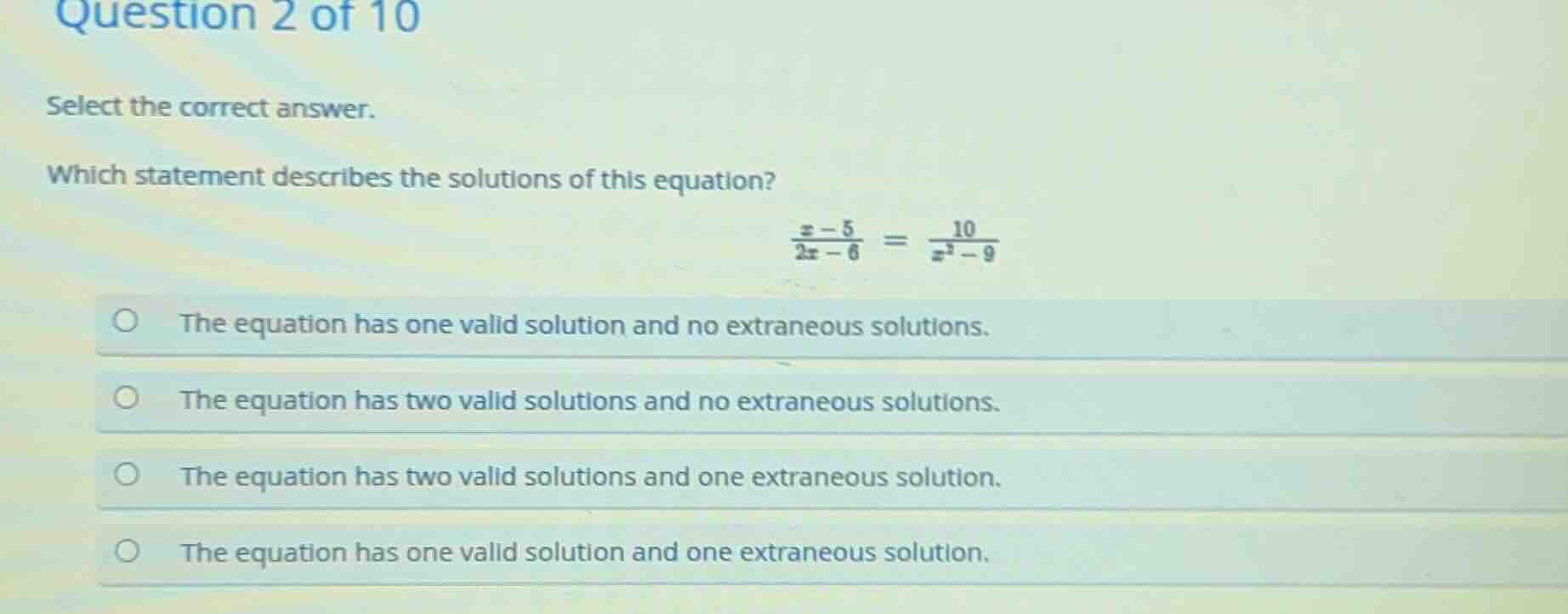
Question
question 2 of 10
select the correct answer.
which statement describes the solutions of this equation?
\\(\frac{x - 5}{2x - 6} = \frac{10}{x^2 - 9}\\)
\\(\bigcirc\\) the equation has one valid solution and no extraneous solutions.
\\(\bigcirc\\) the equation has two valid solutions and no extraneous solutions.
\\(\bigcirc\\) the equation has two valid solutions and one extraneous solution.
\\(\bigcirc\\) the equation has one valid solution and one extraneous solution.
Step1: Factor denominators
Factor \(2x - 6\) as \(2(x - 3)\) and \(x^2 - 9\) as \((x - 3)(x + 3)\). The equation becomes \(\frac{x - 5}{2(x - 3)}=\frac{10}{(x - 3)(x + 3)}\).
Step2: Find domain restrictions
Denominators can't be zero, so \(x
eq3\) and \(x
eq - 3\).
Step3: Cross - multiply to solve
Cross - multiply: \((x - 5)(x + 3)=20\). Expand the left side: \(x^{2}+3x-5x - 15 = 20\), which simplifies to \(x^{2}-2x-35 = 0\).
Step4: Solve the quadratic equation
Factor \(x^{2}-2x - 35=(x - 7)(x + 5)=0\). So \(x = 7\) or \(x=-5\).
Step5: Check for extraneous solutions
Check \(x = 7\): Substitute into original denominators, \(2(7)-6 = 8
eq0\), \(7^{2}-9 = 40
eq0\). Valid.
Check \(x=-5\): Substitute into original denominators, \(2(-5)-6=-16
eq0\), \((-5)^{2}-9 = 16
eq0\). Wait, wait, earlier mistake. Wait, when we cross - multiplied, we had \((x - 5)(x + 3)=2\times10\)? Wait no, original equation after factoring: \(\frac{x - 5}{2(x - 3)}=\frac{10}{(x - 3)(x + 3)}\). Cross - multiply: \((x - 5)(x + 3)=2\times10\)? No, cross - multiply is \((x - 5)(x + 3)\times1=10\times2\)? Wait, no, correct cross - multiplication: \((x - 5)(x + 3)=2\times10\)? Wait, no, \(\frac{a}{b}=\frac{c}{d}\) implies \(a\times d=b\times c\). So \((x - 5)(x + 3)=2(x - 3)\times10\)? No, wait \(b = 2(x - 3)\), \(d=(x - 3)(x + 3)\), \(a=(x - 5)\), \(c = 10\). So \((x - 5)(x + 3)=2(x - 3)\times10\)? No, no: \((x - 5)\times(x + 3)=2\times10\) when we cancel \((x - 3)\) (but we can only cancel \((x - 3)\) if \(x
eq3\)). Wait, I made a mistake in cross - multiplication. Let's correct:
\(\frac{x - 5}{2(x - 3)}=\frac{10}{(x - 3)(x + 3)}\)
Multiply both sides by \(2(x - 3)(x + 3)\) (the least common denominator) to get rid of denominators:
\((x - 5)(x + 3)=20\) (since \(2(x - 3)(x + 3)\times\frac{x - 5}{2(x - 3)}=(x - 5)(x + 3)\) and \(2(x - 3)(x + 3)\times\frac{10}{(x - 3)(x + 3)} = 20\))
Then \(x^{2}+3x-5x - 15=20\)
\(x^{2}-2x-35 = 0\)
Factor: \((x - 7)(x + 5)=0\), so \(x = 7\) or \(x=-5\)
Now check \(x = 3\) is already excluded. Now check \(x = 7\): denominators \(2(7)-6 = 8\), \(7^{2}-9 = 40\), valid.
Check \(x=-5\): denominators \(2(-5)-6=-16\), \((-5)^{2}-9 = 16\), valid. Wait, but that's not matching the options. Wait, no, wait I think I messed up the cross - multiplication. Wait, original equation: \(\frac{x - 5}{2x - 6}=\frac{10}{x^{2}-9}\)
\(2x-6 = 2(x - 3)\), \(x^{2}-9=(x - 3)(x + 3)\)
So cross - multiply: \((x - 5)(x^{2}-9)=10(2x - 6)\)
Expand left side: \((x - 5)(x - 3)(x + 3)=20(x - 3)\)
If \(x
eq3\), we can divide both sides by \((x - 3)\):
\((x - 5)(x + 3)=20\)
Which is what I had before. So \(x^{2}-2x-15 - 20=0\), \(x^{2}-2x-35 = 0\), solutions \(x = 7\) and \(x=-5\)
But the options are about one valid and one extraneous. Wait, maybe I made a mistake in the problem. Wait, no, let's re - check. Wait, maybe the original equation was \(\frac{x - 5}{2x - 6}=\frac{10}{x^{2}-9}\)
Wait, let's plug \(x = 3\) into original equation: left denominator \(2(3)-6 = 0\), right denominator \(9 - 9 = 0\), so \(x
eq3\).
Wait, maybe the quadratic was solved wrong. Wait, \(x^{2}-2x-35 = 0\), discriminant \(b^{2}-4ac=4 + 140 = 144\), square root of 144 is 12, so \(x=\frac{2\pm12}{2}\), \(x=\frac{14}{2}=7\) or \(x=\frac{-10}{2}=-5\). Both are valid? But the options don't have that. Wait, maybe the original equation was \(\frac{x - 5}{2x - 6}=\frac{10}{x - 9}\)? No, the user wrote \(x^{2}-9\). Wait, maybe I misread the equation. Wait, the equation is \(\frac{x - 5}{2x - 6}=\frac{10}{x^{2}-9}\)
Wait, let's check the options again. The options…

Snap & solve any problem in the app
Get step-by-step solutions on Sovi AI
Photo-based solutions with guided steps
Explore more problems and detailed explanations
The equation has two valid solutions and no extraneous solutions.