QUESTION IMAGE
Question
question 4 of 10
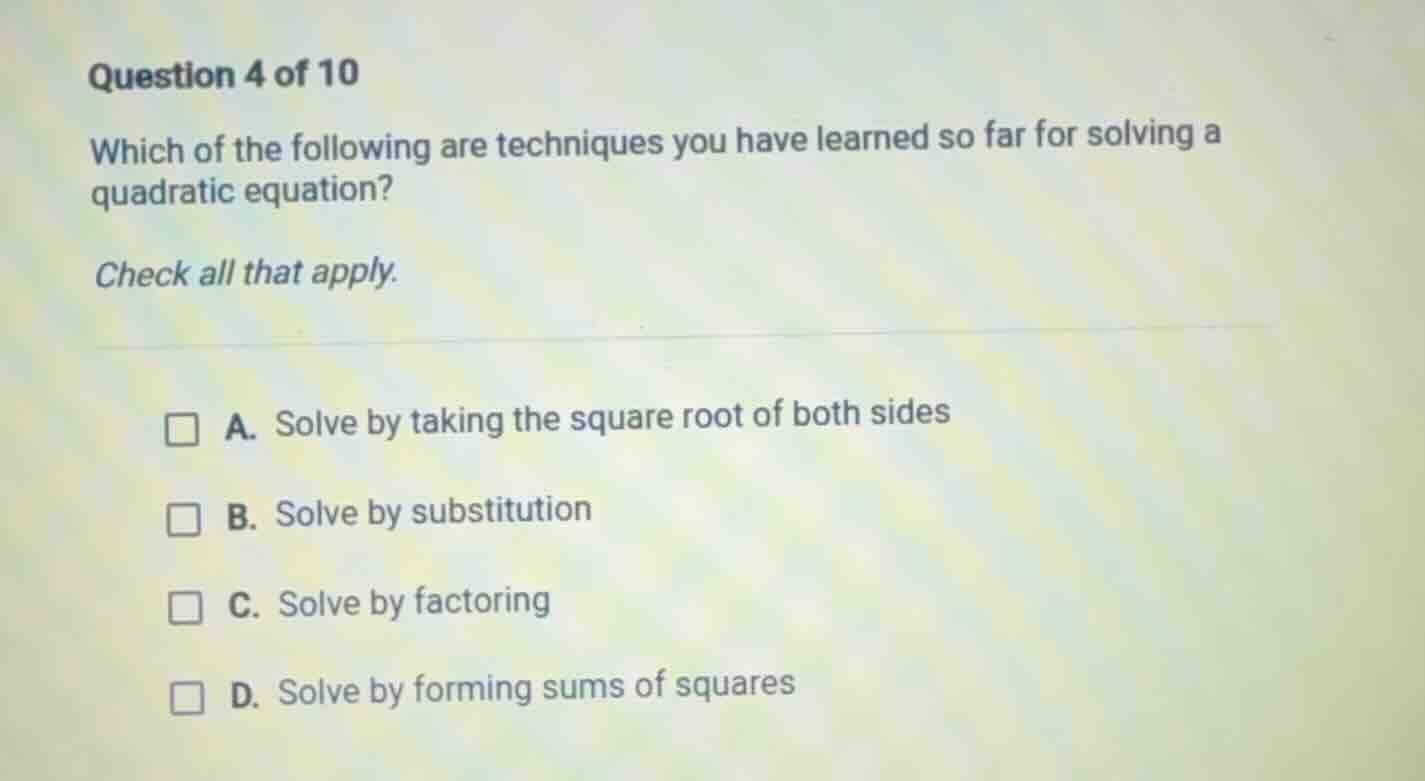
which of the following are techniques you have learned so far for solving a quadratic equation?
check all that apply.
a. solve by taking the square root of both sides
b. solve by substitution
c. solve by factoring
d. solve by forming sums of squares
Brief Explanations
- Option A: For quadratic equations in the form \(x^2 = a\) (or similar with a perfect square on one side), taking the square root of both sides is a valid technique. For example, \(x^2 = 9\) can be solved by \(\sqrt{x^2}=\pm\sqrt{9}\), giving \(x = \pm3\).
- Option B: Substitution is more commonly used in systems of equations (like linear - quadratic systems) rather than a primary technique for solving a single quadratic equation. For a single quadratic equation \(ax^{2}+bx + c = 0\), substitution is not a standard method to find the roots of the quadratic itself.
- Option C: Factoring is a common technique. If a quadratic equation \(ax^{2}+bx + c = 0\) can be factored into \((mx + n)(px+q)=0\), then by the zero - product property (\(ab = 0\) implies \(a = 0\) or \(b = 0\)), we can set each factor equal to zero and solve for \(x\). For example, \(x^{2}+5x + 6 = 0\) factors to \((x + 2)(x + 3)=0\), so \(x=-2\) or \(x=-3\).
- Option D: Forming sums of squares is not a standard technique for solving quadratic equations. Quadratic equations are typically solved by methods like factoring, completing the square, quadratic formula, or taking square roots (for perfect square cases), not by forming sums of squares.

Snap & solve any problem in the app
Get step-by-step solutions on Sovi AI
Photo-based solutions with guided steps
Explore more problems and detailed explanations
A. Solve by taking the square root of both sides, C. Solve by factoring