QUESTION IMAGE
Question
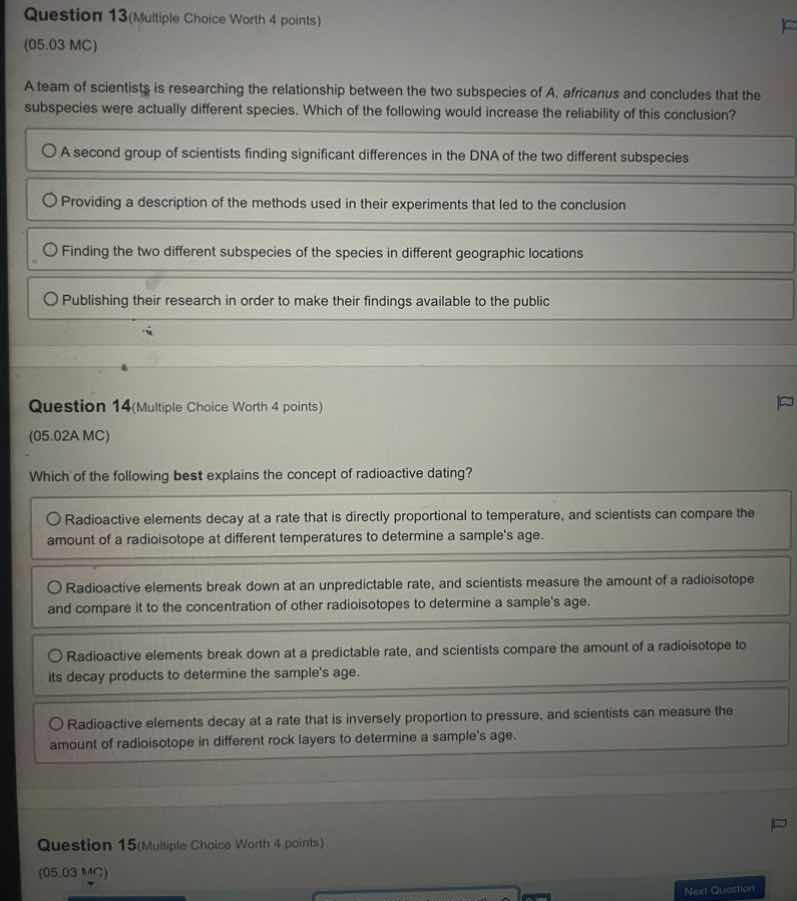
question 13 (multiple choice worth 4 points)
(05.03 mc)
a team of scientists is researching the relationship between the two subspecies of a. africanus and concludes that the subspecies were actually different species. which of the following would increase the reliability of this conclusion?
a second group of scientists finding significant differences in the dna of the two different subspecies
providing a description of the methods used in their experiments that led to the conclusion
finding the two different subspecies of the species in different geographic locations
publishing their research in order to make their findings available to the public
question 14 (multiple choice worth 4 points)
(05.02a mc)
which of the following best explains the concept of radioactive dating?
radioactive elements decay at a rate that is directly proportional to temperature, and scientists can compare the amount of a radioisotope at different temperatures to determine a sample’s age.
radioactive elements break down at an unpredictable rate, and scientists measure the amount of a radioisotope and compare it to the concentration of other radioisotopes to determine a sample’s age.
radioactive elements break down at a predictable rate, and scientists compare the amount of a radioisotope to its decay products to determine the sample’s age.
radioactive elements decay at a rate that is inversely proportion to pressure, and scientists can measure the amount of radioisotope in different rock layers to determine a sample’s age.
question 15 (multiple choice worth 4 points)
(05.03 mc)
Question 13
To increase the reliability of the conclusion that two subspecies are different species, independent verification with strong evidence (like DNA differences) is key. A second group finding significant DNA differences provides corroboration. Describing methods (good for transparency but not as strong as independent confirmation), geographic location (doesn't confirm species difference), or publishing (makes it public but doesn't add new evidence) are less effective.
Radioactive dating relies on the fact that radioactive elements decay at a predictable (constant) rate (half - life). Scientists compare the amount of the radioisotope (parent) to the amount of its decay products (daughter) to calculate the sample’s age. The other options are incorrect: decay rate is not proportional to temperature/pressure (it's constant), and it's not unpredictable (it's very predictable with a known half - life), nor is it compared to other radioisotopes.

Snap & solve any problem in the app
Get step-by-step solutions on Sovi AI
Photo-based solutions with guided steps
Explore more problems and detailed explanations
A. A second group of scientists finding significant differences in the DNA of the two different subspecies