QUESTION IMAGE
Question
question 14 of 20
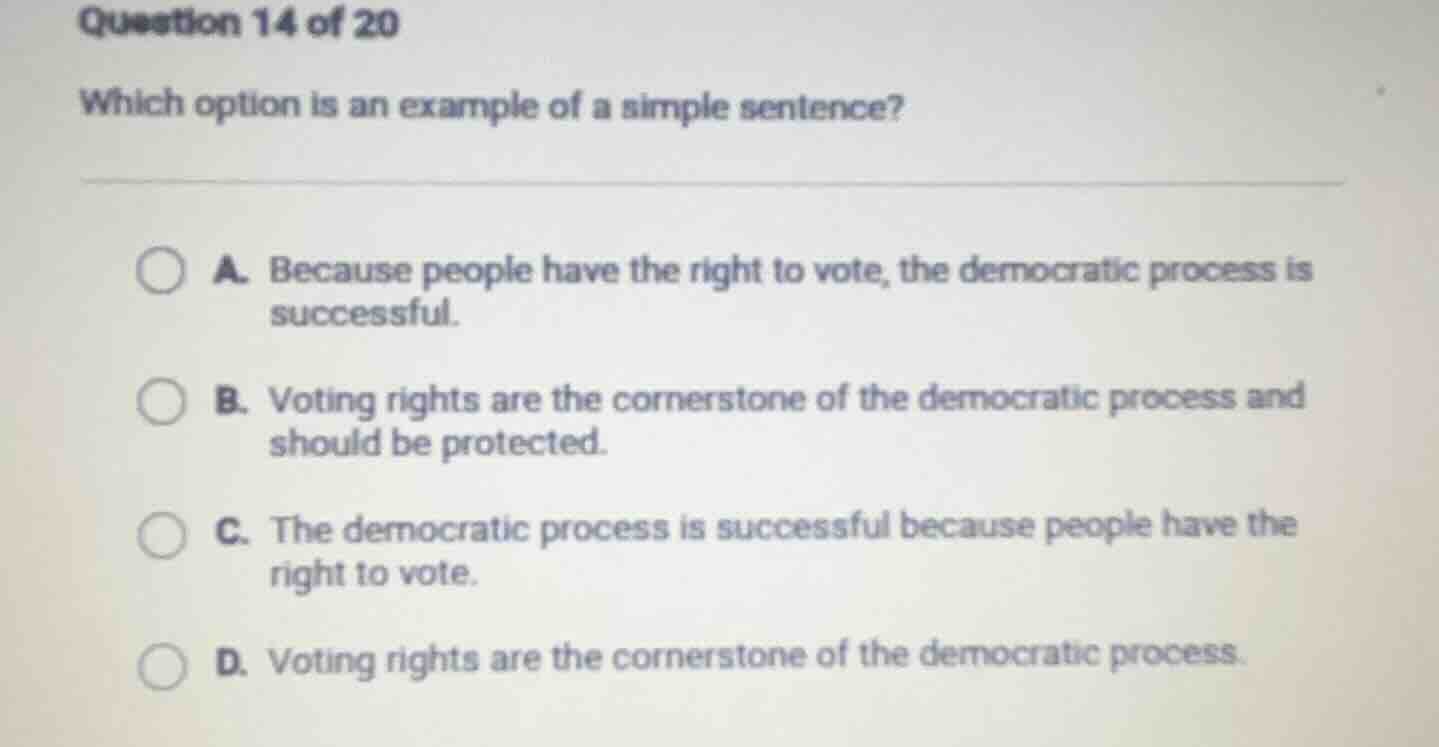
which option is an example of a simple sentence?
a. because people have the right to vote, the democratic process is successful.
b. voting rights are the cornerstone of the democratic process and should be protected.
c. the democratic process is successful because people have the right to vote.
d. voting rights are the cornerstone of the democratic process.
Brief Explanations
A simple sentence contains one independent clause (a complete thought with a subject and predicate) and no dependent clauses.
- Option A has a dependent clause ("Because people have the right to vote") and an independent clause, making it a complex sentence.
- Option B has one independent clause with a compound predicate ("are the cornerstone... and should be protected"), but this is still a single independent clause? No, correction: actually, it is a single independent clause with a compound predicate, but the key distinction is that D is a pure single independent clause with no compound parts. Wait, no: a simple sentence can have compound predicates, but the critical point is that options A and C have dependent adverbial clauses (starting with "because"), making them complex. Option B has a compound predicate, but D is a simple sentence with a single subject ("Voting rights") and single predicate ("are the cornerstone of the democratic process") with no dependent clauses or compound elements beyond the basic structure. Wait, no, the correct definition: a simple sentence is one independent clause, regardless of compound subjects/predicates, but the key here is that A and C are complex (dependent clauses), B has a compound predicate, but D is the most straightforward simple sentence with no dependent clauses and a single subject-predicate pair that forms a complete thought without compounding. The core is that simple sentences have no dependent clauses, so A and C are out. Between B and D: B has a compound predicate, but D is a pure simple sentence with one subject and one predicate, which fits the classic example of a simple sentence.

Snap & solve any problem in the app
Get step-by-step solutions on Sovi AI
Photo-based solutions with guided steps
Explore more problems and detailed explanations
D. Voting rights are the cornerstone of the democratic process.