QUESTION IMAGE
Question
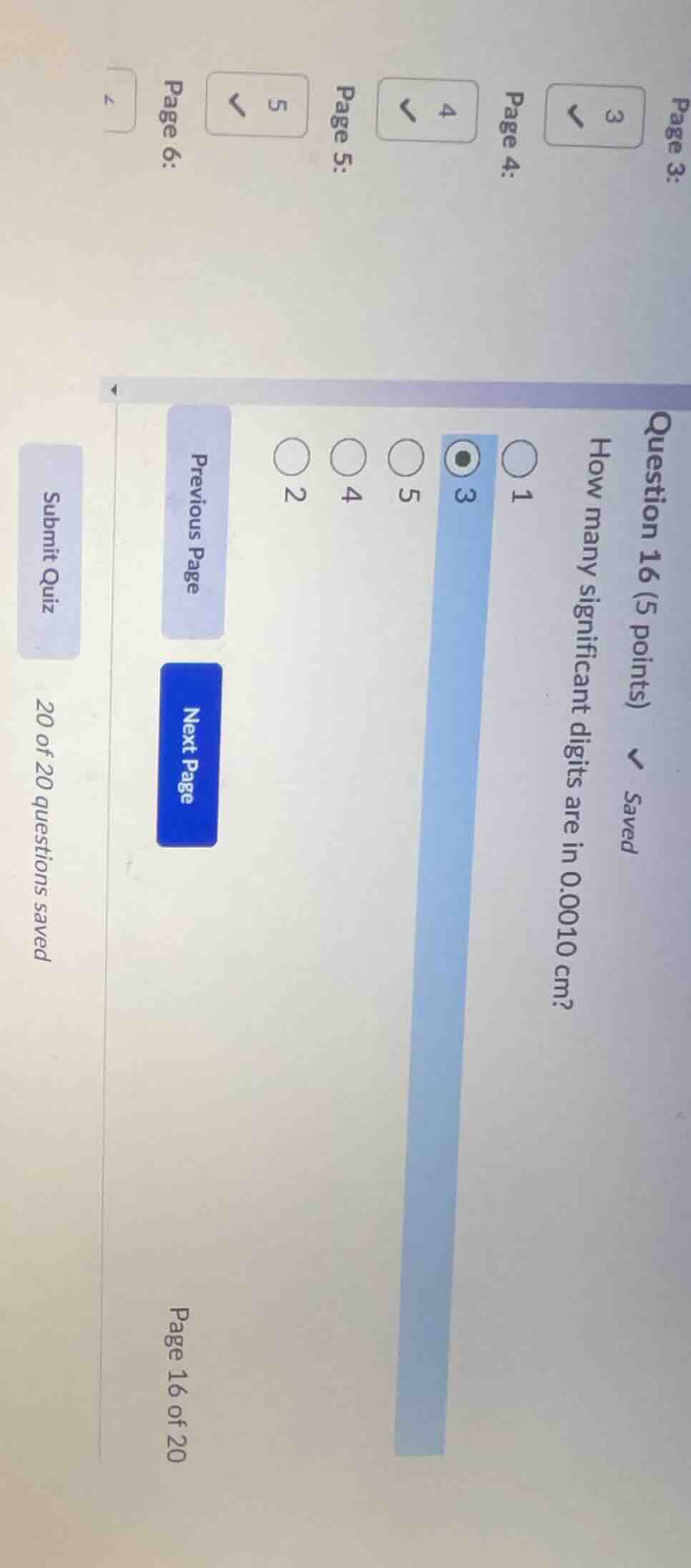
question 16 (5 points) how many significant digits are in 0.00010 cm? 1 3 5 4 2
Step1: Recall significant figure rules
Leading zeros are not significant. Non - zero digits and trailing zeros in a decimal number (after the non - zero digit) are significant. For the number \(0.00010\) cm:
- The leading zeros (the three zeros before 1) are not significant.
- The digit 1 is significant.
- The trailing zero after 1 (in the hundred - thousandths place) is significant.
Step2: Count the significant digits
We have two significant digits? Wait, no, wait. Wait, \(0.00010\): the 1 and the 0 after it. Wait, let's re - examine. The number is \(0.00010\). The first non - zero digit is 1, then the zero after 1 is also significant. So the significant digits are 1 and 0, so that's 2? Wait, no, wait, maybe I made a mistake. Wait, the number is \(0.00010\). Let's write it in scientific notation: \(1.0\times10^{- 4}\). In scientific notation, the digits in the coefficient are significant. So 1 and 0 are significant, so there are 2 significant digits? Wait, but the options have 2, 3, etc. Wait, maybe I messed up. Wait, \(0.00010\): the leading zeros (four zeros before 1) are not significant. The 1 is significant, and the zero after 1 (the fifth decimal place) is significant because it's a trailing zero in a decimal number. So that's two significant digits? But the option 2 is there. Wait, but the selected option in the picture is 3. Wait, maybe I made a mistake. Wait, let's check again. Wait, \(0.00010\): is the zero after 1 significant? Yes. So 1 and 0, that's two. But maybe the number is \(0.00010\) with a typo, like \(0.0010\)? No, the number is \(0.00010\). Wait, maybe I misread the number. Wait, the number is \(0.00010\) cm. So in \(0.00010\), the significant figures are 1 and 0, so 2. But the option 2 is present. Wait, but the user's question is about the number of significant digits in \(0.00010\) cm.
Wait, let's recall the rules again:
- All non - zero digits are significant.
- Zeros between non - zero digits are significant.
- Leading zeros (zeros before the first non - zero digit) are not significant.
- Trailing zeros in a decimal number (after the decimal point and after a non - zero digit) are significant.
For \(0.00010\):
- Leading zeros: the four zeros before 1 are not significant.
- The digit 1 is significant (non - zero).
- The zero after 1 (the fifth decimal place) is significant (trailing zero in decimal).
So that's two significant digits. So the correct answer should be 2. But the selected option in the picture is 3. Maybe there is a mistake in my reasoning. Wait, maybe the number is \(0.0010\) instead of \(0.00010\)? If it's \(0.0010\), then scientific notation is \(1.0\times10^{-3}\), which has two significant digits. If it's \(0.00010\), same. Wait, maybe the number is \(0.000100\)? No, the number is \(0.00010\). Wait, perhaps the question was \(0.0010\) and there was a typo. Alternatively, maybe I made a mistake. Wait, let's check the significant figure rules again.
Wait, another way: count the number of significant figures by looking at the digits from the first non - zero digit. For \(0.00010\), first non - zero digit is 1 (the 4th decimal place), then the next digit is 0 (5th decimal place). So that's two digits. So the number of significant digits is 2.

Snap & solve any problem in the app
Get step-by-step solutions on Sovi AI
Photo-based solutions with guided steps
Explore more problems and detailed explanations
2 (the correct option is the one labeled "2")