QUESTION IMAGE
Question
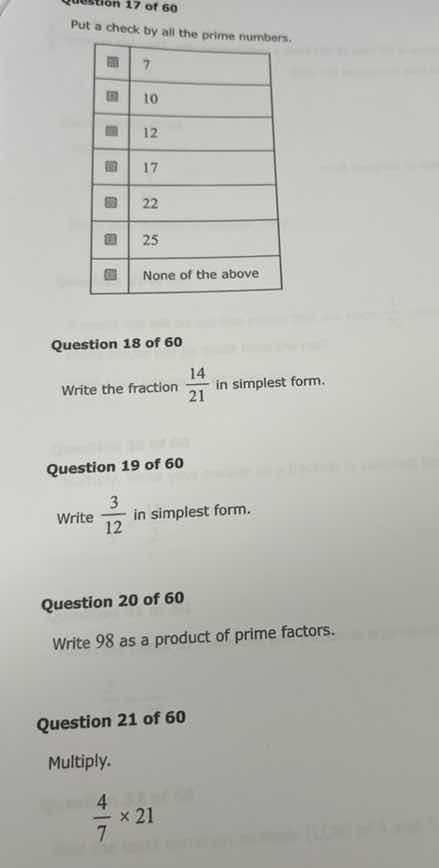
question 17 of 60
put a check by all the prime numbers.
7
10
12
17
22
25
none of the above
question 18 of 60
write the fraction \\(\frac{14}{21}\\) in simplest form.
question 19 of 60
write \\(\frac{3}{12}\\) in simplest form.
question 20 of 60
write 98 as a product of prime factors.
question 21 of 60
multiply.
\\(\frac{4}{7} \times 21\\)
Question 17
Step 1: Recall prime number definition
A prime number is a number greater than 1 that has no positive divisors other than 1 and itself.
- 7: Divisors are 1 and 7, so prime.
- 10: Divisors are 1, 2, 5, 10 (not prime).
- 12: Divisors are 1, 2, 3, 4, 6, 12 (not prime).
- 17: Divisors are 1 and 17, so prime.
- 22: Divisors are 1, 2, 11, 22 (not prime).
- 25: Divisors are 1, 5, 25 (not prime).
Step 2: Identify primes
From the list, 7 and 17 are prime.
Step 1: Find GCD of 14 and 21
The greatest common divisor (GCD) of 14 and 21. Factors of 14: \(1, 2, 7, 14\); factors of 21: \(1, 3, 7, 21\). GCD is 7.
Step 2: Divide numerator and denominator by GCD
\(\frac{14\div7}{21\div7} = \frac{2}{3}\)
Step 1: Find GCD of 3 and 12
Factors of 3: \(1, 3\); factors of 12: \(1, 2, 3, 4, 6, 12\). GCD is 3.
Step 2: Divide numerator and denominator by GCD
\(\frac{3\div3}{12\div3} = \frac{1}{4}\)

Snap & solve any problem in the app
Get step-by-step solutions on Sovi AI
Photo-based solutions with guided steps
Explore more problems and detailed explanations
- 7 (checked)
- 17 (checked)