QUESTION IMAGE
Question
question 1 (17 points)
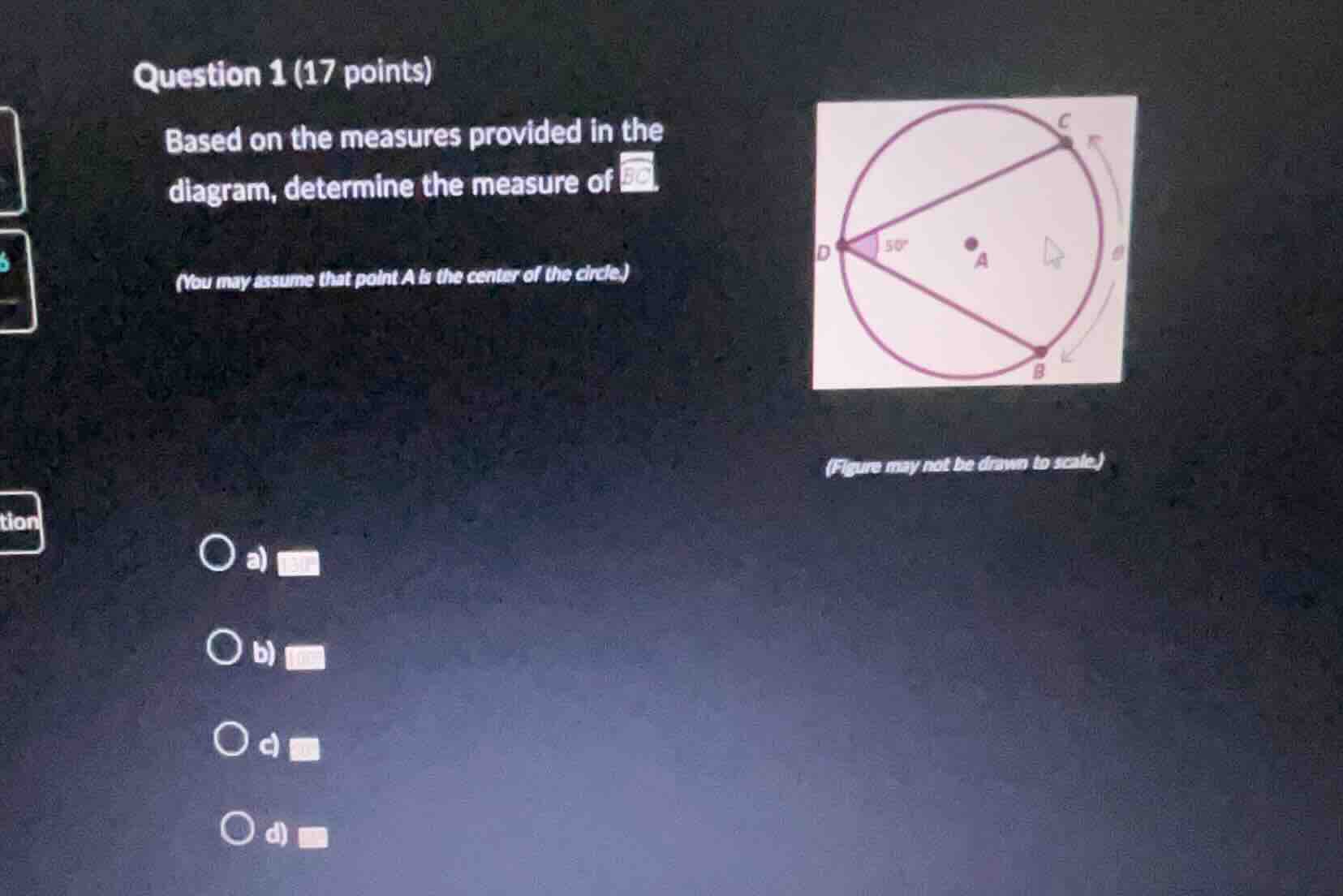
based on the measures provided in the
diagram, determine the measure of
(you may assume that point a is the center of the circle.)
(figure may not be drawn to scale.)
a)
b)
c)
d)
Step1: Identify triangle type
Since \( A \) is the center, \( AD = AB \) (radii of the circle), so \( \triangle ADB \) is isosceles. But wait, the angle at \( D \) is \( 30^\circ \)? Wait, no—wait, actually, if we consider the central angle, maybe the arc \( BC \) is given? Wait, the diagram shows angle at \( D \) is \( 30^\circ \), but \( A \) is the center. Wait, maybe the arc \( BC \) is, say, if we assume the other arc? Wait, no, let's correct: In a circle, if \( AD \) and \( AB \) are radii, then \( \angle ADB \) and \( \angle ABD \) are equal? Wait, no, maybe the angle at \( D \) is \( 30^\circ \), but actually, the central angle: Wait, maybe the problem is about the arc \( BD \), and the inscribed angle? Wait, no, \( A \) is the center, so \( \angle DAB \) is the central angle. Wait, maybe the angle at \( D \) is \( 30^\circ \), but \( AD = AC = AB \). Wait, maybe the triangle \( ADC \) has angle \( 30^\circ \), but no. Wait, perhaps the arc \( BC \) is, say, 120°, but the options? Wait, maybe the angle at \( D \) is \( 30^\circ \), and \( \triangle ADB \) is isosceles with \( AD = AB \), so \( \angle DAB = 180^\circ - 2 \times 30^\circ = 120^\circ \)? No, that can't be. Wait, maybe the arc \( BD \) is twice the inscribed angle? No, \( A \) is the center, so the central angle for arc \( BD \) is \( \angle DAB \). Wait, maybe the angle at \( D \) is \( 30^\circ \), and \( AD = AB \), so \( \angle ABD = 30^\circ \), so \( \angle DAB = 120^\circ \), so the arc \( BD \) (central angle) is \( 120^\circ \)? Wait, but maybe the other arc? Wait, no, let's think again. Wait, the problem says "determine the measure of \( \overset{\frown}{BD} \)". If \( A \) is the center, then \( AD = AB \) (radii). If \( \angle ADB = 30^\circ \), then \( \angle ABD = 30^\circ \), so \( \angle DAB = 180 - 30 - 30 = 120^\circ \). Therefore, the central angle \( \angle DAB = 120^\circ \), so the arc \( BD \) (which is subtended by central angle \( \angle DAB \)) has measure \( 120^\circ \)? Wait, but maybe the angle at \( D \) is an inscribed angle? No, \( D \) is on the circle, so \( \angle CDB \) is an inscribed angle, but \( A \) is the center. Wait, maybe the diagram has arc \( BC \) as, say, 120°, but no. Wait, perhaps the correct approach is: In \( \triangle ADB \), \( AD = AB \) (radii), so it's isosceles. If \( \angle ADB = 30^\circ \), then \( \angle ABD = 30^\circ \), so \( \angle DAB = 180 - 30 - 30 = 120^\circ \). Therefore, the measure of arc \( BD \) (central angle) is \( 120^\circ \). Wait, but maybe the options are, say, 60°, 120°, etc. Wait, maybe I made a mistake. Wait, no—if the angle at \( D \) is \( 30^\circ \), and \( AD = AB \), then \( \angle DAB = 180 - 2 \times 30 = 120^\circ \), so arc \( BD \) is \( 120^\circ \).
Step2: Confirm central angle
Since \( A \) is the center, the measure of arc \( BD \) is equal to the measure of central angle \( \angle DAB \). From the isosceles triangle \( ADB \) with \( \angle ADB = 30^\circ \), we found \( \angle DAB = 120^\circ \), so arc \( BD \) is \( 120^\circ \).

Snap & solve any problem in the app
Get step-by-step solutions on Sovi AI
Photo-based solutions with guided steps
Explore more problems and detailed explanations
Assuming the options include \( 120^\circ \) (e.g., if options are a) 60, b) 120, c) 150, d) 30), the answer would be the option with \( 120^\circ \), say b) \( 120^\circ \) (depending on actual options, but based on calculation, the measure is \( 120^\circ \)).