QUESTION IMAGE
Question
question 32
1 pts
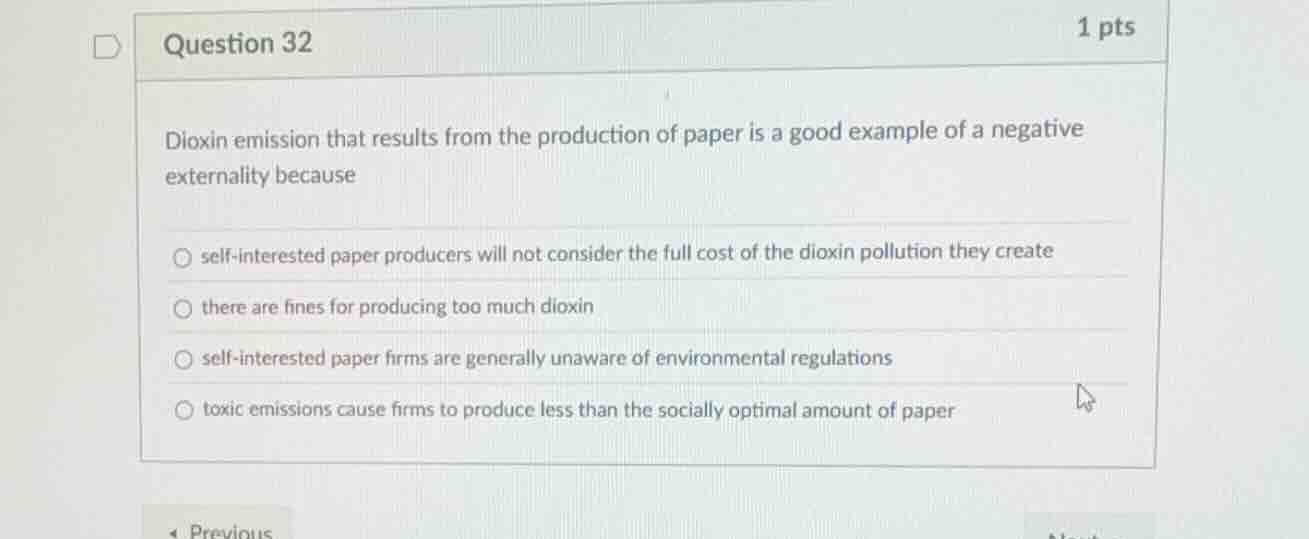
dioxin emission that results from the production of paper is a good example of a negative
externality because
self-interested paper producers will not consider the full cost of the dioxin pollution they create
there are fines for producing too much dioxin
self-interested paper firms are generally unaware of environmental regulations
toxic emissions cause firms to produce less than the socially optimal amount of paper
Brief Explanations
To determine the correct answer, we analyze each option:
- Option 1: A negative externality occurs when a third - party (not involved in the production - consumption transaction) bears costs. Self - interested paper producers, when making production decisions, only consider their private costs (like costs of raw materials, labor for paper production) and not the external cost (cost of dioxin pollution on society, e.g., health costs, environmental damage). So they don't consider the full cost (private + external) of the pollution they create. This fits the definition of a negative externality.
- Option 2: Fines for producing too much dioxin are a form of government intervention to correct the externality, not a reason why dioxin emission is a negative externality.
- Option 3: Awareness of environmental regulations is not related to the concept of a negative externality. A negative externality is about the unaccounted - for costs imposed on others, not about knowledge of regulations.
- Option 4: In the case of a negative externality, firms produce more than the socially optimal amount (because they ignore the external cost), not less. So this option is incorrect.

Snap & solve any problem in the app
Get step-by-step solutions on Sovi AI
Photo-based solutions with guided steps
Explore more problems and detailed explanations
A. self - interested paper producers will not consider the full cost of the dioxin pollution they create