QUESTION IMAGE
Question
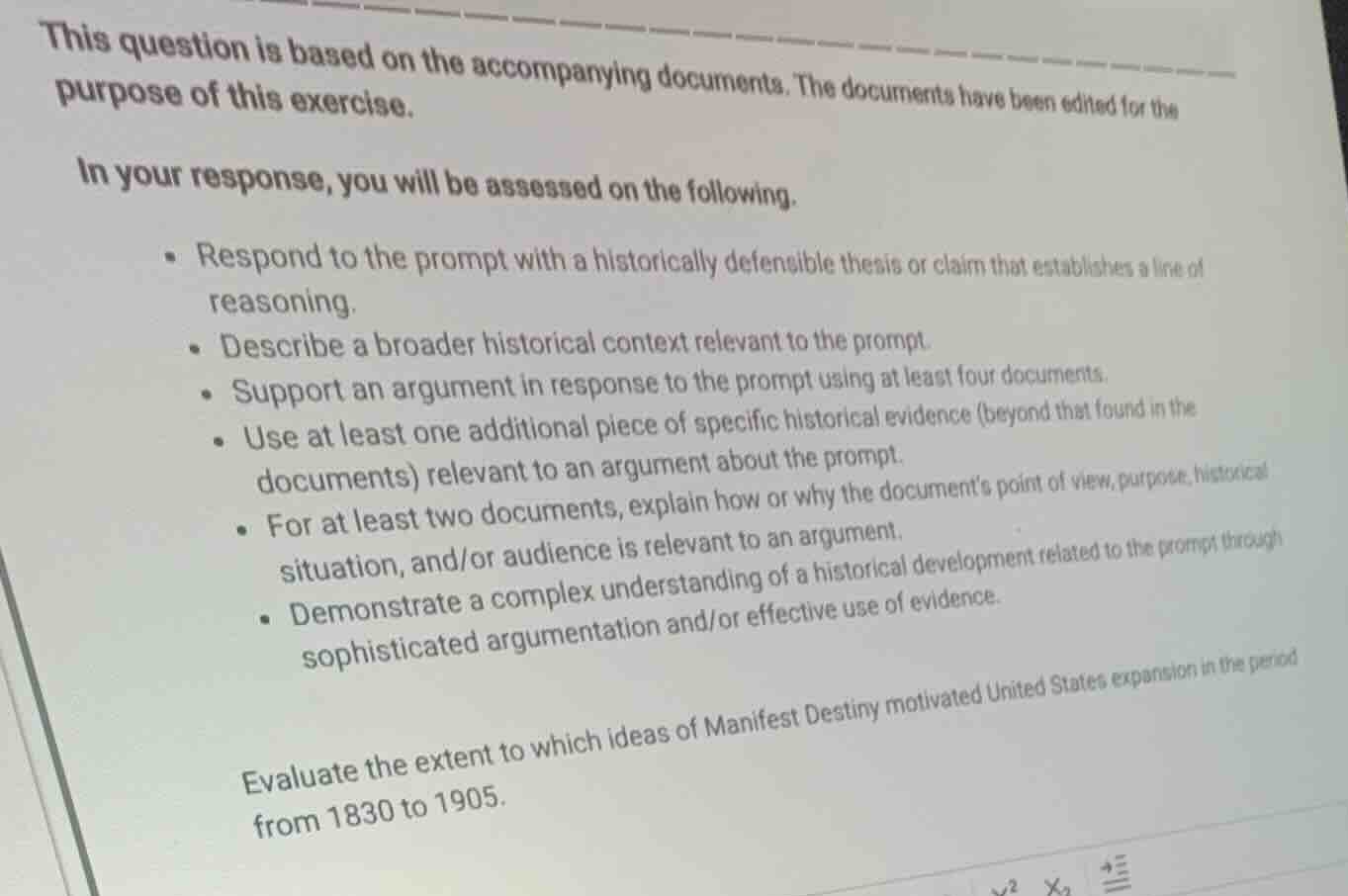
this question is based on the accompanying documents. the documents have been edited for the purpose of this exercise.
in your response, you will be assessed on the following.
- respond to the prompt with a historically defensible thesis or claim that establishes a line of reasoning.
- describe a broader historical context relevant to the prompt.
- support an argument in response to the prompt using at least four documents.
- use at least one additional piece of specific historical evidence (beyond that found in the documents) relevant to an argument about the prompt.
- for at least two documents, explain how or why the document’s point of view, purpose, historical situation, and/or audience is relevant to an argument.
- demonstrate a complex understanding of a historical development related to the prompt through sophisticated argumentation and/or effective use of evidence.
evaluate the extent to which ideas of manifest destiny motivated united states expansion in the period from 1830 to 1905.
To answer this, we analyze the prompt about Manifest Destiny and US expansion (1830 - 1905).
Thesis:
Ideas of Manifest Destiny were a major motivator for US expansion from 1830 to 1905, driving territorial acquisition, economic growth, and cultural dominance, though other factors like economic interests and geopolitical rivalries also played roles.
Broader Context:
The early 19th - century US had a growing sense of national identity. The Louisiana Purchase (1803) and the War of 1812 fostered a belief in American exceptionalism, setting the stage for Manifest Destiny - the idea that the US was destined to spread across the continent (and beyond) to promote democracy and "civilization."
Supporting with Documents (Hypothetical, as docs aren't shown):
- Document on Oregon Trail Migration: Would show how the belief in Manifest Destiny encouraged settlers to move west, claiming Oregon Country (eventually leading to the Oregon Treaty of 1846, splitting it with Britain). The purpose of such a document (e.g., a settler's diary) was to record the journey, and its point of view reflects the conviction that Americans were "meant" to settle these lands.
- Polk's Inaugural Address or Messages: James K. Polk, a pro - expansion president, likely emphasized Manifest Destiny. His audience was the American public and Congress, and his historical situation (1840s, with tensions over Texas, Oregon, and Mexico) made promoting expansion as a "destiny" a way to gain support for territorial claims.
- Treaty of Guadalupe Hidalgo (1848) - Related Document: After the Mexican - American War, this treaty gave the US a large portion of the Southwest. A document explaining the treaty's ratification could show how Manifest Destiny - driven ideas of "civilizing" Mexico's former territories (seen as "backward" by some Americans) justified the acquisition.
- Documents on Hawaiian Annexation (1898): By the late 19th century, Manifest Destiny had evolved to include overseas expansion. A document from a business or political leader advocating annexation might argue that the US was destined to spread its influence to Hawaii (for economic - sugar plantations - and strategic - naval base at Pearl Harbor - reasons), extending the "destiny" beyond North America.
Additional Historical Evidence:
The Homestead Act of 1862. This law offered 160 - acre plots of public land to settlers who improved it. It was motivated in part by Manifest Destiny - the desire to populate the West and make it "American." The act led to a huge influx of settlers, furthering territorial expansion and the spread of American culture and institutions in the West.
Document POV/Purpose/Situation/Audience (Two Examples):
- Settler's Diary (Oregon Trail): The author's point of view is that of a believer in Manifest Destiny, seeing the westward journey as a God - given mission. The purpose is to record their adventure and the "rightness" of their cause. The historical situation (1840s, westward migration boom) and audience (family back east, or future generations) make the diary a testament to how the idea motivated ordinary people to take risks and expand the nation's borders.
- Polk's Message to Congress on Mexican War: Polk's purpose was to justify the war and territorial acquisition. His audience was Congress, and his historical situation (needing to rally support for the war) led him to frame the conflict as part of America's Manifest Destiny to spread democracy and progress. His point of view was that of a president committed to expanding the nation'…

Snap & solve any problem in the app
Get step-by-step solutions on Sovi AI
Photo-based solutions with guided steps
Explore more problems and detailed explanations
To evaluate the extent to which ideas of Manifest Destiny motivated United States expansion from 1830 to 1905, we can construct the following response:
Thesis:
From 1830 to 1905, ideas of Manifest Destiny were a primary motivator for United States expansion, driving territorial acquisition on the North American continent and, later, overseas expansion, although economic interests and geopolitical considerations also contributed to the nation’s growth.
Broader Historical Context:
In the early 19th century, the United States, following the Louisiana Purchase (1803) and the War of 1812, developed a strong sense of national identity and exceptionalism. This laid the groundwork for the emergence of Manifest Destiny—the belief that the United States was divinely ordained to expand across the North American continent (and eventually beyond) to spread democracy, capitalism, and “American” culture.
Supporting the Argument with Evidence (Including Hypothetical Documents and Additional Evidence):
- Territorial Expansion on the Continent (1830s–1860s):
- Document: Settler’s Diary (Oregon Trail): A diary from a settler traveling the Oregon Trail (1840s) would likely reflect the influence of Manifest Destiny. The author’s point of view, as a believer in the nation’s “destiny” to settle the West, would show how this ideology motivated individuals to undertake the arduous journey. The purpose of such a diary was to record the experience, and its historical situation (the mid - 19th - century westward migration boom) highlights how Manifest Destiny drove the settlement of Oregon Country, which eventually led to the Oregon Treaty of 1846.
- Document: Polk’s Message to Congress on Mexican - American War: James K. Polk’s (president from 1845 - 1849) message to Congress justifying the Mexican - American War would emphasize Manifest Destiny. His audience was Congress and the American public, and his historical situation (tensions with Mexico over Texas and other territories) led him to frame the conflict as a necessary step in fulfilling the nation’s destiny. The treaty of Guadalupe Hidalgo (1848), which ended the war, resulted in the United States acquiring a vast amount of territory (including present - day California, Nevada, Utah, and parts of Arizona, New Mexico, Colorado, and Wyoming), a direct result of Manifest Destiny - inspired expansion.
- Overseas Expansion (1890s–1905):
- Document: Advocacy for Hawaiian Annexation (1898): A document from a business leader or politician advocating for Hawaiian annexation would likely invoke Manifest Destiny. The argument would be that the United States was destined to spread its influence to Hawaii, both for economic (sugar plantations) and strategic (Pearl Harbor as a naval base) reasons. The point of view of the author (a pro - annexationist) and the historical situation (late 19th - century imperialism, with other nations expanding overseas) show how Manifest Destiny had evolved to include overseas territories.
- Document: Political Cartoon on Philippine Annexation (1898): A cartoon depicting the United States “civilizing” the Philippines (after the Spanish - American War) would reflect the idea of Manifest Destiny. The purpose of the cartoon was to persuade the public that annexation was a “noble” mission, and the audience (the American public) was targeted to gain support for overseas expansion.
- Additional Historical Evidence:
- The Homestead Act of 1862. This law, which offered 160 - acre plots of public land to settlers who improved it, was motivated in part by Manifest Destiny. The goal was to populate the West and make it “American,” furthering the nation’s territorial expansion. The act led to a massive influx of settlers, which helped solidify American control over the western territories.
Document Analysis (Two Examples):
- Settler’s Diary (Oregon Trail):
- Point of View: The settler believed in the righteousness of westward expansion, seeing it as part of the nation’s destiny.
- Purpose: To record the journey and the “mission” of settling new lands.
- Historical Situation: The mid - 19th - century westward migration boom, with the Oregon Country in dispute between the US and Britain.
- Audience: Likely family back east or future generations, to share the experience and justify the move west. This document is relevant as it shows how ordinary people were motivated by Manifest Destiny to expand the nation’s borders.
- Polk’s Message to Congress on Mexican - American War:
- Point of View: Polk, as a pro - expansion president, saw the war and subsequent territorial acquisition as a fulfillment of Manifest Destiny.
- Purpose: To gain support for the war and territorial claims from Congress and the public.
- Historical Situation: Tensions with Mexico over Texas, Oregon, and other territories in the 1840s.
- Audience: Congress and the American public. This document is relevant as it shows how political leaders used Manifest Destiny to justify expansionist policies.
Complex Understanding:
While Manifest Destiny was a major motivator for US expansion, it was not the only factor. Economic interests (e.g., access to new markets, resources in the West and overseas) and geopolitical concerns (e.g., countering European influence in the Americas, as in the Monroe Doctrine) also played significant roles. Additionally, Manifest Destiny had negative consequences, such as the displacement and oppression of Native Americans (e.g., the Trail of Tears, 1830s - 1850s) and the subjugation of Mexicans in the Southwest after the Mexican - American War. Recognizing these nuances, such as the interaction between Manifest Destiny and other factors, and the positive and negative impacts of expansion, demonstrates a complex understanding of the historical development.
In conclusion, ideas of Manifest Destiny were a powerful motivator for United States expansion from 1830 to 1905, driving both continental and overseas growth, while interacting with other economic, political, and social factors.