QUESTION IMAGE
Question
question
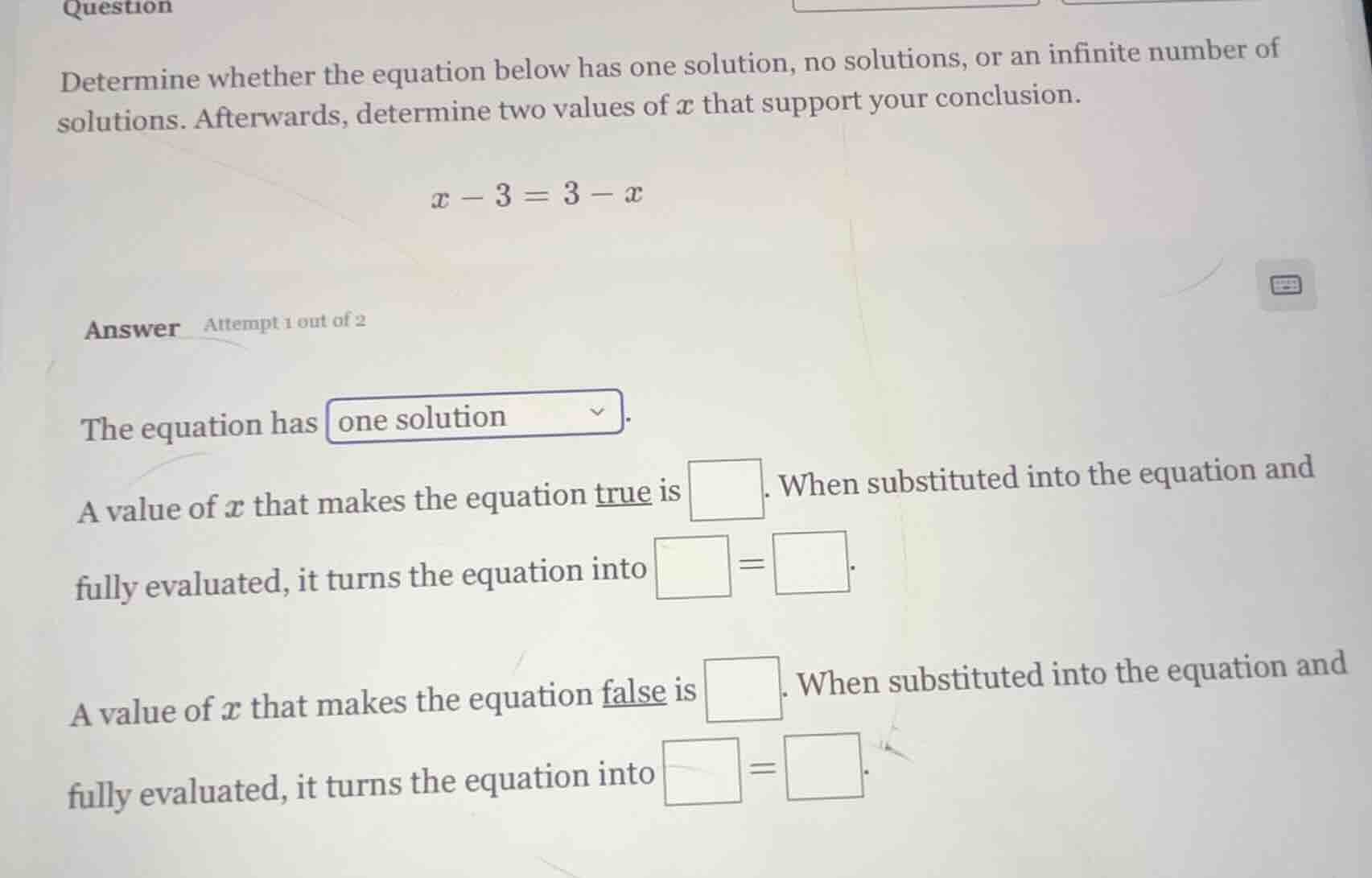
determine whether the equation below has one solution, no solutions, or an infinite number of solutions. afterwards, determine two values of ( x ) that support your conclusion.
( x - 3 = 3 - x )
answer attempt 1 out of 2
the equation has one solution (downarrow).
a value of ( x ) that makes the equation true is (square). when substituted into the equation and fully evaluated, it turns the equation into (square = square).
a value of ( x ) that makes the equation false is (square). when substituted into the equation and fully evaluated, it turns the equation into (square = square).
Step1: Solve the equation \(x - 3 = 3 - x\)
Add \(x\) to both sides: \(x + x - 3 = 3 - x + x\) → \(2x - 3 = 3\)
Add 3 to both sides: \(2x - 3 + 3 = 3 + 3\) → \(2x = 6\)
Divide by 2: \(x = 3\)
So the equation has one solution (\(x = 3\)).
Step2: Find a value that makes it true (use \(x = 3\))
Substitute \(x = 3\) into \(x - 3 = 3 - x\):
Left side: \(3 - 3 = 0\)
Right side: \(3 - 3 = 0\)
So \(0 = 0\).
Step3: Find a value that makes it false (use \(x = 0\))
Substitute \(x = 0\) into \(x - 3 = 3 - x\):
Left side: \(0 - 3 = -3\)
Right side: \(3 - 0 = 3\)
So \(-3 = 3\) (which is false).

Snap & solve any problem in the app
Get step-by-step solutions on Sovi AI
Photo-based solutions with guided steps
Explore more problems and detailed explanations
The equation has one solution.
A value of \(x\) that makes the equation true is \(3\). When substituted into the equation and fully evaluated, it turns the equation into \(0 = 0\).
A value of \(x\) that makes the equation false is \(0\). When substituted into the equation and fully evaluated, it turns the equation into \(-3 = 3\).
(Note: The false value can be any number except 3, e.g., \(x = 1\) would give \(1 - 3 = -2\) and \(3 - 1 = 2\), so \(-2 = 2\), also valid.)