QUESTION IMAGE
Question
question
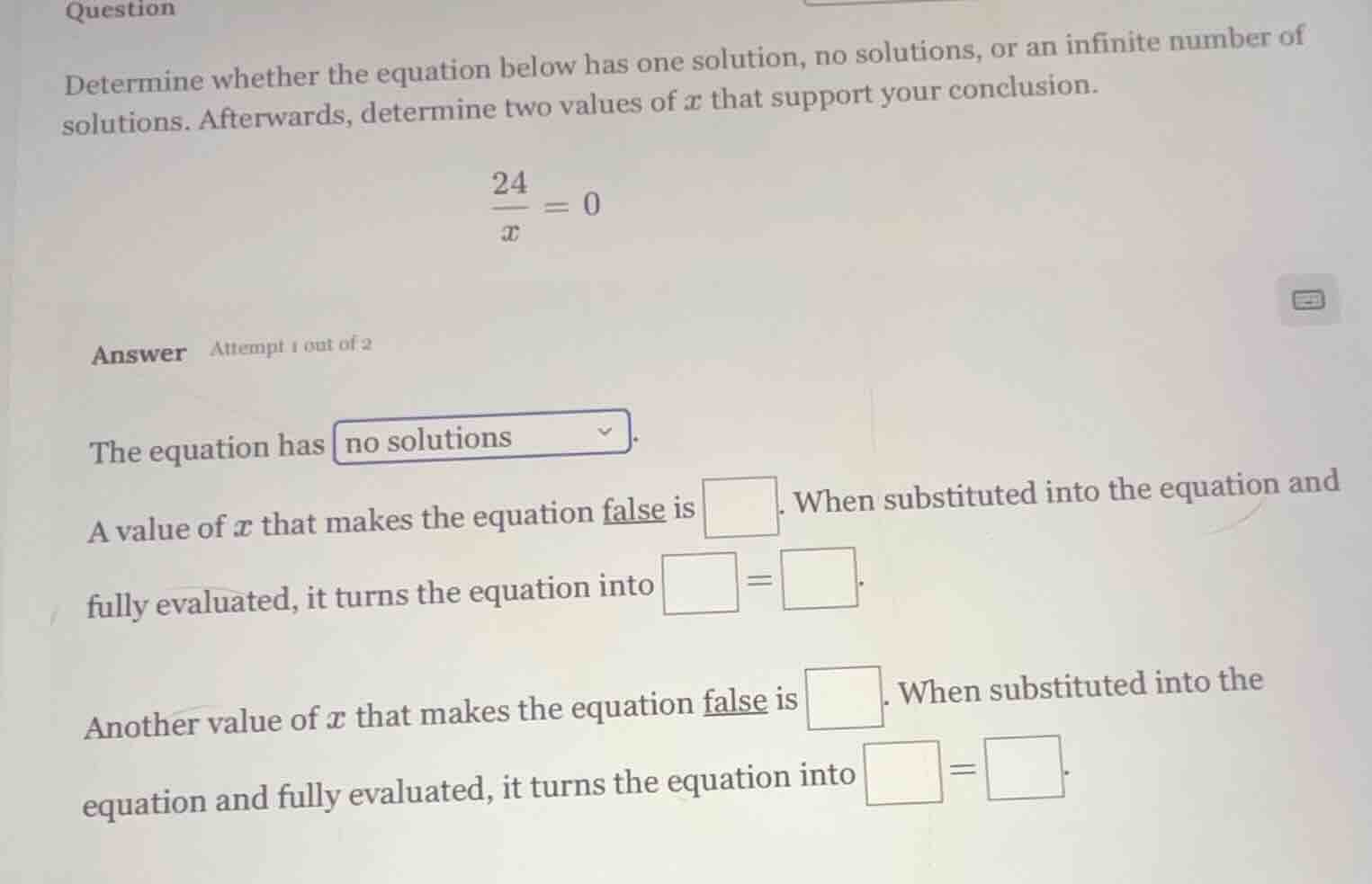
determine whether the equation below has one solution, no solutions, or an infinite number of solutions. afterwards, determine two values of x that support your conclusion.
\\(\frac{24}{x} = 0\\)
answer attempt 1 out of 2
the equation has no solutions
a value of x that makes the equation false is \\(\square\\). when substituted into the equation and fully evaluated, it turns the equation into \\(\square = \square\\).
another value of x that makes the equation false is \\(\square\\). when substituted into the equation and fully evaluated, it turns the equation into \\(\square = \square\\).
Step1: Analyze the equation $\frac{24}{x}=0$
For a fraction $\frac{a}{b}$ (where $a = 24$ and $b=x$), the value of the fraction is zero only when the numerator $a = 0$ and the denominator $b
eq0$. Here, the numerator $24
eq0$, so there is no value of $x$ (since $x$ is in the denominator, $x
eq0$ as well) that can make $\frac{24}{x}=0$ true.
Step2: Test $x = 1$
Substitute $x = 1$ into the equation: $\frac{24}{1}=24$, so the equation becomes $24 = 0$, which is false.
Step3: Test $x = 2$
Substitute $x = 2$ into the equation: $\frac{24}{2}=12$, so the equation becomes $12 = 0$, which is false.

Snap & solve any problem in the app
Get step-by-step solutions on Sovi AI
Photo-based solutions with guided steps
Explore more problems and detailed explanations
The equation has no solutions.
A value of $x$ that makes the equation false is $1$. When substituted into the equation and fully evaluated, it turns the equation into $24 = 0$.
Another value of $x$ that makes the equation false is $2$. When substituted into the equation and fully evaluated, it turns the equation into $12 = 0$.
(Note: Other non - zero values of $x$ can also be used, like $x = 3$ (giving $\frac{24}{3}=8$ and $8 = 0$), etc.)