QUESTION IMAGE
Question
question
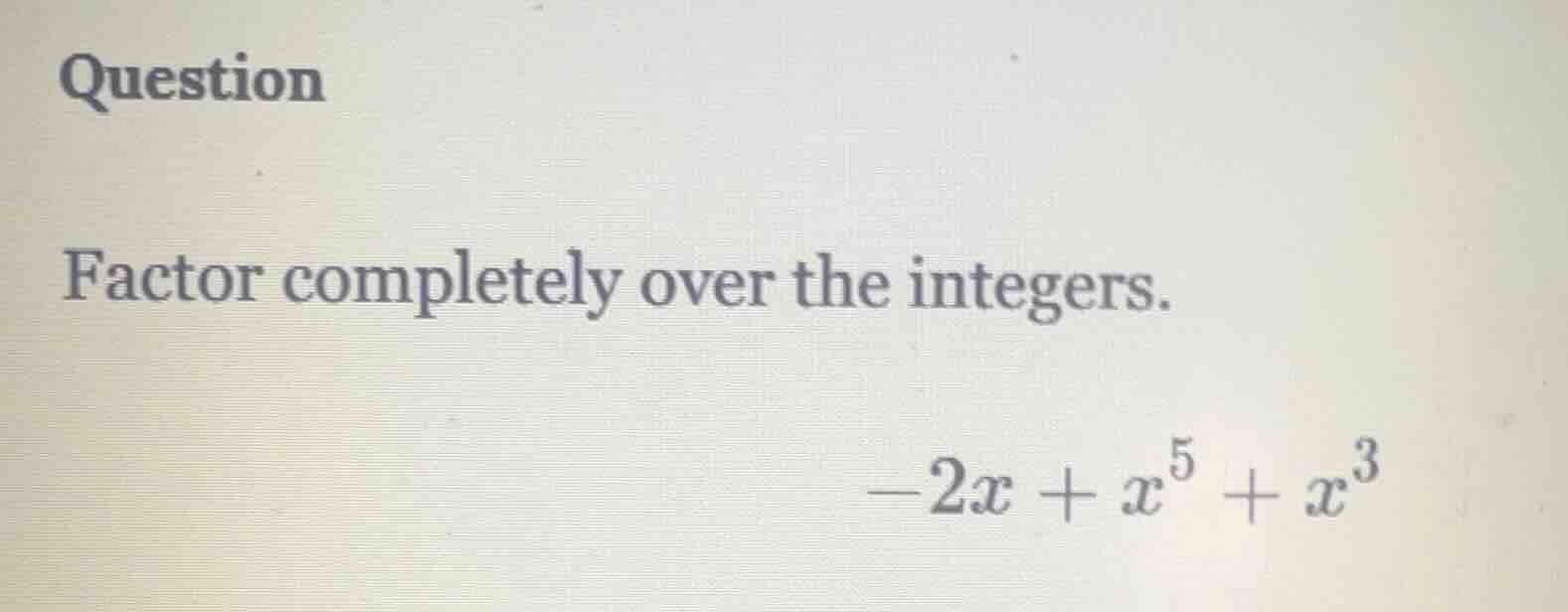
factor completely over the integers.
$-2x + x^5 + x^3$
Step1: Rearrange the terms
First, we rearrange the given polynomial \(-2x + x^5 + x^3\) in descending order of exponents. So we get \(x^5 + x^3 - 2x\).
Step2: Factor out the greatest common factor (GCF)
The GCF of the terms \(x^5\), \(x^3\), and \(-2x\) is \(x\). Factoring out \(x\) from each term, we have:
\(x(x^4 + x^2 - 2)\)
Step3: Factor the quadratic in terms of \(y = x^2\)
Let \(y = x^2\). Then the quadratic expression \(x^4 + x^2 - 2\) becomes \(y^2 + y - 2\). We factor this quadratic:
We need two numbers that multiply to \(-2\) and add to \(1\). The numbers are \(2\) and \(-1\). So,
\(y^2 + y - 2=(y + 2)(y - 1)\)
Step4: Substitute back \(y = x^2\)
Substituting back \(y = x^2\) into \((y + 2)(y - 1)\), we get \((x^2 + 2)(x^2 - 1)\)
Step5: Factor the difference of squares
The term \(x^2 - 1\) is a difference of squares, which factors as \((x + 1)(x - 1)\)
Step6: Combine all the factors
Putting it all together, the completely factored form of the original polynomial is:
\(x(x^2 + 2)(x + 1)(x - 1)\)

Snap & solve any problem in the app
Get step-by-step solutions on Sovi AI
Photo-based solutions with guided steps
Explore more problems and detailed explanations
\(x(x^2 + 2)(x + 1)(x - 1)\)