QUESTION IMAGE
Question
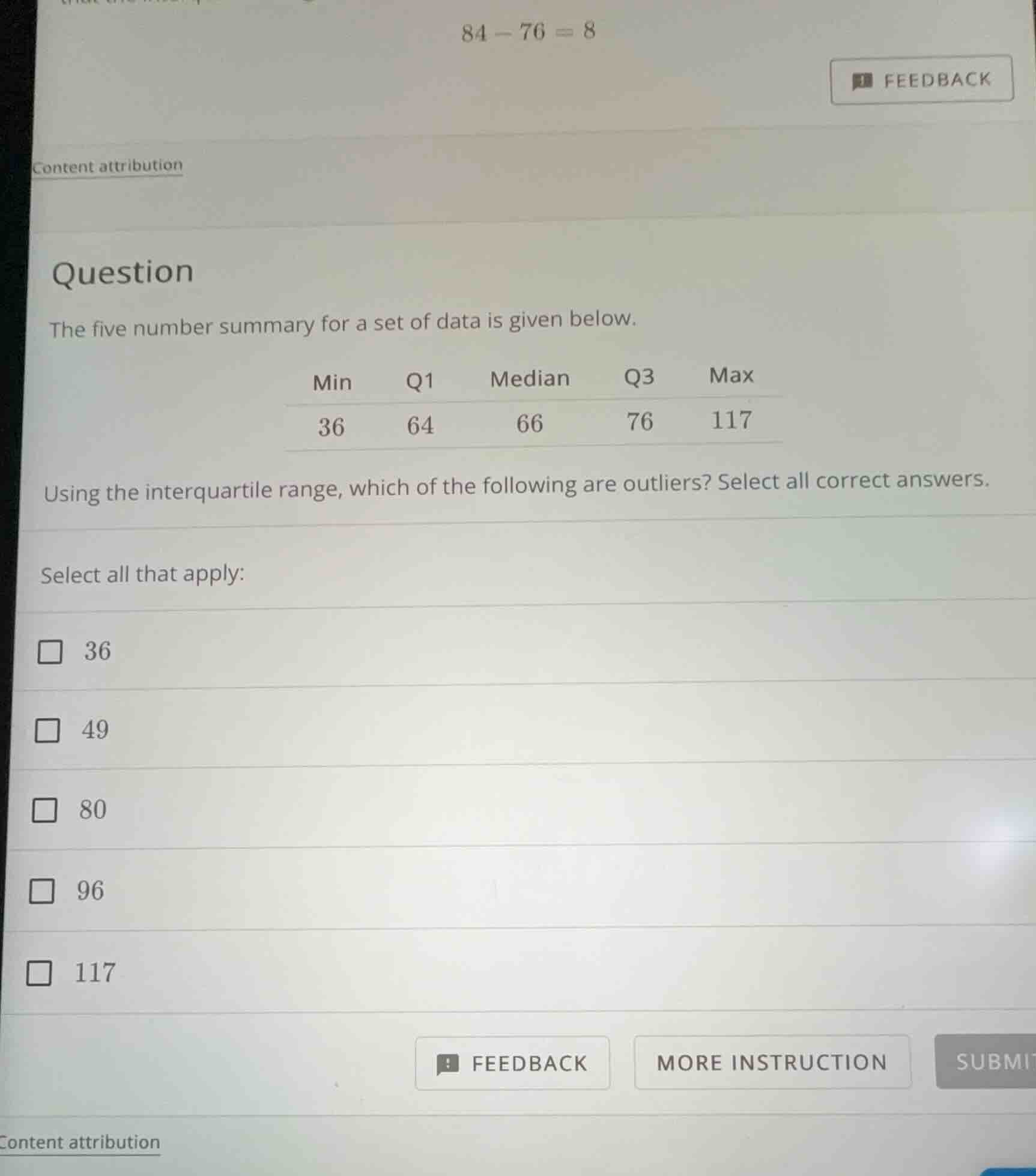
question the five number summary for a set of data is given below. min q1 median q3 max 36 64 66 76 117 using the interquartile range, which of the following are outliers? select all correct answers. select all that apply: 36 49 80 96 117
Step1: Calculate IQR
IQR = Q3 - Q1 = 76 - 64 = 12
Step2: Find lower bound
Lower bound = Q1 - 1.5IQR = 64 - 1.512 = 64 - 18 = 46
Step3: Find upper bound
Upper bound = Q3 + 1.5IQR = 76 + 1.512 = 76 + 18 = 94
Step4: Check each number
- 36: 36 < 46? No, 36 is not less than 46 (wait, 36 < 46? Yes, 36 is less than 46? Wait 46 is lower bound. Wait 36 < 46, so check if 36 is an outlier. Wait 36 is the Min, but according to lower bound 46, numbers less than 46 are outliers? Wait no, lower bound is Q1 - 1.5IQR = 46, so numbers less than 46 are outliers. 36 < 46, so 36 is an outlier? Wait no, wait the Min is 36, but let's recalculate. Wait IQR is 12, 1.5IQR is 18. Q1 is 64, so lower bound is 64 - 18 = 46. So any number less than 46 is an outlier. 36 is less than 46, so 36 is an outlier. Then 49: 49 > 46 and 49 < 94, so not an outlier. 80: 80 < 94, not an outlier. 96: 96 > 94? 96 > 94, so 96 is an outlier? Wait 96 > 94, so 96 is an outlier. 117: 117 > 94, so 117 is an outlier? Wait wait, upper bound is 94, so numbers greater than 94 are outliers. So 96 and 117 are greater than 94, so they are outliers. Wait but let's check again.
Wait original five number summary: Min=36, Q1=64, Median=66, Q3=76, Max=117.
IQR = 76 - 64 = 12.
Lower bound = 64 - 1.5*12 = 64 - 18 = 46.
Upper bound = 76 + 1.5*12 = 76 + 18 = 94.
So numbers less than 46 or greater than 94 are outliers.
Now check each option:
- 36: 36 < 46? Yes, so 36 is an outlier? Wait but 36 is the Min, but according to the lower bound, 36 is less than 46, so it's an outlier.
- 49: 49 is between 46 and 94, so not an outlier.
- 80: 80 is between 46 and 94, so not an outlier.
- 96: 96 > 94, so outlier.
- 117: 117 > 94, so outlier.
Wait but the options are 36, 49, 80, 96, 117.
Wait so 36 (less than 46), 96 (greater than 94), 117 (greater than 94) are outliers.
Wait but let's check 36: the Min is 36, but according to the outlier rule, if the Min is less than the lower bound, then it's an outlier. So 36 is less than 46, so it's an outlier. Then 96 and 117 are greater than 94, so they are outliers.
Wait but the options given are 36, 49, 80, 96, 117.
So correct outliers are 36, 96, 117? Wait but let's check 36 again. Wait the lower bound is 46, so any data point less than 46 is an outlier. 36 is less than 46, so it's an outlier. 49 is greater than 46, so not. 80 is between 46 and 94, not. 96 is greater than 94, so outlier. 117 is greater than 94, so outlier.
Wait but the original Min is 36, but according to the outlier rule, if the data point is less than Q1 - 1.5IQR or greater than Q3 + 1.5IQR, it's an outlier. So 36 is less than 46 (Q1 - 1.5IQR), so it's an outlier. 96 is greater than 94 (Q3 + 1.5IQR), so outlier. 117 is greater than 94, so outlier.
So the outliers are 36, 96, 117.
Wait but let's check the options again. The options are 36, 49, 80, 96, 117.
So 36: outlier, 96: outlier, 117: outlier.
Wait but maybe I made a mistake. Let's recalculate:
IQR = Q3 - Q1 = 76 - 64 = 12.
1.5*IQR = 18.
Lower fence = Q1 - 1.5*IQR = 64 - 18 = 46.
Upper fence = Q3 + 1.5*IQR = 76 + 18 = 94.
So any data point below 46 or above 94 is an outlier.
Now check each value:
- 36: 36 < 46 → outlier.
- 49: 46 ≤ 49 ≤ 94 → not outlier.
- 80: 46 ≤ 80 ≤ 94 → not outlier.
- 96: 96 > 94 → outlier.
- 117: 117 > 94 → outlier.
So the outliers are 36, 96, 117.

Snap & solve any problem in the app
Get step-by-step solutions on Sovi AI
Photo-based solutions with guided steps
Explore more problems and detailed explanations
36, 96, 117