QUESTION IMAGE
Question
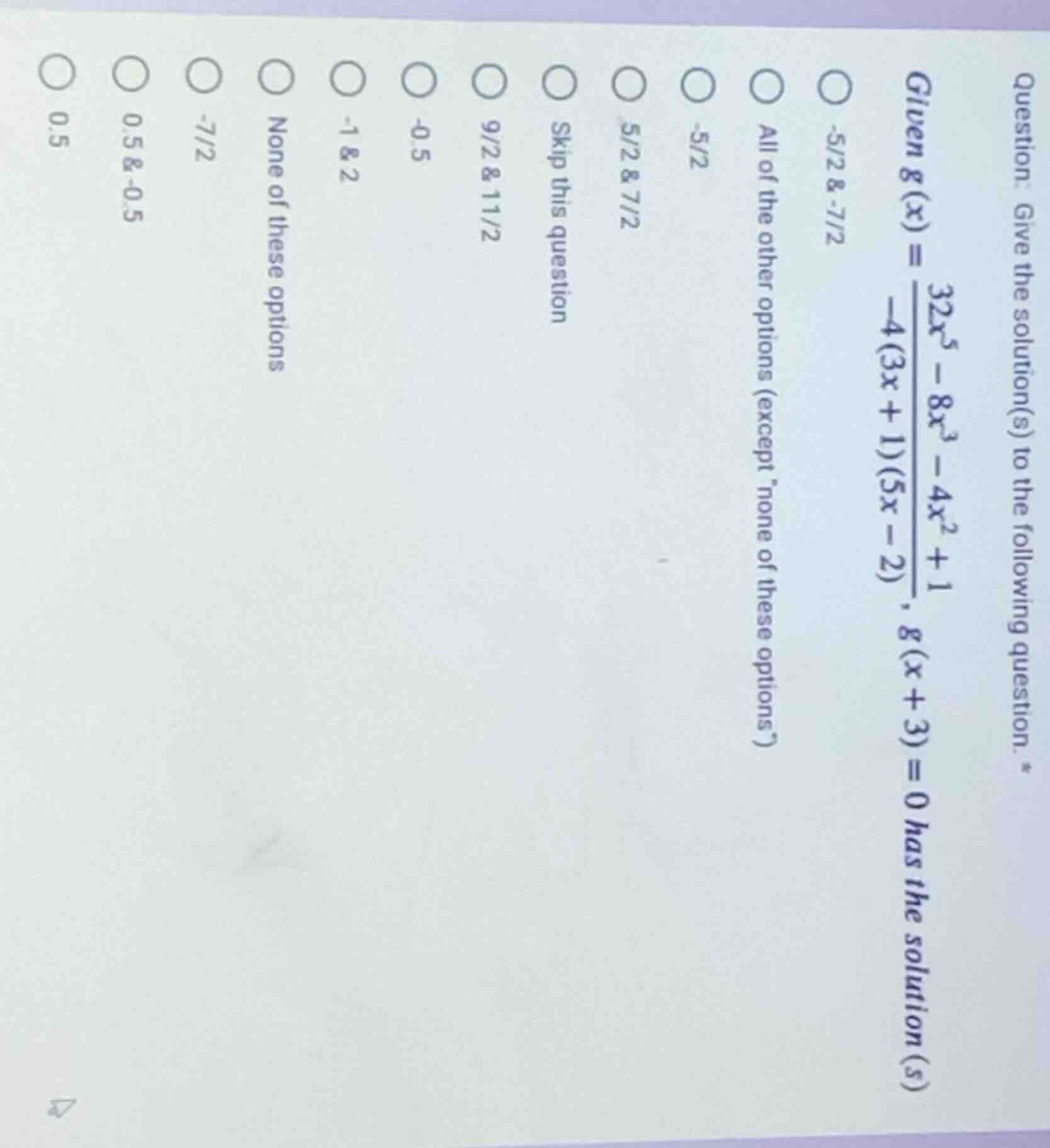
question: give the solution(s) to the following question. * given ( g(x) = \frac{32x^5 - 8x^3 - 4x^2 + 1}{-4(3x + 1)(5x - 2)} ), ( g(x + 3) = 0 ) has the solution(s) (-5/2 & -7/2) all of the other options (except none of these options) (-5/2) (5/2 & 7/2) skip this question (9/2 & 11/2) (-0.5) (-1 & 2) none of these options (-7/2) (0.5 & -0.5) (0.5)
Step1: Set \( g(x + 3)=0 \)
We know that \( g(x)=\frac{32x^{5}-8x^{3}-4x^{2}+1}{-4(3x + 1)(5x - 2)} \), so \( g(x + 3)=\frac{32(x + 3)^{5}-8(x + 3)^{3}-4(x + 3)^{2}+1}{-4(3(x + 3)+1)(5(x + 3)-2)} = 0\). A fraction is zero when its numerator is zero (and denominator is not zero). So we set the numerator equal to zero: \( 32(x + 3)^{5}-8(x + 3)^{3}-4(x + 3)^{2}+1 = 0\). Let \( t=x + 3\), then the equation becomes \( 32t^{5}-8t^{3}-4t^{2}+1 = 0\).
Step2: Try to factor the numerator
We can try to factor by grouping or trial and error. Let's try to find roots of \( 32t^{5}-8t^{3}-4t^{2}+1 = 0\) by testing some simple values. Let's try \( t=\frac{1}{2}\): \( 32\times(\frac{1}{2})^{5}-8\times(\frac{1}{2})^{3}-4\times(\frac{1}{2})^{2}+1=32\times\frac{1}{32}-8\times\frac{1}{8}-4\times\frac{1}{4}+1 = 1 - 1 - 1 + 1=0\). So \( t - \frac{1}{2}\) is a factor.
We perform polynomial division or use synthetic division to factor \( 32t^{5}-8t^{3}-4t^{2}+1\) by \( t-\frac{1}{2}\). After factoring, we get \( (t - \frac{1}{2})(32t^{4}+16t^{3}+0t^{2}-4t - 2)=0\). We can further factor the quartic. Let's try \( t =-\frac{1}{2}\) in the quartic \( 32t^{4}+16t^{3}-4t - 2\): \( 32\times(-\frac{1}{2})^{4}+16\times(-\frac{1}{2})^{3}-4\times(-\frac{1}{2})-2=32\times\frac{1}{16}+16\times(-\frac{1}{8}) + 2 - 2=2 - 2+2 - 2 = 0\). So \( t+\frac{1}{2}\) is a factor.
After factoring out \( (t - \frac{1}{2})(t+\frac{1}{2})\) from the quartic, we get \( (t - \frac{1}{2})(t+\frac{1}{2})(32t^{3}+0t^{2}-4)=0\). Then \( 32t^{3}-4 = 0\Rightarrow t^{3}=\frac{4}{32}=\frac{1}{8}\Rightarrow t=\frac{1}{2}\) (we already have this root).
So the roots of the numerator are \( t=\frac{1}{2}\) and \( t =-\frac{1}{2}\).
Step3: Solve for \( x \)
Since \( t=x + 3\), for \( t=\frac{1}{2}\): \( x+3=\frac{1}{2}\Rightarrow x=\frac{1}{2}-3=-\frac{5}{2}\). For \( t =-\frac{1}{2}\): \( x + 3=-\frac{1}{2}\Rightarrow x=-\frac{1}{2}-3=-\frac{7}{2}\).
Now we need to check the denominator \( -4(3(x + 3)+1)(5(x + 3)-2)\) for these values of \( x \).
For \( x =-\frac{5}{2}\): \( 3(x + 3)+1=3(-\frac{5}{2}+3)+1=3(\frac{1}{2})+1=\frac{3}{2}+1=\frac{5}{2}
eq0\), \( 5(x + 3)-2=5(-\frac{5}{2}+3)-2=5(\frac{1}{2})-2=\frac{5}{2}-2=\frac{1}{2}
eq0\).
For \( x =-\frac{7}{2}\): \( 3(x + 3)+1=3(-\frac{7}{2}+3)+1=3(-\frac{1}{2})+1=-\frac{3}{2}+1=-\frac{1}{2}
eq0\), \( 5(x + 3)-2=5(-\frac{7}{2}+3)-2=5(-\frac{1}{2})-2=-\frac{5}{2}-2=-\frac{9}{2}
eq0\).
So the solutions are \( x =-\frac{5}{2}\) and \( x=-\frac{7}{2}\).

Snap & solve any problem in the app
Get step-by-step solutions on Sovi AI
Photo-based solutions with guided steps
Explore more problems and detailed explanations
-5/2 & -7/2