QUESTION IMAGE
Question
question 5 of 8
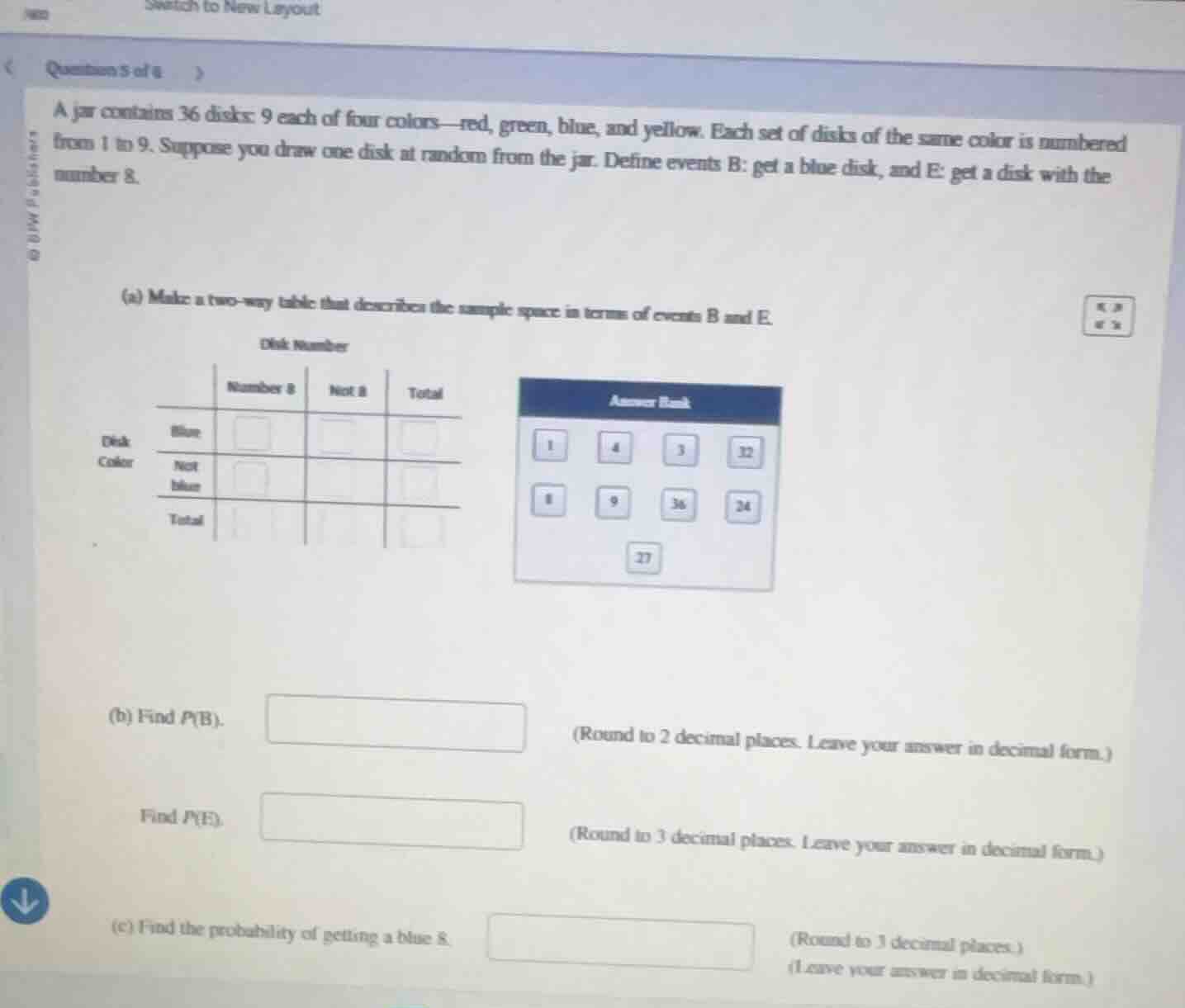
a jar contains 36 disks: 9 each of four colors—red, green, blue, and yellow. each set of disks of the same color is numbered from 1 to 9. suppose you draw one disk at random from the jar. define events b: get a blue disk, and e: get a disk with the number 8.
(a) make a two - way table that describes the sample space in terms of events b and e.
disk color
| number 8 | not 8 | total | |
|---|---|---|---|
| not blue | |||
| total |
answer bank
1, 4, 3, 32, 8, 9, 36, 24, 27
(b) find p(b). (round to 2 decimal places. leave your answer in decimal form.)
find p(e). (round to 3 decimal places. leave your answer in decimal form.)
(c) find the probability of getting a blue 8. (round to 3 decimal places. leave your answer in decimal form.)
Part (a)
We have a total of 36 disks (9 of each color: red, green, blue, yellow). Each color has disks numbered 1 - 9.
- For the "Blue" row:
- Number 8: There is 1 blue disk with number 8.
- Not 8: There are \(9 - 1 = 8\) blue disks that are not 8.
- Total for blue: \(9\) (since there are 9 blue disks).
- For the "Not blue" row:
- Number 8: There are 3 other colors (red, green, yellow), each with a disk numbered 8, so \(3\) disks.
- Not 8: Total non - blue disks are \(36 - 9=27\). Subtract the number of non - blue disks with number 8 (\(3\)): \(27 - 3 = 24\).
- Total for not blue: \(27\) (since \(36-9 = 27\)).
- For the "Total" row:
- Number 8: There are 4 colors, each with a disk numbered 8, so \(4\) disks.
- Not 8: Total disks minus number 8 disks: \(36 - 4=32\).
- Total: \(36\) (total number of disks).
So the two - way table is:
| Disk Color \ Disk Number | Number 8 | Not 8 | Total |
|---|---|---|---|
| Not blue | 3 | 24 | 27 |
| Total | 4 | 32 | 36 |
Part (b) - \(P(B)\)
The probability of an event \(B\) (getting a blue disk) is given by the number of favorable outcomes (number of blue disks) divided by the total number of possible outcomes (total number of disks).
- Step 1: Identify the number of blue disks and total disks.
The number of blue disks \(n(B)=9\), and the total number of disks \(N = 36\).
- Step 2: Calculate the probability.
The formula for probability is \(P(B)=\frac{n(B)}{N}\). Substituting the values, we get \(P(B)=\frac{9}{36}=0.25\).
for \(P(E)\)
The probability of an event \(E\) (getting a disk with number 8) is given by the number of favorable outcomes (number of disks with number 8) divided by the total number of possible outcomes (total number of disks).
- Step 1: Identify the number of disks with number 8 and total disks.
The number of disks with number 8 \(n(E) = 4\) (one for each color: red, green, blue, yellow), and the total number of disks \(N=36\).
- Step 2: Calculate the probability.
Using the formula \(P(E)=\frac{n(E)}{N}\), we substitute \(n(E) = 4\) and \(N = 36\). So \(P(E)=\frac{4}{36}\approx0.111\) (rounded to 3 decimal places).
Part (c) - Probability of getting a blue 8

Snap & solve any problem in the app
Get step-by-step solutions on Sovi AI
Photo-based solutions with guided steps
Explore more problems and detailed explanations
The probability of getting a blue 8 is the number of blue disks with number 8 divided by the total number of disks.
- Step 1: Identify the number of blue disks with number 8 and total disks.
The number of blue disks with number 8 \(n = 1\), and the total number of disks \(N=36\).
- Step 2: Calculate the probability.
Using the formula \(P=\frac{n}{N}\), we get \(P=\frac{1}{36}\approx0.028\) (rounded to 3 decimal places).
Final Answers
(a)
The two - way table is as shown above.
(b)
- \(P(B)=\boldsymbol{0.25}\)
- \(P(E)=\boldsymbol{0.111}\)
(c)
The probability of getting a blue 8 is \(\boldsymbol{0.028}\)