QUESTION IMAGE
Question
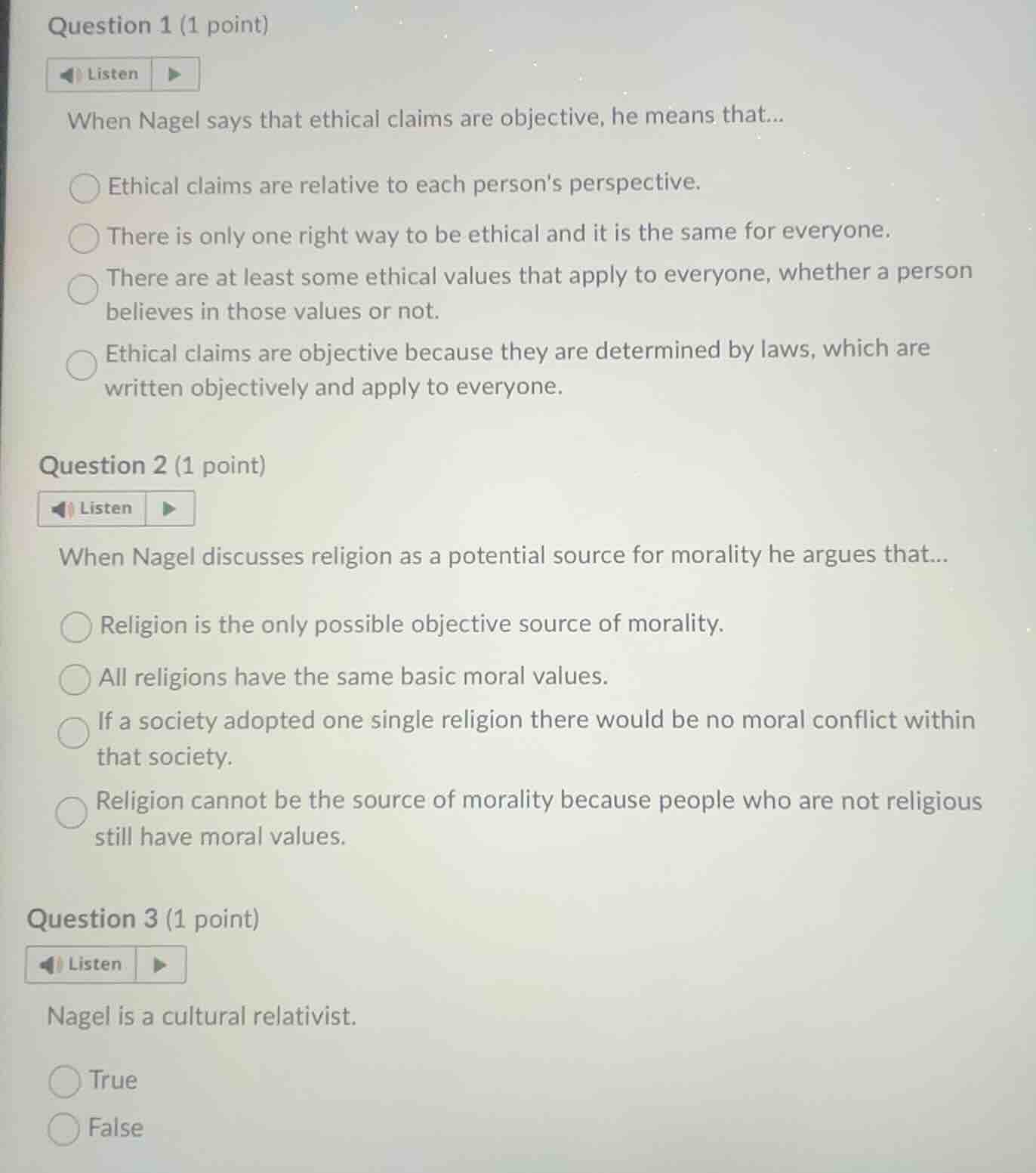
question 1 (1 point)
listen
when nagel says that ethical claims are objective, he means that...
ethical claims are relative to each person’s perspective.
there is only one right way to be ethical and it is the same for everyone.
there are at least some ethical values that apply to everyone, whether a person believes in those values or not.
ethical claims are objective because they are determined by laws, which are written objectively and apply to everyone.
question 2 (1 point)
listen
when nagel discusses religion as a potential source for morality he argues that...
religion is the only possible objective source of morality.
all religions have the same basic moral values.
if a society adopted one single religion there would be no moral conflict within that society.
religion cannot be the source of morality because people who are not religious still have moral values.
question 3 (1 point)
listen
nagel is a cultural relativist.
true
false
For Question 1: Thomas Nagel's account of ethical objectivity holds that some moral values are universally binding regardless of individual belief, rejecting pure relativism, overly rigid universalism, and tying ethics solely to human laws.
For Question 2: Nagel argues that morality cannot originate from religion because non-religious people still possess and adhere to moral values, undermining religion as a necessary source.
For Question 3: Nagel explicitly rejects cultural relativism, arguing for objective moral standards that transcend cultural norms, so he is not a cultural relativist.

Snap & solve any problem in the app
Get step-by-step solutions on Sovi AI
Photo-based solutions with guided steps
Explore more problems and detailed explanations
- There are at least some ethical values that apply to everyone, whether a person believes in those values or not.
- Religion cannot be the source of morality because people who are not religious still have moral values.
- False