QUESTION IMAGE
Question
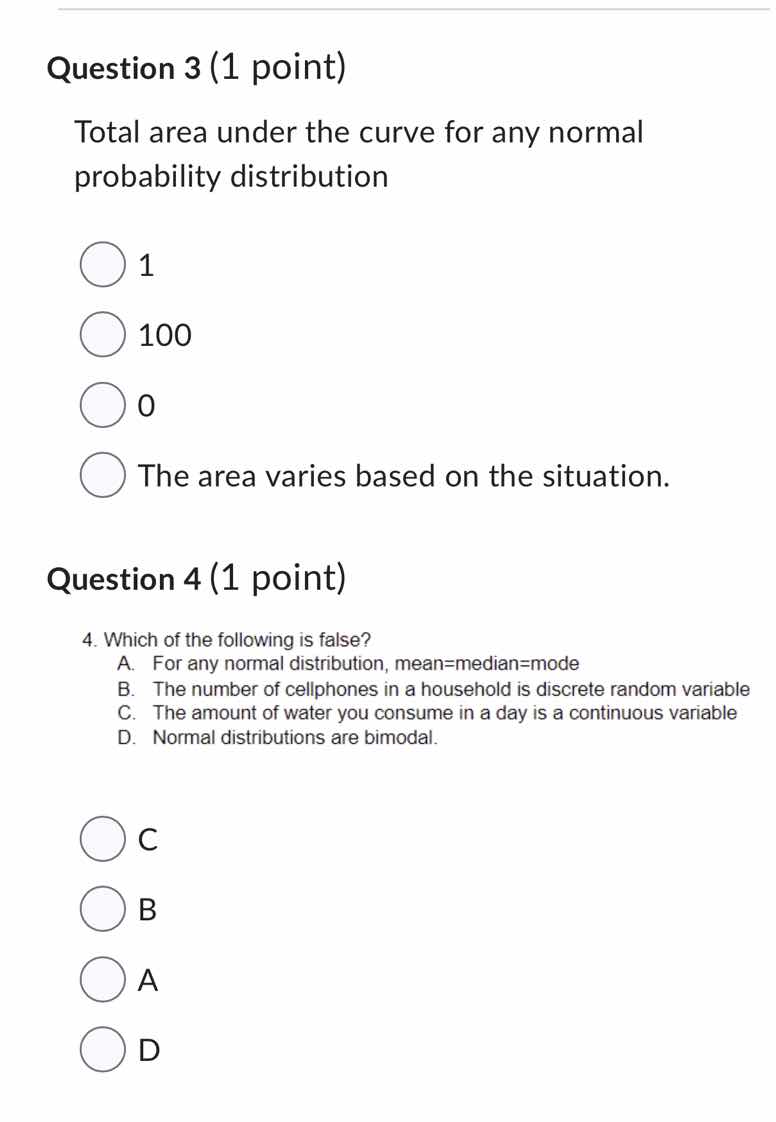
question 3 (1 point)
total area under the curve for any normal
probability distribution
1
100
0
the area varies based on the situation.
question 4 (1 point)
- which of the following is false?
a. for any normal distribution, mean=median=mode
b. the number of cellphones in a household is discrete random variable
c. the amount of water you consume in a day is a continuous variable
d. normal distributions are bimodal.
c
b
a
d
Question 3
Step1: Recall normal distribution properties
In a normal probability distribution, the total area under the curve represents the total probability, which is always 1 (or 100% when expressed as a percentage, but in terms of the area value, it's 1). The other options (100, 0, or varying) are incorrect because the total probability in any probability distribution (including normal) must sum to 1.
- Option A: In a normal distribution, it's symmetric, so mean = median = mode. This is true.
- Option B: The number of cellphones is a countable (discrete) random variable. This is true.
- Option C: Water consumption can take any value (continuous), so this is true.
- Option D: Normal distributions are unimodal (one mode), not bimodal. So this is false.

Snap & solve any problem in the app
Get step-by-step solutions on Sovi AI
Photo-based solutions with guided steps
Explore more problems and detailed explanations
1