QUESTION IMAGE
Question
question 9 (1 point)
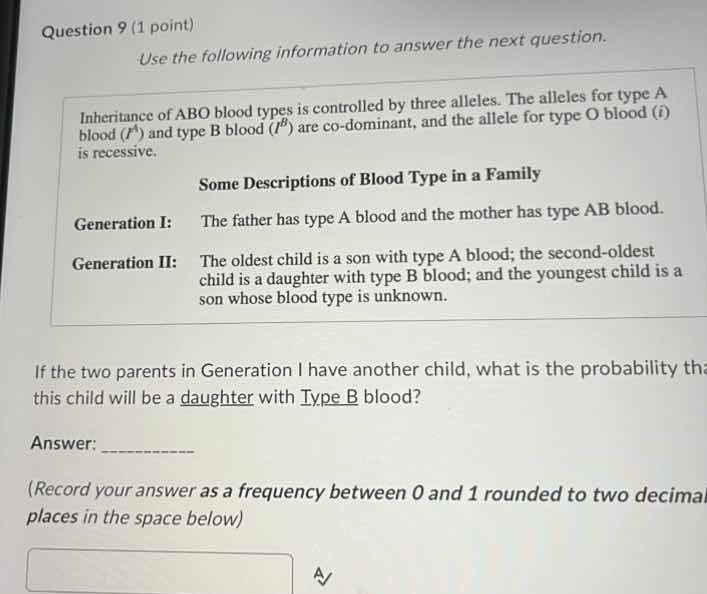
use the following information to answer the next question.
inheritance of abo blood types is controlled by three alleles. the alleles for type a blood ((i^a)) and type b blood ((i^b)) are co - dominant, and the allele for type o blood (i) is recessive.
some descriptions of blood type in a family
generation i: the father has type a blood and the mother has type ab blood.
generation ii: the oldest child is a son with type a blood; the second - oldest child is a daughter with type b blood; and the youngest child is a son whose blood type is unknown.
if the two parents in generation i have another child, what is the probability that this child will be a daughter with type b blood?
answer:
(record your answer as a frequency between 0 and 1 rounded to two decimal places in the space below)
Step1: Determine parental genotypes
Father has type A blood. Since one child has type B blood (genotype \(I^B i\) or \(I^B I^B\), but mother is \(I^A I^B\), so father must be \(I^A i\) (because to have a child with B blood, father must contribute \(i\) as mother contributes \(I^B\)). Mother is \(I^A I^B\) (type AB).
Step2: Find possible gametes
Father (\(I^A i\)) produces gametes: \(I^A\), \(i\) (each with probability \(0.5\)).
Mother (\(I^A I^B\)) produces gametes: \(I^A\), \(I^B\) (each with probability \(0.5\)).
Step3: Determine possible offspring genotypes for blood type B
Blood type B requires genotype with \(I^B\). So:
- Father’s \(i\) + Mother’s \(I^B\): \(I^B i\) (type B).
- Father’s \(I^A\) + Mother’s \(I^B\): \(I^A I^B\) (type AB, not B).
So only when father gives \(i\) and mother gives \(I^B\), offspring has type B. Probability of this: \(P(\text{father } i) \times P(\text{mother } I^B) = 0.5 \times 0.5 = 0.25\).
Step4: Probability of daughter
Probability of female offspring is \(0.5\) (since sex ratio is 50% male, 50% female).
Step5: Combine probabilities
Probability of daughter with type B blood = Probability (type B) × Probability (daughter) = \(0.25 \times 0.5 = 0.125\), rounded to two decimal places is \(0.13\)? Wait, wait, let's recheck. Wait, father's genotype: let's confirm. Father is type A, mother is AB. Children: oldest son A, second daughter B. So for daughter to be B, her genotype is \(I^B i\) (since mother is AB, she can give \(I^B\), father must give \(i\)). So father's genotype: if he were \(I^A I^A\), he can't give \(i\), so he must be \(I^A i\). So gametes: father: \(I^A\) (0.5), \(i\) (0.5); mother: \(I^A\) (0.5), \(I^B\) (0.5).
Offspring with type B: only when father gives \(i\) and mother gives \(I^B\): \(i \times I^B\) → probability \(0.5 \times 0.5 = 0.25\) (for blood type B). Then probability of daughter: 0.5. So total probability: \(0.25 \times 0.5 = 0.125\), which is \(0.13\) when rounded to two decimals? Wait, 0.125 rounded to two decimals is 0.13? Wait, no: 0.125 is exactly halfway, but typically rounded to 0.13? Wait, no, 0.125 rounded to two decimal places: the third digit is 5, so round up the second digit: 0.13. Wait, but let's recalculate the blood type probability again. Wait, possible offspring genotypes:
Father (\(I^A i\)) × Mother (\(I^A I^B\)):
| Father \ Mother | \(I^A\) (0.5) | \(I^B\) (0.5) |
|---|---|---|
| \(i\) (0.5) | \(I^A i\) (A) | \(I^B i\) (B) |
So the probability of type B blood: number of type B genotypes over total. Total possible genotypes: 4 (each cell is 0.5×0.5=0.25 probability). Type B is \(I^B i\), which is 1 cell (probability 0.25). So probability of type B is \(0.25\). Then probability of daughter: 0.5. So \(0.25 \times 0.5 = 0.125\), which is \(0.13\) when rounded to two decimal places? Wait, 0.125 rounded to two decimals: the second decimal is 2, third is 5, so we round up the second decimal: 0.13. Wait, but maybe I made a mistake in father's genotype. Wait, is father \(I^A I^A\) possible? If father is \(I^A I^A\), then his gametes are only \(I^A\). Then offspring with mother \(I^A I^B\) would be \(I^A I^A\) (A), \(I^A I^B\) (AB). No type B offspring, but there is a daughter with type B, so father must be \(I^A i\). So that part is correct. So probability of type B: 0.25, probability of daughter: 0.5, so 0.25*0.5=0.125, rounded to two decimals is 0.13? Wait, 0.125 is exactly 1/8, which is 0.125, so when rounded to two decimal places, it's 0.1…

Snap & solve any problem in the app
Get step-by-step solutions on Sovi AI
Photo-based solutions with guided steps
Explore more problems and detailed explanations
0.13