QUESTION IMAGE
Question
question 3 (1 point)
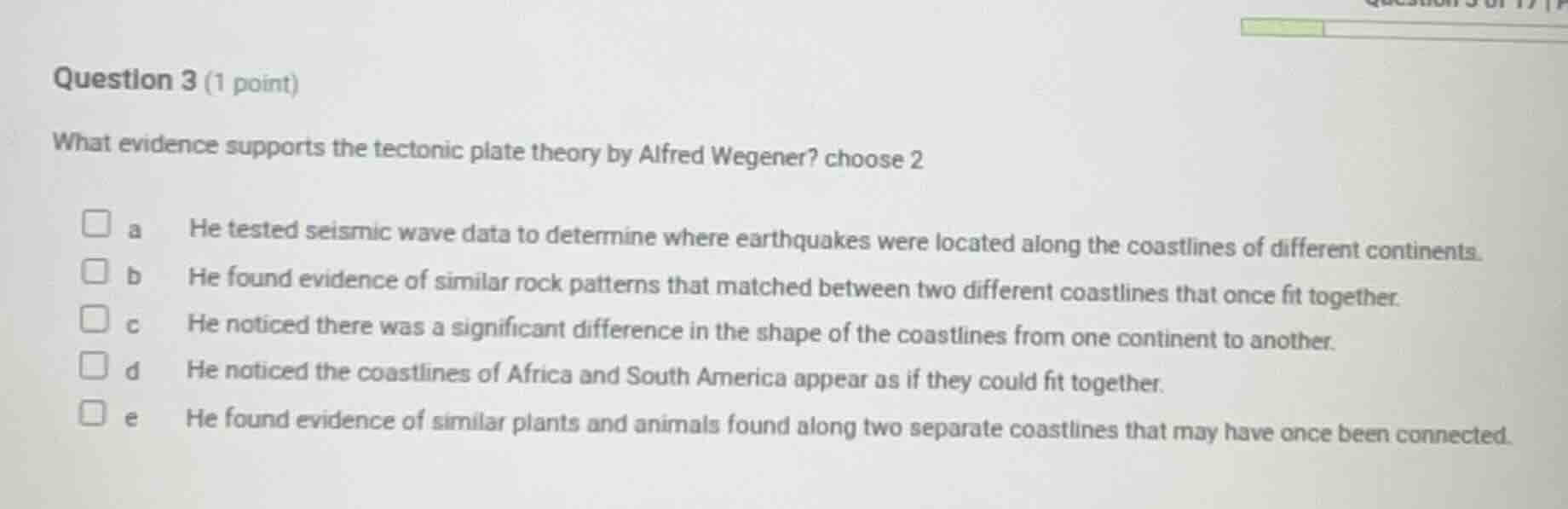
what evidence supports the tectonic plate theory by alfred wegener? choose 2
a he tested seismic wave data to determine where earthquakes were located along the coastlines of different continents.
b he found evidence of similar rock patterns that matched between two different coastlines that once fit together.
c he noticed there was a significant difference in the shape of the coastlines from one continent to another.
d he noticed the coastlines of africa and south america appear as if they could fit together.
e he found evidence of similar plants and animals found along two separate coastlines that may have once been connected.
To solve this, we analyze each option:
- Option a: Seismic wave data for earthquake locations was not Wegener's evidence for continental drift (tectonic plate theory's precursor).
- Option b: Matching rock patterns between coastlines that once fit (like on Africa and South America) supports the idea of continental drift as rocks formed in the same area would have similar patterns.
- Option c: Significant difference in coastline shape does not support; rather, the similarity in fit (like puzzle pieces) does.
- Option d: The visual fit of Africa and South America's coastlines was a key observation by Wegener, suggesting they were once joined.
- Option e: Similar plants/animals on separate coastlines (biogeographical evidence) supports the idea that continents were connected, as species could migrate when connected.
So the correct options are b, d, e? Wait, no, let's recheck. Wait, Wegener's evidence for continental drift (which led to plate tectonics) included:
- Fit of continents (like Africa and South America - option d).
- Similar rock formations (option b).
- Fossil evidence (similar plants/animals - option e).
Wait, the question says "choose 2". Wait, maybe I made a mistake. Let's re-express:
Wegener's evidence for continental drift (the basis for plate tectonics) included:
- Continental Fit (Option d): The coastlines of Africa and South America look like they fit together like puzzle pieces.
- Rock Formations (Option b): Matching rock layers and structures between continents that were once joined.
- Fossil/Organism Evidence (Option e): Similar fossils of plants and animals on continents now separated, suggesting they were once connected (so species could move between them).
But the question says "choose 2". Let's check the options again:
Option b: "He found evidence of similar rock patterns that matched between two different coastlines that once fit together." – Correct.
Option d: "He noticed the coastlines of Africa and South America appear as if they could fit together." – Correct.
Option e: "He found evidence of similar plants and animals found along two separate coastlines that may have once been connected." – Also correct, but the question says "choose 2". Wait, maybe the intended correct ones are b, d, or b, e, or d, e? Wait, let's check standard Wegener evidence:
The main evidence Wegener used:
- Continental Jigsaw Puzzle (Option d): Coastlines fit.
- Rock Strata (Option b): Matching rock layers.
- Fossil Evidence (Option e): Similar fossils.
But the question says "choose 2". Let's see the options:
- Option b: Rock patterns matching – correct.
- Option d: Coastline fit – correct.
- Option e: Similar plants/animals – correct.
Wait, maybe the question considers d and b, or d and e, or b and e. Let's check each:
- Option a: Incorrect (seismic waves were later, not Wegener's).
- Option c: Incorrect (difference in shape doesn't support; similarity in fit does).
So possible correct pairs: b & d, b & e, or d & e. But let's check standard answers. Typically, Wegener's evidence includes:
- Fit of continents (d).
- Similar rock formations (b).
- Fossil evidence (e).
Since the question says "choose 2", the most common two are d (continental fit) and b (rock patterns), or d and e, or b and e. But let's check the options again.
Wait, the question is about "tectonic plate theory by Alfred Wegener" – note that Wegener proposed continental drift, and plate tectonics came later, but his work was the foundation.
So the correct options are:
- Option b: Similar rock patterns (correct).
- Optio…

Snap & solve any problem in the app
Get step-by-step solutions on Sovi AI
Photo-based solutions with guided steps
Explore more problems and detailed explanations
b. He found evidence of similar rock patterns that matched between two different coastlines that once fit together, d. He noticed the coastlines of Africa and South America appear as if they could fit together (or other valid pair like b and e, d and e; but the most common are b and d, or d and e, or b and e. However, based on typical questions, the correct two are often b and d, or d and e. Wait, let's recheck:
Wait, the question is "What evidence supports the tectonic plate theory by Alfred Wegener? choose 2".
Wegener's evidence for continental drift (which led to plate tectonics) includes:
- Continental Fit (d): Coastlines fit.
- Rock Formations (b): Matching rock layers.
- Fossil Evidence (e): Similar fossils.
So the correct options are two of b, d, e. So the answer could be b and d, b and e, or d and e. But let's check the options:
If we choose two, the most appropriate are b and d, or d and e. But let's see the options:
Option b: Rock patterns – correct.
Option d: Coastline fit – correct.
So the answer is b and d, or d and e, or b and e. But the standard answer for this type of question usually includes d (continental fit) and b (rock patterns), or d and e. So the correct options are:
b. He found evidence of similar rock patterns that matched between two different coastlines that once fit together
d. He noticed the coastlines of Africa and South America appear as if they could fit together
(or b and e, or d and e)