QUESTION IMAGE
Question
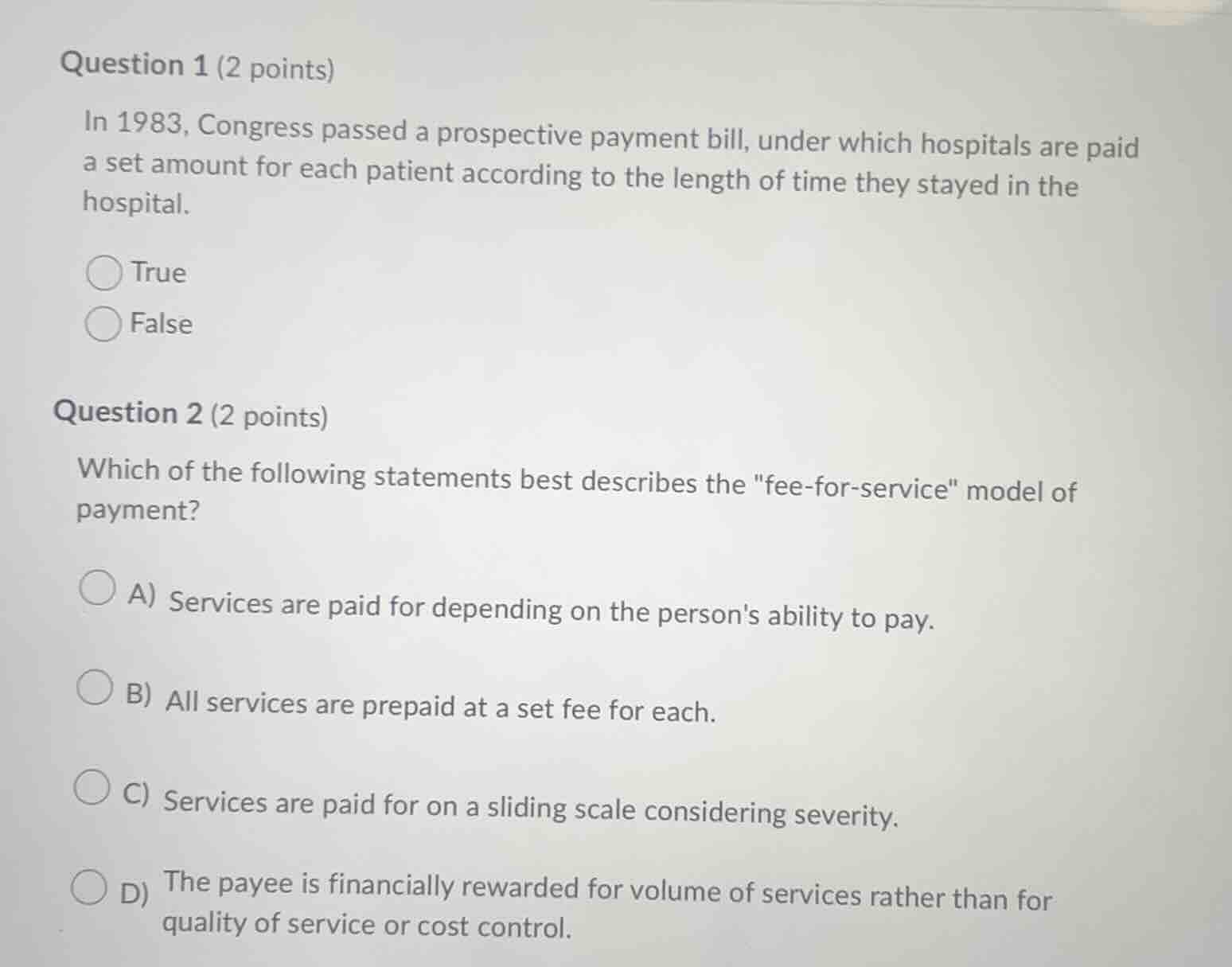
question 1 (2 points)
in 1983, congress passed a prospective payment bill, under which hospitals are paid a set amount for each patient according to the length of time they stayed in the hospital.
true
false
question 2 (2 points)
which of the following statements best describes the \fee - for - service\ model of payment?
a) services are paid for depending on the persons ability to pay.
b) all services are prepaid at a set fee for each.
c) services are paid for on a sliding scale considering severity.
d) the payee is financially rewarded for volume of services rather than for quality of service or cost control.
For Question 1: The 1983 prospective payment system (Diagnosis-Related Groups, DRGs) pays hospitals a fixed amount based on the patient's diagnosis, not length of stay.
For Question 2: The fee-for-service model reimburses providers per service delivered, incentivizing more services over cost or quality.

Snap & solve any problem in the app
Get step-by-step solutions on Sovi AI
Photo-based solutions with guided steps
Explore more problems and detailed explanations
- False
- D) The payee is financially rewarded for volume of services rather than for quality of service or cost control.