QUESTION IMAGE
Question
question 8 (5 points)
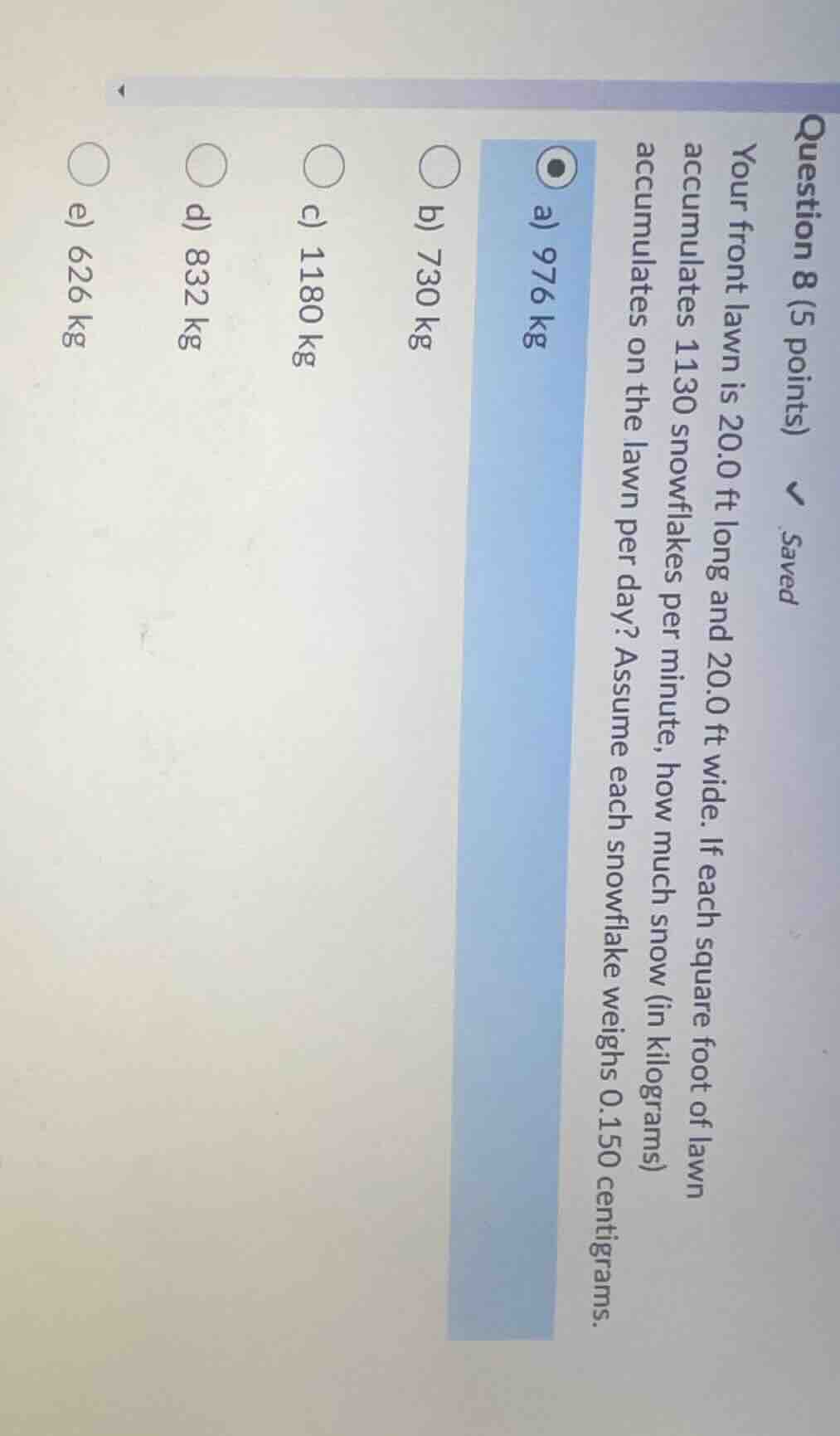
your front lawn is 20.0 ft long and 20.0 ft wide. if each square foot of lawn accumulates 1130 snowflakes per minute, how much snow (in kilograms) accumulates on the lawn per day? assume each snowflake weighs 0.150 centigrams.
a) 976 kg
b) 730 kg
c) 1180 kg
d) 832 kg
e) 626 kg
Step1: Calculate lawn area
The lawn is a rectangle, area \( A = \text{length} \times \text{width} \). Length = 20.0 ft, width = 20.0 ft. So \( A = 20.0 \, \text{ft} \times 20.0 \, \text{ft} = 400 \, \text{ft}^2 \).
Step2: Snowflakes per day on lawn
Snowflakes per minute per square foot: 1130. So per square foot per day (1 day = 24×60 = 1440 minutes), snowflakes = \( 1130 \, \text{min}^{-1} \times 1440 \, \text{min} = 1130 \times 1440 \). For 400 ft², total snowflakes per day = \( 1130 \times 1440 \times 400 \)? Wait, no: Wait, the problem says "each square foot of lawn accumulates 1130 snowflakes per minute". So per square foot, per minute: 1130. So per square foot per day: 1130 × 1440. Then total for 400 ft²: 1130 × 1440 × 400? No, wait, no—wait, the rate is 1130 snowflakes per minute per square foot. So for the entire lawn (400 ft²), snowflakes per minute = 1130 × 400. Then per day (1440 minutes) = 1130 × 400 × 1440.
Step3: Weight of each snowflake
Each snowflake is 0.150 centigrams. Convert to kilograms: 1 centigram = \( 10^{-5} \) kg, so 0.150 cg = \( 0.150 \times 10^{-5} \) kg = \( 1.5 \times 10^{-6} \) kg.
Step4: Total weight per day
Total snowflakes per day: \( 1130 \, \text{min}^{-1} \times 400 \, \text{ft}^2 \times 1440 \, \text{min} \). Wait, no—wait, the problem says "each square foot of lawn accumulates 1130 snowflakes per minute". So per square foot, per minute: 1130. So for 400 square feet, per minute: 1130 × 400. Then per day (1440 minutes): 1130 × 400 × 1440. Then multiply by weight per snowflake (1.5×10⁻⁶ kg).
Let's compute:
First, snowflakes per minute for 400 ft²: \( 1130 \times 400 = 452000 \) snowflakes per minute.
Per day (1440 minutes): \( 452000 \times 1440 = 452000 \times 1440 \).
Calculate that: 452000 × 1440 = 452000 × 1440 = let's compute 452 × 1440 × 1000. 452 × 1440: 452×1400=632800, 452×40=18080, total=632800+18080=650880. Then ×1000: 650,880,000 snowflakes per day.
Now, weight per snowflake: 0.150 cg = 0.150 × 10⁻² g = 0.150 × 10⁻⁵ kg = 1.5 × 10⁻⁶ kg.
Total weight: 650,880,000 × 1.5 × 10⁻⁶ kg.
Calculate that: 650880000 × 1.5e-6 = (650880000 × 1.5) × 1e-6 = 976320 × 1e-6 = 976.32 kg ≈ 976 kg. Which matches option a.
Wait, let's recheck:
Wait, maybe I messed up the rate. Let's re-express:
Rate: 1130 snowflakes per minute per square foot.
Lawn area: 20×20=400 ft².
Minutes in a day: 24×60=1440.
Snowflakes per day on lawn: 1130 (per min per ft²) × 1440 (min) × 400 (ft²) = 1130 × 1440 × 400.
Calculate 1130 × 1440 = 1130 × 1440 = let's compute 1130×1440: 1130×1000=1,130,000; 1130×400=452,000; 1130×40=45,200. Wait, 1440=1000+400+40? No, 1440=1400+40. 1130×1400=1,582,000; 1130×40=45,200. Total 1,582,000+45,200=1,627,200. Then ×400: 1,627,200 × 400 = 650,880,000 snowflakes per day.
Each snowflake: 0.150 cg = 0.150 × 10⁻² g = 0.150 × 10⁻⁵ kg = 1.5 × 10⁻⁶ kg.
Total weight: 650,880,000 × 1.5 × 10⁻⁶ kg = (650,880,000 × 1.5) × 10⁻⁶ = 976,320,000 × 10⁻⁶ = 976.32 kg ≈ 976 kg. So option a.

Snap & solve any problem in the app
Get step-by-step solutions on Sovi AI
Photo-based solutions with guided steps
Explore more problems and detailed explanations
a) 976 kg