QUESTION IMAGE
Question
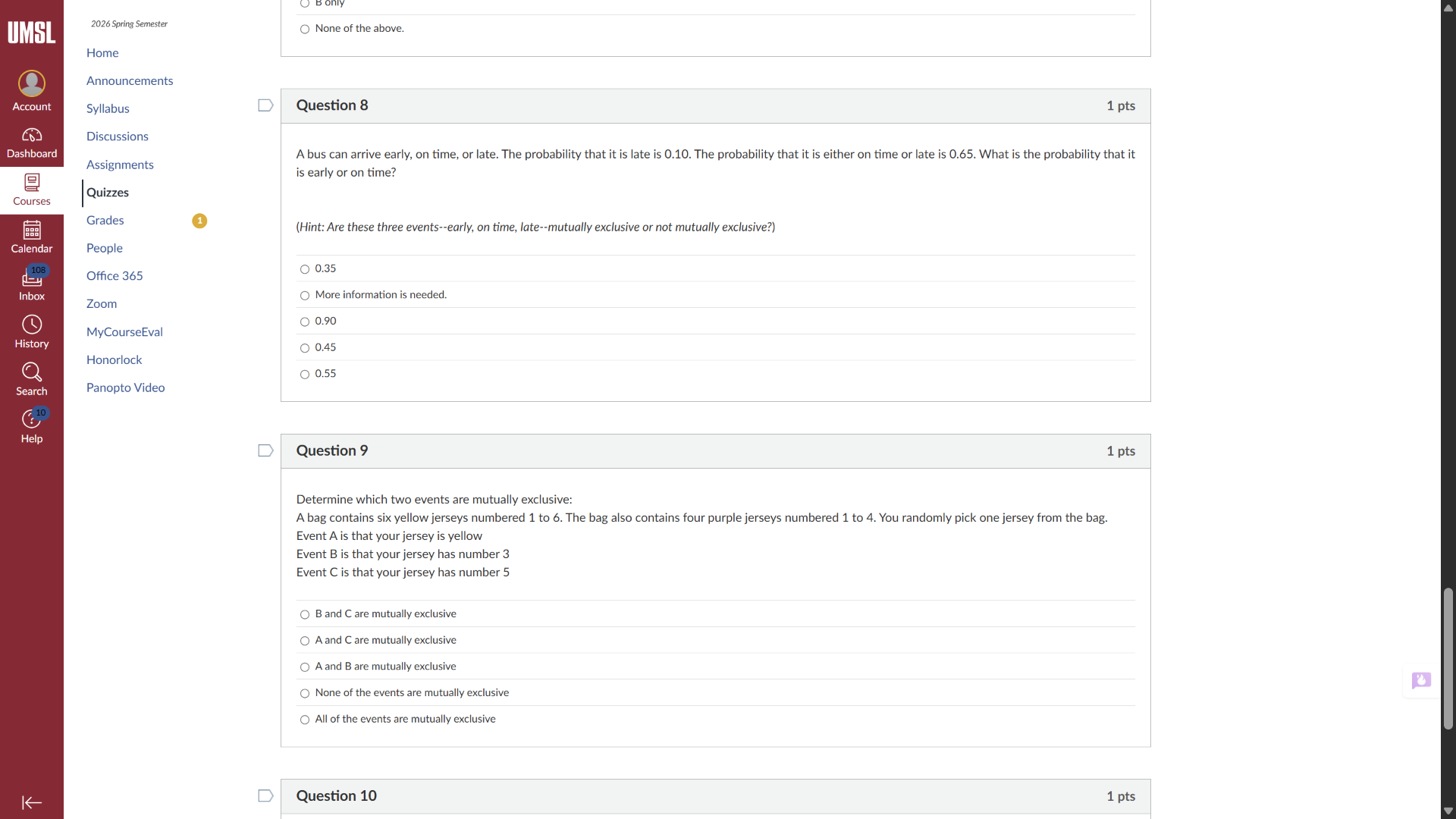
question 8 1 pts a bus can arrive early, on time, or late. the probability that it is late is 0.10. the probability that it is either on time or late is 0.65. what is the probability that it is early or on time? (hint: are these three events--early, on time, late--mutually exclusive or not mutually exclusive?) 0.35 more information is needed. 0.90 0.45 0.55 question 9 1 pts determine which two events are mutually exclusive: a bag contains six yellow jerseys numbered 1 to 6. the bag also contains four purple jerseys numbered 1 to 4. you randomly pick one jersey from the bag. event a is that your jersey is yellow event b is that your jersey has number 3 event c is that your jersey has number 5 b and c are mutually exclusive a and c are mutually exclusive a and b are mutually exclusive none of the events are mutually exclusive all of the events are mutually exclusive question 10 1 pts
Question 8
Step1: Identify mutually exclusive events
The events (early, on time, late) are mutually exclusive (a bus can't be both early and on time, etc.). Let \( P(L) = 0.10 \) (late), \( P(O \cup L) = 0.65 \) (on time or late). Since \( O \) and \( L \) are mutually exclusive, \( P(O \cup L)=P(O)+P(L) \), so \( P(O)=0.65 - 0.10 = 0.55 \). The total probability of all events is 1, so \( P(Early)=1 - P(L)=1 - 0.10 = 0.90 - P(O)? \) Wait, no: total probability \( P(Early)+P(O)+P(L)=1 \). We need \( P(Early \cup O)=P(Early)+P(O) \) (mutually exclusive). First, find \( P(Early)=1 - P(O \cup L)=1 - 0.65 = 0.35 \)? Wait, no: \( P(Early)+P(O \cup L)=1 \) (since early and (on time or late) are mutually exclusive). So \( P(Early \cup O)=P(Early)+P(O)= (1 - P(O \cup L))+P(O)=1 - P(L)=1 - 0.10 = 0.90 \)? Wait, let's re-express:
Let \( E \) = early, \( O \) = on time, \( L \) = late. \( E, O, L \) are mutually exclusive, so \( P(E)+P(O)+P(L)=1 \). We know \( P(L)=0.10 \), \( P(O \cup L)=P(O)+P(L)=0.65 \), so \( P(O)=0.65 - 0.10 = 0.55 \). Then \( P(E)=1 - P(O) - P(L)=1 - 0.55 - 0.10 = 0.35 \). Now, \( P(E \cup O)=P(E)+P(O)=0.35 + 0.55 = 0.90 \).
Step2: Calculate the required probability
Using the fact that \( E, O, L \) are mutually exclusive, \( P(E \cup O)=1 - P(L)=1 - 0.10 = 0.90 \) (since \( E \cup O \) is the complement of \( L \)).
Mutually exclusive events cannot occur at the same time. Event B (number 3) and Event C (number 5) cannot happen together (a jersey can't have both number 3 and 5). Event A (yellow) can occur with B or C (yellow jersey with number 3 or 5 exists). So B and C are mutually exclusive.

Snap & solve any problem in the app
Get step-by-step solutions on Sovi AI
Photo-based solutions with guided steps
Explore more problems and detailed explanations
0.90