QUESTION IMAGE
Question
question 1
1 pts
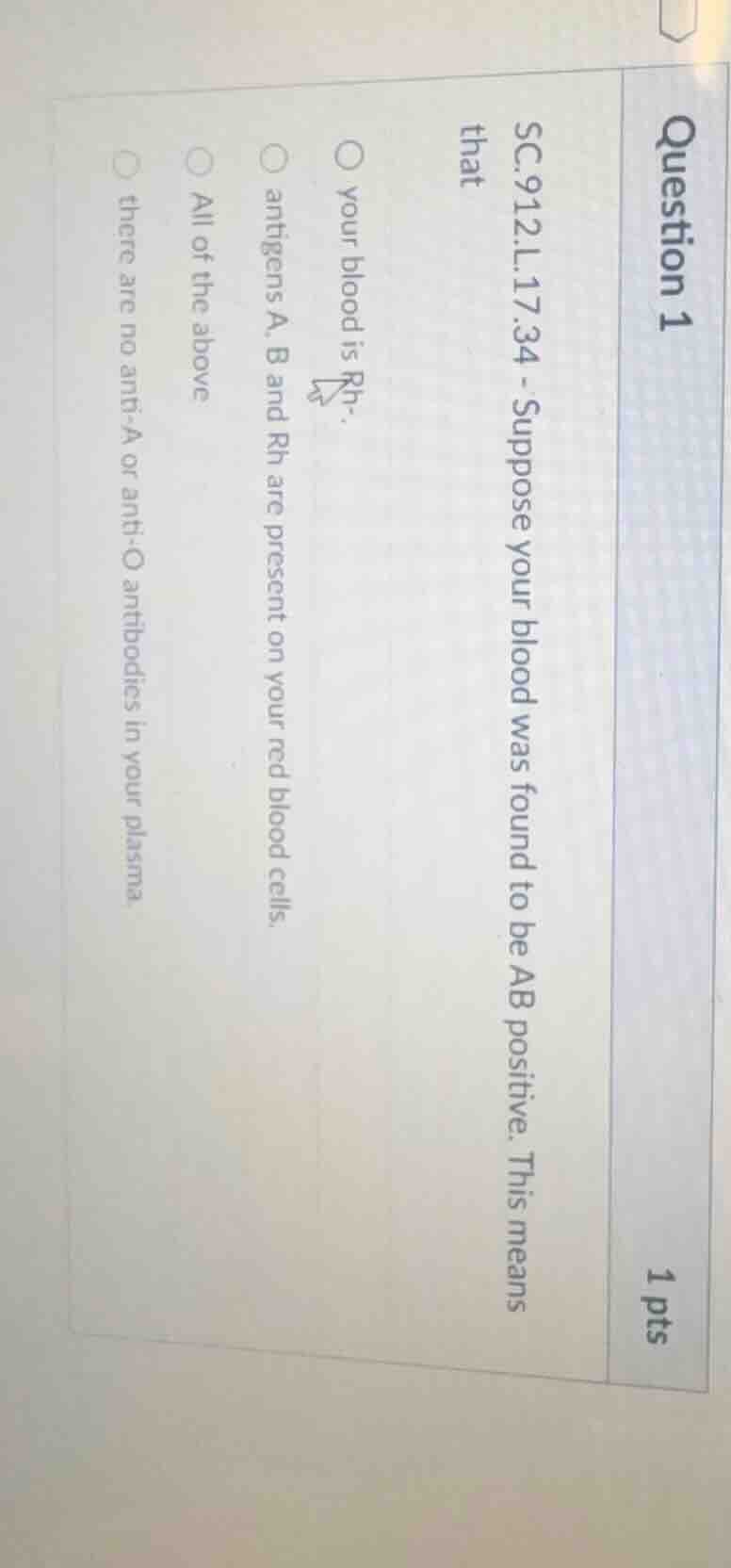
sc.912.l.17.34 - suppose your blood was found to be ab positive. this means that
your blood is rh-.
antigens a, b and rh are present on your red blood cells.
all of the above
there are no anti - a or anti - o antibodies in your plasma.
Brief Explanations
- For blood type AB positive:
- AB blood type has both A and B antigens on red blood cells.
- Rh - positive means Rh antigen is present.
- In AB blood, there are no anti - A or anti - B antibodies (and also no anti - O as O is a different type concept here). And the first option "your blood is Rh - " is incorrect as AB positive is Rh+. The second option says antigens A, B and Rh are present (which is true for AB+), and the fourth option says there are no anti - A or anti - O antibodies (which is true for AB blood, as AB blood has neither anti - A nor anti - B, and anti - O is not a typical antibody in this context). But the "All of the above" is incorrect because the first option is wrong. Wait, no, let's re - evaluate:
- AB positive blood: Red blood cells have A, B, and Rh antigens (so the second option is correct).
- AB blood has no anti - A or anti - B antibodies (and since O is a different blood type, anti - O is not a relevant antibody here, so the fourth option's statement about no anti - A or anti - O is a bit misphrased but the core idea of no anti - A is correct). The first option "your blood is Rh - " is wrong as AB positive is Rh+. But wait, maybe I made a mistake. Wait, the options:
- Option 1: "your blood is Rh - " → Wrong, AB positive is Rh+.
- Option 2: "antigens A, B and Rh are present on your red blood cells" → Correct, AB positive has A, B antigens and Rh antigen.
- Option 3: "All of the above" → Wrong because option 1 is wrong.
- Option 4: "there are no anti - A or anti - O antibodies in your plasma" → AB blood has no anti - A or anti - B antibodies. Anti - O is not a standard antibody, but the main point is no anti - A. So is this option correct? AB blood has no anti - A or anti - B, so the statement about no anti - A is correct. But the anti - O part is a bit odd. However, among the options, the second option is correct. Wait, no, let's check again. The question is "Suppose your blood was found to be AB positive. This means that...".
- AB positive:
- Antigens: A, B (from AB) and Rh (from positive) on RBCs. So option 2 is correct.
- Antibodies: AB blood has no anti - A or anti - B antibodies in plasma. The option 4 says "no anti - A or anti - O", anti - O is not a typical antibody, but the key is no anti - A. So option 4 is partially correct (the anti - O part is incorrect, but the anti - A part is correct). The first option is wrong. So the correct option is the second one? Wait, no, maybe the option 4 is considered correct in the context. Wait, AB blood: plasma has no anti - A, no anti - B. So "no anti - A" is correct. Anti - O is not a standard antibody, but maybe in the question's context, they consider that. But the first option is wrong (Rh - is wrong, AB positive is Rh+). So the correct option is the second one? Wait, no, let's see the options again.
- Option 2: "antigens A, B and Rh are present on your red blood cells" → This is correct for AB positive.

Snap & solve any problem in the app
Get step-by-step solutions on Sovi AI
Photo-based solutions with guided steps
Explore more problems and detailed explanations
B. antigens A, B and Rh are present on your red blood cells