QUESTION IMAGE
Question
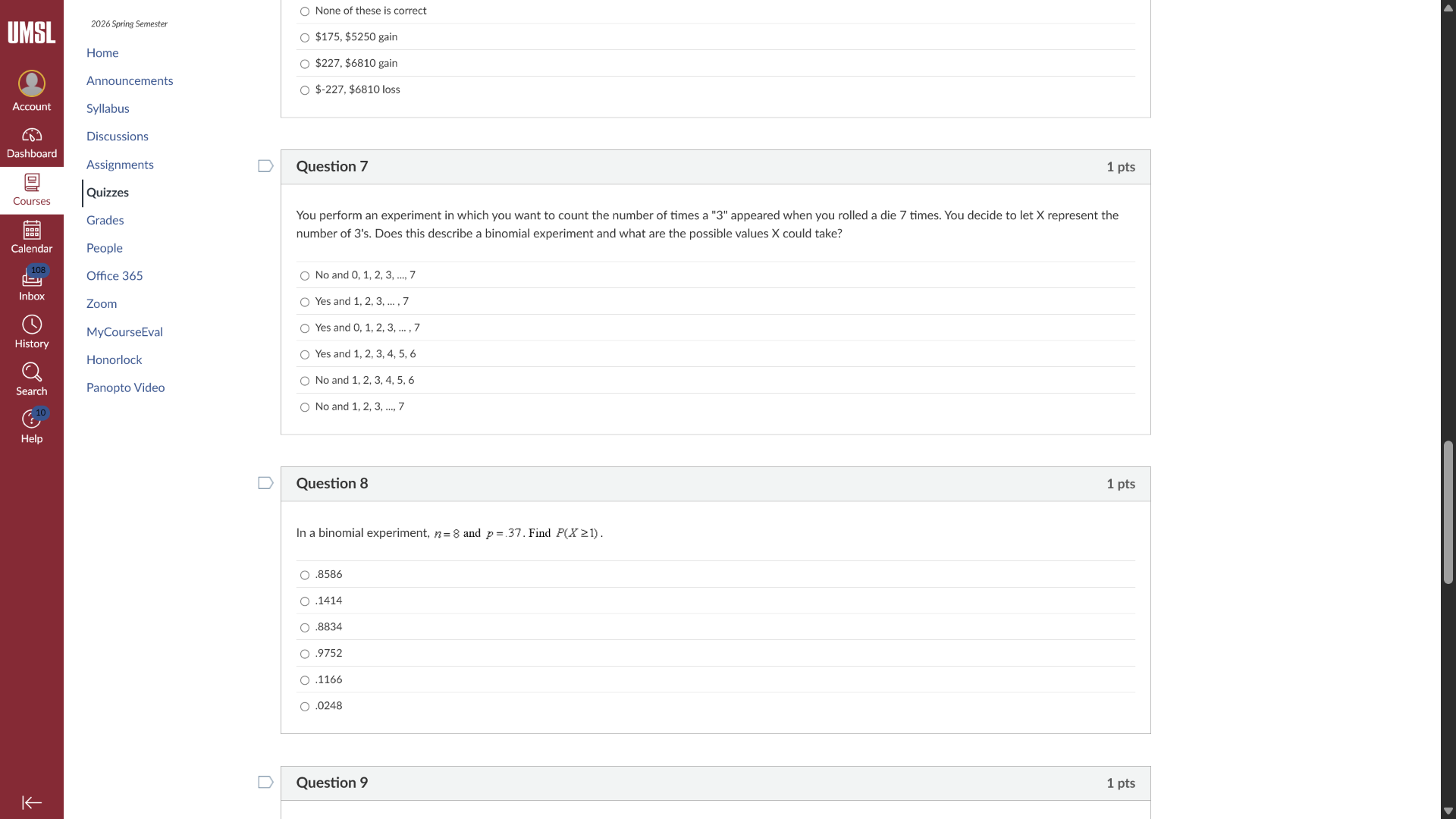
question 7
1 pts
you perform an experiment in which you want to count the number of times a \3\ appeared when you rolled a die 7 times. you decide to let x represent the number of 3s. does this describe a binomial experiment and what are the possible values x could take?
no and 0, 1, 2, 3, ..., 7
yes and 1, 2, 3, ..., 7
yes and 0, 1, 2, 3, ..., 7
yes and 1, 2, 3, 4, 5, 6
no and 1, 2, 3, 4, 5, 6
no and 1, 2, 3, ..., 7
question 8
1 pts
in a binomial experiment, n = 8 and p = .37. find p(x ≥ 1).
.8586
.1414
.8834
.9752
.1166
.0248
question 9
1 pts
Question 7
To determine if it's a binomial experiment: A binomial experiment has fixed number of trials (\(n = 7\) rolls), independent trials, two outcomes (success: rolling a 3, failure: not rolling a 3), and constant probability of success (\(p=\frac{1}{6}\)). So it is a binomial experiment. The number of successes \(X\) can be 0 (no 3s) up to 7 (all 3s), so possible values are \(0, 1, 2, \dots, 7\).
Step1: Recall the complement rule for binomial probability.
The complement of \(P(X\geq1)\) is \(P(X = 0)\). So \(P(X\geq1)=1 - P(X = 0)\).
Step2: Use the binomial probability formula \(P(X = k)=C(n,k)\times p^{k}\times(1 - p)^{n - k}\).
For \(k = 0\), \(C(8,0)=1\), \(p = 0.37\), \(1-p=0.63\), \(n = 8\). So \(P(X = 0)=1\times(0.37)^{0}\times(0.63)^{8}\).
Step3: Calculate \((0.63)^{8}\).
\((0.63)^{8}\approx0.0248\) (using a calculator). Then \(P(X\geq1)=1 - 0.0248 = 0.9752\).

Snap & solve any problem in the app
Get step-by-step solutions on Sovi AI
Photo-based solutions with guided steps
Explore more problems and detailed explanations
C. Yes and 0, 1, 2, 3, …, 7