QUESTION IMAGE
Question
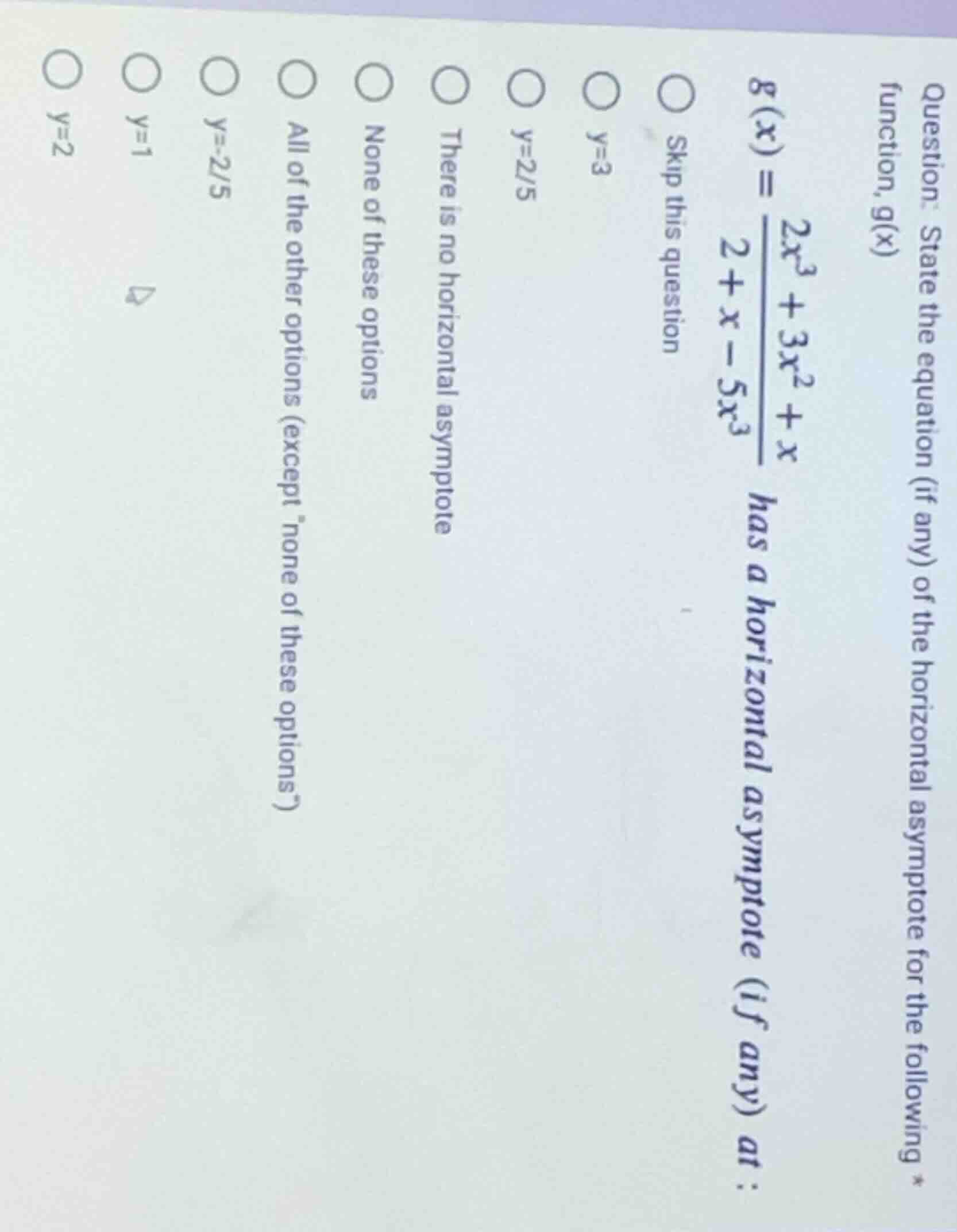
question: state the equation (if any) of the horizontal asymptote for the following function, g(x)\\
g(x) = \frac{2x^3 + 3x^2 + x}{2 + x - 5x^3} has a horizontal asymptote (if any) at :\\
\bigcirc skip this question\\
\bigcirc y=3\\
\bigcirc y=2/5\\
\bigcirc there is no horizontal asymptote\\
\bigcirc none of these options\\
\bigcirc all of the other options (except none of these options)\\
\bigcirc y=-2/5\\
\bigcirc y=1\\
\bigcirc y=2
Step1: Identify degrees of numerator and denominator
For the function \( g(x)=\frac{2x^{3}+3x^{2}+x}{2 + x-5x^{3}} \), the degree of the numerator (highest power of \( x \)) is \( 3 \) (from \( 2x^{3} \)) and the degree of the denominator is also \( 3 \) (from \( - 5x^{3} \)).
Step2: Find horizontal asymptote (degree equal)
When the degrees of the numerator (\( n \)) and denominator (\( m \)) are equal (\( n = m \)), the horizontal asymptote is the ratio of the leading coefficients.
The leading coefficient of the numerator is \( 2 \) (coefficient of \( x^{3} \)) and the leading coefficient of the denominator is \( - 5 \) (coefficient of \( x^{3} \)). Wait, wait, let's re - check the denominator: \( 2 + x-5x^{3}=-5x^{3}+x + 2 \), so leading coefficient is \( - 5 \), numerator leading coefficient is \( 2 \). Wait, no, maybe I made a mistake. Wait the denominator is \( -5x^{3}+x + 2 \), numerator is \( 2x^{3}+3x^{2}+x \). So the horizontal asymptote \( y=\frac{\text{leading coefficient of numerator}}{\text{leading coefficient of denominator}}=\frac{2}{-5}=-\frac{2}{5} \)? Wait, no, the options have \( y = - 2/5 \) as an option. Wait, let's re - express the function:
\( g(x)=\frac{2x^{3}+3x^{2}+x}{-5x^{3}+x + 2} \)
Divide numerator and denominator by \( x^{3} \) (since \( x\to\pm\infty \), \( x
eq0 \)):
\( g(x)=\frac{2+\frac{3}{x}+\frac{1}{x^{2}}}{-5+\frac{1}{x^{2}}+\frac{2}{x^{3}}} \)
As \( x\to\pm\infty \), \( \frac{3}{x}\to0 \), \( \frac{1}{x^{2}}\to0 \), \( \frac{1}{x^{3}}\to0 \), \( \frac{2}{x^{3}}\to0 \)
So \( \lim_{x\to\pm\infty}g(x)=\frac{2 + 0+0}{-5+0 + 0}=-\frac{2}{5} \)

Snap & solve any problem in the app
Get step-by-step solutions on Sovi AI
Photo-based solutions with guided steps
Explore more problems and detailed explanations
\( y =-\frac{2}{5} \) (corresponding to the option \( y=-2/5 \))