QUESTION IMAGE
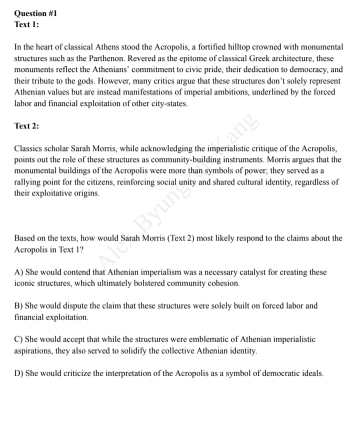
Question
question #1
text 1:
in the heart of classical athens stood the acropolis, a fortified hilltop crowned with monumental structures such as the parthenon. revered as the epitome of classical greek architecture, these structures have long been interpreted as symbols of athenian democracy and cultural achievement, embodying the ideals of justice, wisdom, and beauty that the athenians held dear. however, many critics argue that these structures do not solely represent the gods and athenian values but are instead manifestations of imperial ambitions, underlined by the forced labor and financial exploitation of other city - states.
text 2:
classics scholar sarah morris, while acknowledging the imperialistic critique of the acropolis, points out the role of these structures: many community - building structures. morris argues that the monumental buildings of the acropolis were more than symbols of power; they served as a source of civic pride, reinforcing social unity and shared cultural identity, regardless of their exploitative origins.
based on the texts, how would sarah morris (text 2) most likely respond to the claims about the acropolis in text 1?
a) she would contend that athenian imperialism was a necessary catalyst for creating these iconic structures, which ultimately fostered community cohesion.
b) she would dispute the claim that these structures were solely built on forced labor and financial exploitation.
c) she would accept that while the structures were celebrations of athenian imperialistic aspirations, they also served to solidify the collective athenian identity.
d) she would criticize the interpretation of the acropolis as a symbol of democratic ideals.
Text 1 states the Acropolis structures reflect Athenian imperial ambitions via forced labor and financial exploitation. Text 2 notes Morris acknowledges the imperial critique but argues the monuments also served as community-building tools (fostering unity, shared identity, etc.). Option C aligns with this: accepting the imperial emblem claim while adding the collective identity role. Other options misalign: A introduces a new "mercantary catalyst" not mentioned; B disputes forced labor/exploitation which Morris acknowledges; D critiques democratic ideals, which is not addressed in Morris's argument.

Snap & solve any problem in the app
Get step-by-step solutions on Sovi AI
Photo-based solutions with guided steps
Explore more problems and detailed explanations
C) She would accept that the structures were emblematic of Athenian imperialistic aspirations, but she also viewed them as solidifying collective Athenian identity.