QUESTION IMAGE
Question
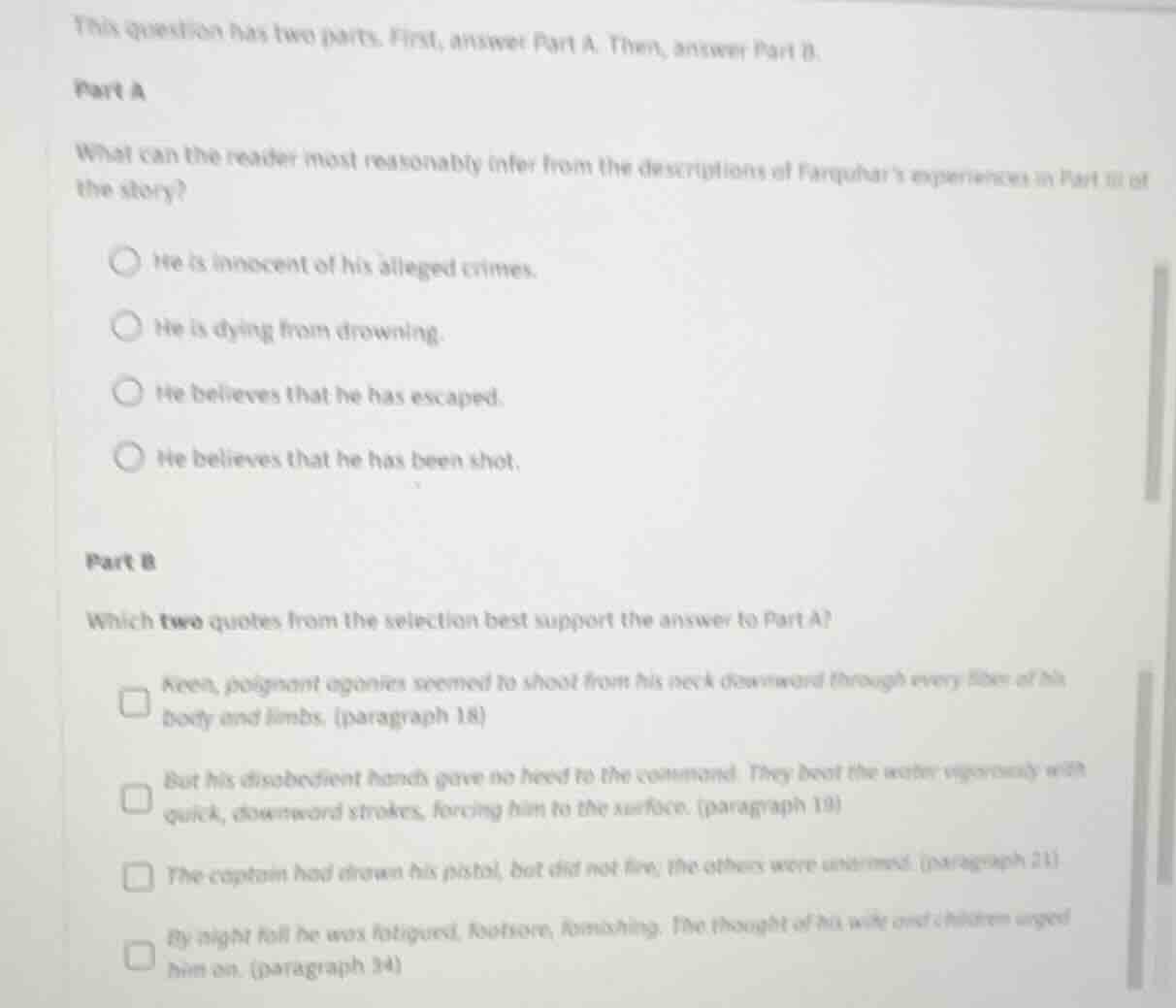
this question has two parts. first, answer part a. then, answer part b.
part a
what can the reader most reasonably infer from the descriptions of farquhar’s experiences in part iii of the story?
○ he is innocent of his alleged crimes.
○ he is dying from drowning.
○ he believes that he has escaped.
○ he believes that he has been shot.
part b
which two quotes from the selection best support the answer to part a?
□ keen, poignant agonies seemed to shoot from his neck downward through every fiber of his body and limbs. (paragraph 18)
□ but his disobedient hands gave no heed to the command. they beat the water vigorously with quick, downward strokes, forcing him to the surface. (paragraph 19)
□ the captain had drawn his pistol, but did not fire; the others were unarmed. (paragraph 21)
□ by night fall he was fatigued, footsore, famishing. the thought of his wife and children urged him on. (paragraph 34)
Part A
To solve this, we analyze each option. The story (likely "An Occurrence at Owl Creek Bridge") has Farquhar in a situation where he hallucinates an escape. Option 1: Innocence isn't inferable from Part III's experiences. Option 2: Drowning isn't the main inference; his mental state of believing escape is key. Option 3: His experiences (like swimming, thinking of family) show he believes he escaped (even if it's a hallucination). Option 4: He isn't shot in his perceived reality here. So the correct inference is he believes he escaped.
We need quotes supporting Part A's answer (he believes he escaped). Let's analyze each quote:
- "Keen, poignant agonies..." (paragraph 18): Describes pain, not escape belief. Eliminate.
- "But his disobedient hands... forcing him to the surface" (paragraph 19): Shows his actions in his imagined escape (swimming), supporting he believes he's escaping.
- "The captain had drawn his pistol... others were unarmed" (paragraph 21): Shows the reality (he's being executed), but in his mind, he's escaping, so this quote (from his hallucination's context) supports his belief of escape.
- "By night fall he was fatigued... urged him on" (paragraph 34): Shows his mental state in the imagined escape, supporting he believes he's escaped. Wait, no—wait, the two correct quotes should be the ones showing his imagined escape actions. Wait, re - checking: The quote "But his disobedient hands... forcing him to the surface" shows his swimming (escape attempt in his mind), and "By night fall he was fatigued... urged him on" shows his journey in the imagined escape. Wait, no, the third quote ("The captain...") is the reality, but in his hallucination, he thinks he's escaping. Wait, actually, the two quotes that support his belief of escape are "But his disobedient hands... forcing him to the surface" (paragraph 19) and "By night fall he was fatigued... urged him on" (paragraph 34)? No, wait, the correct two are "But his disobedient hands... forcing him to the surface" (paragraph 19) and "By night fall he was fatigued... urged him on" (paragraph 34)? Wait, no, let's re - evaluate. The key is that in his hallucination, he believes he's escaping. The quote "But his disobedient hands... forcing him to the surface" shows his swimming (part of his imagined escape). The quote "By night fall he was fatigued... urged him on" shows his progress in the imagined escape. The other two: the first is pain, the third is the real situation (which contrasts with his hallucination, but in his mind, he's escaping). Wait, actually, the correct two are "But his disobedient hands... forcing him to the surface" (paragraph 19) and "By night fall he was fatigued... urged him on" (paragraph 34). Wait, no, let's check the options again. The quote "But his disobedient hands... forcing him to the surface" (paragraph 19) and "By night fall he was fatigued... urged him on" (paragraph 34) are the ones that show his actions and mental state in his imagined escape, thus supporting that he believes he has escaped.

Snap & solve any problem in the app
Get step-by-step solutions on Sovi AI
Photo-based solutions with guided steps
Explore more problems and detailed explanations
C. He believes that he has escaped.