QUESTION IMAGE
Question
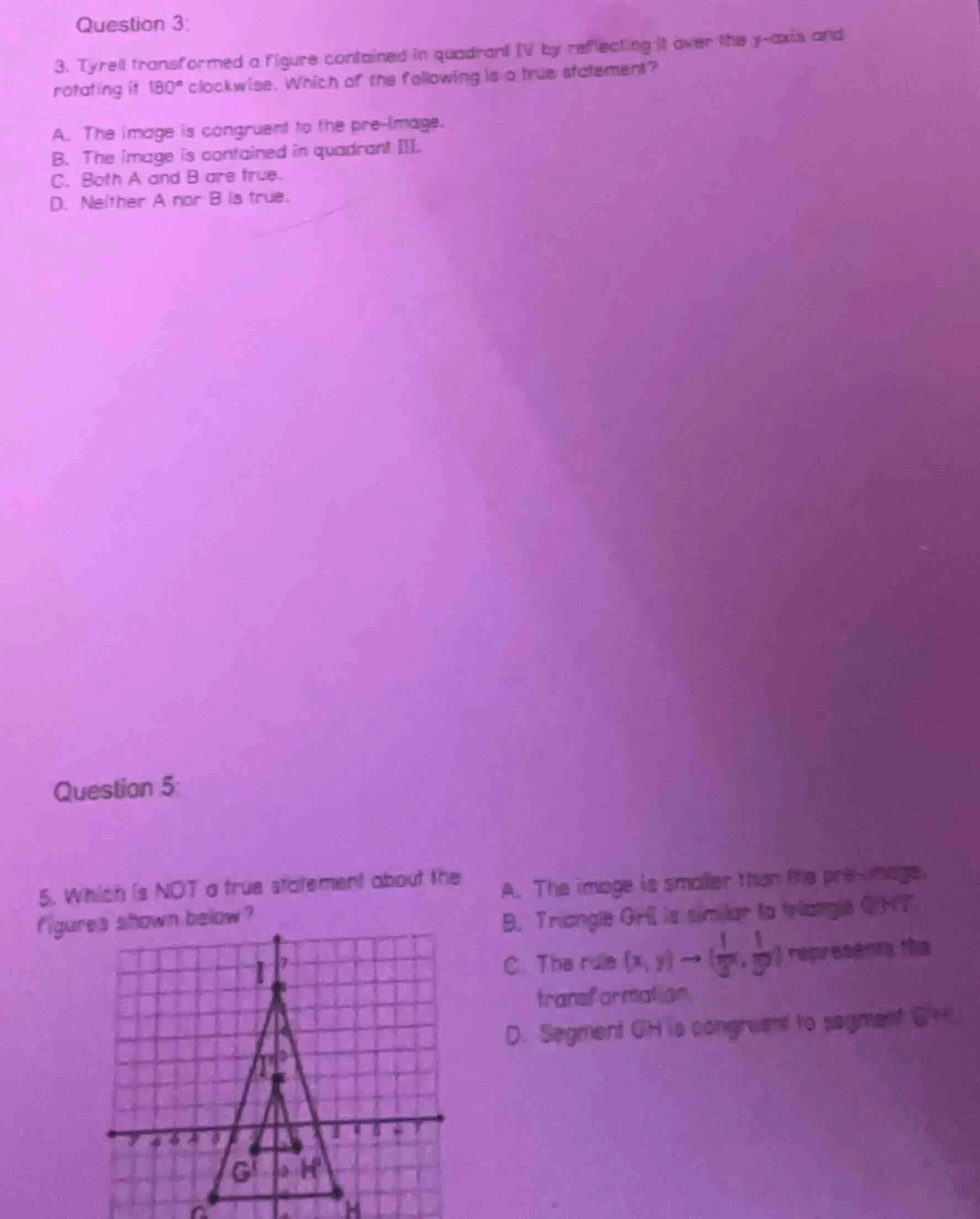
question 3:3. tyrell transformed a figure contained in quadrant iv by reflecting it over the y-axis and rotating it $180^\circ$ clockwise. which of the following is a true statement?a. the image is congruent to the pre-image.b. the image is contained in quadrant iii.c. both a and b are true.d. neither a nor b is true.question 5:5. which is not a true statement about the figures shown below?a. the image is smaller than the pre-image.b. triangle ghi is similar to triangle ghi.c. the rule $(x, y) \to \left(\frac{1}{2}x, \frac{1}{2}y\
ight)$ represents the transformation.d. segment gh is congruent to segment gh.
(Question 3):
Step1: Check congruence
Reflections and rotations are rigid transformations, so the image and pre-image are congruent. This makes statement A true.
Step2: Track quadrant change
- A point $(x,y)$ in Quadrant IV has $x>0, y<0$. Reflect over y-axis: $(-x,y)$ (Quadrant III).
- Rotate $180^\circ$ clockwise: $(x,-y)$? No, correct rotation rule: $(a,b)\to(-a,-b)$. So $(-x,y)\to(x,-y)$? No, wait: original pre-image point $(x,y)$ (IV: $x>0,y<0$). Reflect over y-axis: $(-x,y)$ (now $x<0,y<0$: Quadrant III). Rotate $180^\circ$ clockwise: apply $(a,b)\to(-a,-b)$ to $(-x,y)$: $(x,-y)$? No, no—wait, 180 rotation (any direction) maps $(a,b)$ to $(-a,-b)$. So starting with $(x,y)$ (IV: $x>0,y<0$):
Reflect over y-axis: $(-x, y)$ (III: $-x<0, y<0$)
Rotate 180: $(-(-x), -y)=(x, -y)$—wait, $(x,-y)$ is $x>0, -y>0$? No, $y$ was negative, so $-y$ is positive. That is Quadrant I? Wait no, I messed up: pre-image is in IV, so $(positive, negative)$. Reflect over y-axis: $(-positive, negative)$ = (negative, negative) → Quadrant III. Rotate 180 clockwise: (negative, negative) becomes (positive, positive)? No, 180 rotation of $(a,b)$ is $(-a,-b)$. So $(negative, negative)$ → $(positive, positive)$ which is Quadrant I? Wait no, that can't be. Wait, no: the question says "transformed a figure contained in quadrant IV by reflecting it over the y-axis and rotating it 180° clockwise". So first reflection over y-axis: IV (x+, y-) → II (x-, y-? No! Wait y stays the same. IV is x positive, y negative. Reflect over y-axis: x becomes negative, y stays negative. So that is Quadrant III? No, Quadrant II is x negative, y positive. Quadrant III is x negative, y negative. Yes, so reflection over y-axis takes IV to III. Then rotate 180 clockwise: any 180 rotation takes (x,y) to (-x,-y). So (x-, y-) → (x+, y+) which is Quadrant I. So statement B says "image is in III" which is false. Wait but rigid transformations preserve congruence, so A is true, B is false. Wait no, did I do the rotation wrong? Wait 180 clockwise rotation is same as 180 counterclockwise, rule $(x,y)\to(-x,-y)$. So yes: starting with IV point (2,-3): reflect over y-axis: (-2,-3) (III). Rotate 180: (2,3) (I). So image is in I, so B is false. So only A is true? But option C says both A and B are true. Wait no, wait maybe I mixed up the order? The question says "reflecting it over the y-axis and rotating it 180° clockwise"—so first reflect, then rotate. So yes, that's what I did. So A is true, B is false. Wait but let's check again: congruence: rigid transformations (reflection, rotation) preserve size and shape, so congruent. So A is true. B says image is in III, but we just saw it's in I, so B is false. So only A is true? But option C is both, D is neither, A is "image congruent to pre-image". Wait maybe I messed up the rotation direction? No, 180 rotation is same clockwise or counterclockwise. Wait wait, maybe the reflection is over y-axis first: IV (x+, y-) → II? No! Wait no: Quadrant I: x+, y+; II: x-, y+; III: x-, y-; IV: x+, y-. So (x+, y-) reflected over y-axis is (-x+, y-) = (x-, y-) which is III, correct. Then 180 rotation: (x-, y-) → (x+, y+) which is I. So image is in I, so B is false. So A is true, B is false. So option A is a true statement. Wait but let's check the options again:
A. The image is congruent to the pre-image. (true)
B. The image is contained in quadrant III. (false)
C. Both A and B are true. (false)
D. Neither A nor B is true. (false)
Wait but maybe I made a mistake in the quadrant after rotation. Wait another way: take a point (1,-1) in IV. Reflect over y-axis…
(Question 5):
Step1: Analyze transformation type
The figure is a dilation (smaller image from larger pre-image). Dilation preserves similarity, not congruence.
Step2: Evaluate each option
A. Image is smaller than pre-image: True (dilation with scale factor <1).
B. Triangles are similar: True (dilation preserves similarity).
C. Rule $(x,y)\to(\frac{1}{2}x,\frac{1}{2}y)$: True (image is half the size of pre-image, so scale factor $\frac{1}{2}$).
D. Segment GH ≅ G'H': False (dilation changes length, so segments are not congruent). The question asks for the NOT true statement.
---

Snap & solve any problem in the app
Get step-by-step solutions on Sovi AI
Photo-based solutions with guided steps
Explore more problems and detailed explanations
Question 3: A. The image is congruent to the pre-image.
Question 5: D. Segment GH is congruent to segment G'H'.