QUESTION IMAGE
Question
question 4 of 5
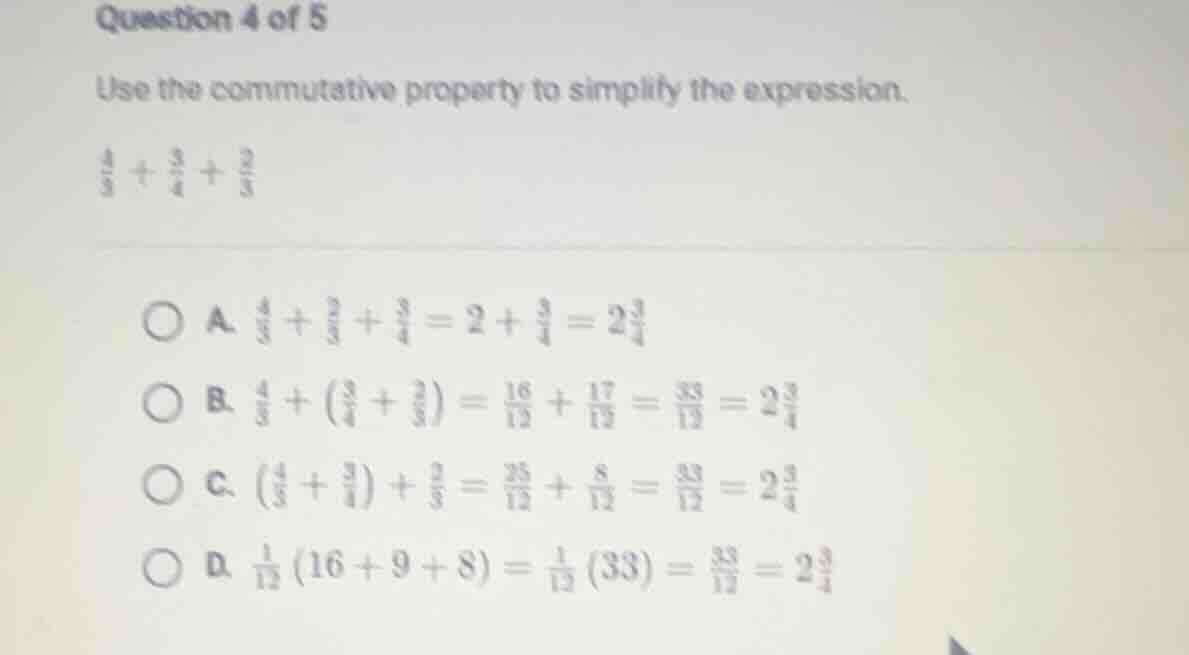
use the commutative property to simplify the expression.
\\(\frac{4}{3} + \frac{3}{4} + \frac{2}{3}\\)
\\(\bigcirc\\) a. \\(\frac{4}{3} + \frac{2}{3} + \frac{3}{4} = 2 + \frac{3}{4} = 2\frac{3}{4}\\)
\\(\bigcirc\\) b. \\(\frac{4}{3} + \left(\frac{3}{4} + \frac{2}{3}\
ight) = \frac{16}{12} + \frac{17}{12} = \frac{33}{12} = 2\frac{3}{4}\\)
\\(\bigcirc\\) c. \\(\left(\frac{4}{3} + \frac{3}{4}\
ight) + \frac{2}{3} = \frac{25}{12} + \frac{8}{12} = \frac{33}{12} = 2\frac{3}{4}\\)
\\(\bigcirc\\) d. \\(\frac{1}{12}(16 + 9 + 8) = \frac{1}{12}(33) = \frac{33}{12} = 2\frac{3}{4}\\)
Step1: Recall the commutative property
The commutative property of addition states that \(a + b = b + a\), which means we can reorder the addends. For the expression \(\frac{4}{3}+\frac{3}{4}+\frac{2}{3}\), we can reorder \(\frac{3}{4}\) and \(\frac{2}{3}\) to group the fractions with the same denominator. So we get \(\frac{4}{3}+\frac{2}{3}+\frac{3}{4}\).
Step2: Simplify \(\frac{4}{3}+\frac{2}{3}\)
When adding \(\frac{4}{3}\) and \(\frac{2}{3}\), since they have the same denominator, we add the numerators: \(\frac{4 + 2}{3}=\frac{6}{3} = 2\).
Step3: Add the remaining term
Now we add the result from step 2 to \(\frac{3}{4}\). So \(2+\frac{3}{4}=2\frac{3}{4}\) (or \(\frac{11}{4}\) as an improper fraction, but \(2\frac{3}{4}\) is the mixed number form here).
Now let's analyze each option:
- Option A: Follows the commutative property by reordering \(\frac{3}{4}\) and \(\frac{2}{3}\), then simplifies \(\frac{4}{3}+\frac{2}{3}\) correctly to 2, and then adds \(\frac{3}{4}\) to get \(2\frac{3}{4}\).
- Option B: Uses the associative property (grouping \(\frac{3}{4}\) and \(\frac{2}{3}\)) instead of the commutative property for reordering, and also the calculation of \(\frac{3}{4}+\frac{2}{3}\) to \(\frac{17}{12}\) is correct but the approach is not using commutative property as intended for simplification (and the first step of reordering is not done as per commutative property for simplifying the like - denominator terms first).
- Option C: Uses the associative property (grouping \(\frac{4}{3}\) and \(\frac{3}{4}\)) and then adds \(\frac{2}{3}\), which does not use the commutative property to group like - denominator terms for easier calculation.
- Option D: Uses a common denominator (12) to convert all fractions and then factors out \(\frac{1}{12}\), which is using the distributive property (or just common denominator addition) and not the commutative property.

Snap & solve any problem in the app
Get step-by-step solutions on Sovi AI
Photo-based solutions with guided steps
Explore more problems and detailed explanations
A. \(\frac{4}{3}+\frac{2}{3}+\frac{3}{4}=2+\frac{3}{4}=2\frac{3}{4}\)