QUESTION IMAGE
Question
question 6
1 p
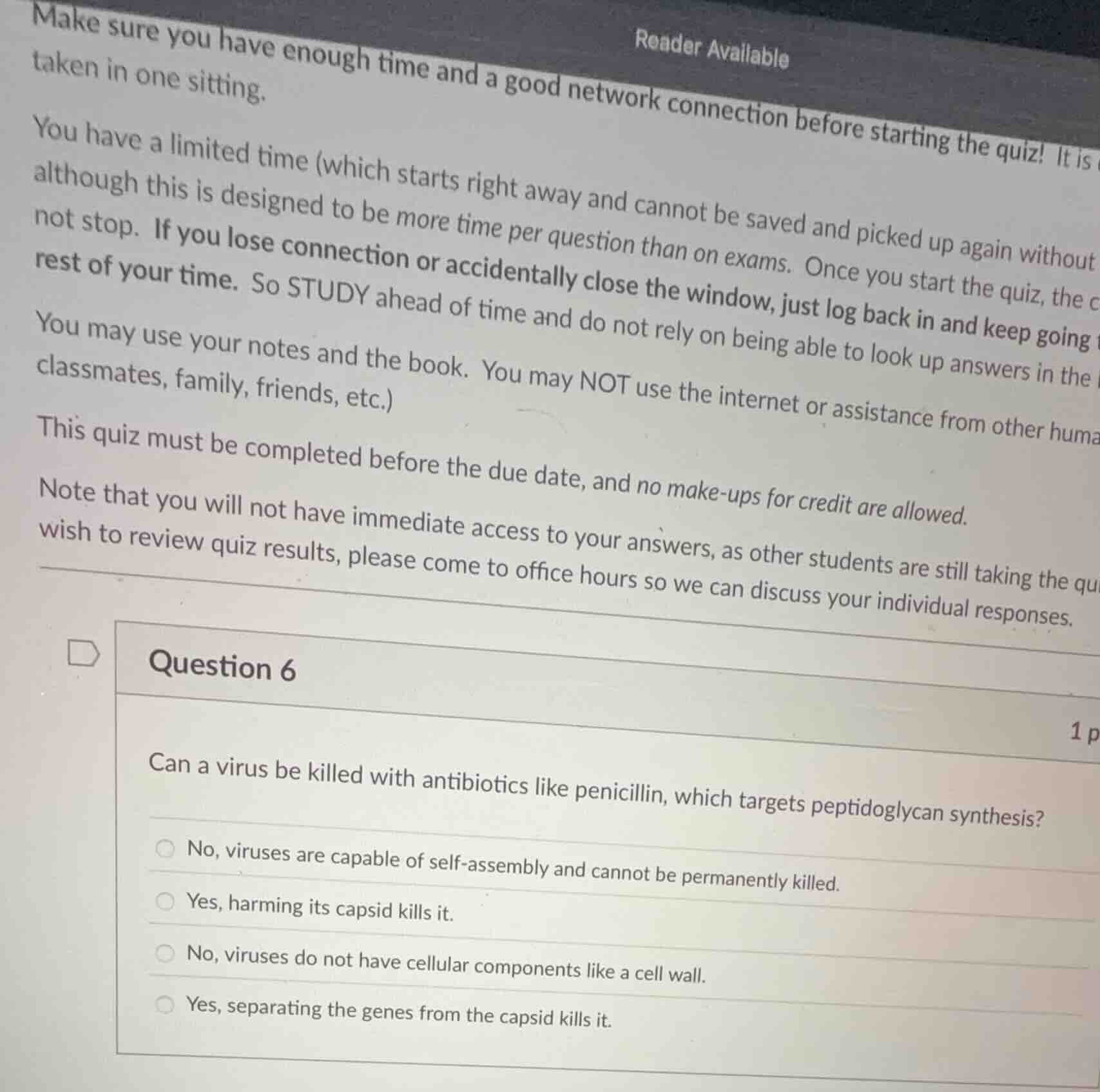
can a virus be killed with antibiotics like penicillin, which targets peptidoglycan synthesis?
no, viruses are capable of self - assembly and cannot be permanently killed.
yes, harming its capsid kills it.
no, viruses do not have cellular components like a cell wall.
yes, separating the genes from the capsid kills it.
Antibiotics like penicillin target peptidoglycan synthesis, which is a component of bacterial cell walls. Viruses lack cellular structures like cell walls (they are acellular, consisting of genetic material and a capsid, and replicate within host cells). So antibiotics, which act on cellular components, are ineffective against viruses. Let's analyze the options:
- Option 1: The reason about self - assembly is incorrect for why antibiotics don't work on viruses.
- Option 2: Antibiotics don't act on virus capsids, so this is wrong.
- Option 3: Correct, as viruses have no cell wall (or other bacterial - like cellular components) for antibiotics to target.
- Option 4: Separating genes from capsid is not how antibiotics work, and this is not the reason antibiotics don't affect viruses.

Snap & solve any problem in the app
Get step-by-step solutions on Sovi AI
Photo-based solutions with guided steps
Explore more problems and detailed explanations
C. No, viruses do not have cellular components like a cell wall. (Here we assume the option with "No, viruses do not have cellular components like a cell wall" is option C as per the standard multiple - choice labeling. If the original had a different label, adjust accordingly. But from the given options, the correct one is the one stating that viruses don't have cellular components like a cell wall.)